[Exclusive] Heavy-Lift Helicopter Budget Cut by 92%... Will KAI and Lockheed Martin Corporation Turn to Joint Production?
- Input
- 2026-09-03 14:48:22
- Updated
- 2026-09-03 14:48:22
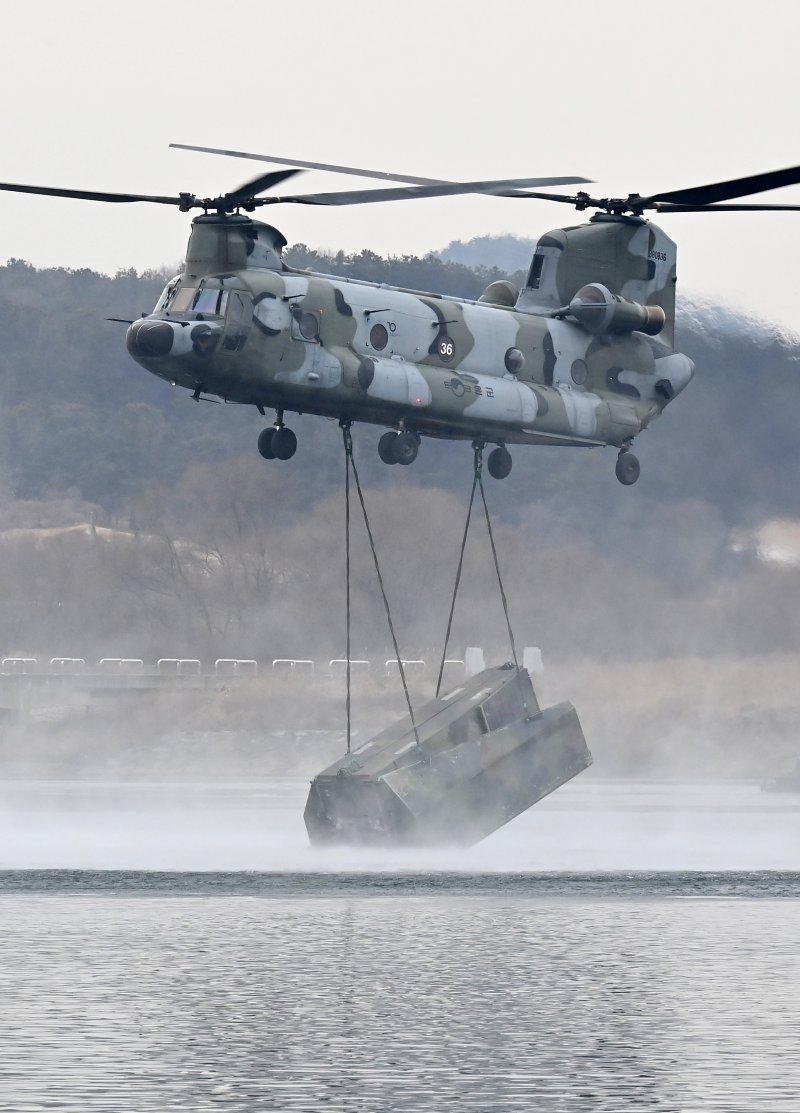
[Financial News] The budget for next year’s special-operations heavy-lift helicopter program has been cut by 92%, it was confirmed on the 3rd. The reduction comes as the Defense Acquisition Program Administration (DAPA) and The Boeing Company face delays in concluding a foreign procurement contract. Against this backdrop, observers say joint production with domestic defense companies, including Korea Aerospace Industries (KAI)—a proposal made during the bidding process by Lockheed Martin Corporation, the world’s largest defense contractor—could be reconsidered.
According to DAPA’s draft budget for next year, obtained through Yoo Yong-won, a member of the National Defense Committee of the National Assembly, funding for the special-operations heavy-lift helicopter program was slashed by 92%, from KRW 33.2 billion this year to KRW 2.6 billion.
The Republic of Korea Army plans to acquire about 20 special-operations heavy-lift helicopters by 2033 at a cost of KRW 3.4 trillion. DAPA drew up a foreign procurement plan and selected The Boeing Company as the preferred negotiating bidder. Although the final contract was initially targeted for June, there had been no announcement as of September. The budget has now also been largely cut.
DAPA said it is continuing consultations with The Boeing Company and working to complete the foreign procurement within a reasonable range that does not exceed the total project cost. The model proposed by Boeing is the CH-47F/ER, an upgraded version of the CH-47H Chinook operated by the ROK Army. The price is USD 57 million per aircraft, equivalent to approximately KRW 80 billion.
Many in the industry believe it would be premature to conclude that negotiations have broken down as long as the budget has not been cut entirely. However, because the target contract date has also been missed, the parties appear to be facing difficulties in price or technology negotiations. As a result, a “Plan B” could realistically be considered.
One possible Plan B is the renewed consideration of joint production proposed by Lockheed Martin Corporation. Lockheed Martin Corporation and its subsidiary Sikorsky Aircraft previously sought to participate in the special-operations heavy-lift helicopter program through a strategic partnership with KAI.
At the time, Frank Crisafulli, Sikorsky Aircraft’s director of international business, said at a press briefing with Korean reporters on November 12, 2024, “We want to go beyond simply conducting final assembly here and move toward jointly developing components and exporting them.”
If Lockheed Martin Corporation is approached again and joint production with KAI moves forward, the transfer of technology that could serve as a foundation for developing Korea’s next-generation helicopters could be expected.
The problem is the price. The Sikorsky CH-53K King Stallion proposed by Lockheed Martin Corporation and Sikorsky Aircraft is more expensive than the Chinook. Lockheed Martin Corporation ultimately withdrew from DAPA’s bidding process because it considered the budget insufficient.
Some politicians argue that the helicopters should be deployed quickly, even if additional funding is required. Special-operations heavy-lift helicopters are central to the airborne infiltration capabilities of the ROKASWC’s Special Mission Brigades, including decapitation operations against North Korea.
Yoo Yong-won said, “Special forces remain strategically significant even in advanced modern warfare.” He added, “If the special-operations heavy-lift helicopter program is delayed because of the budget cut, there are concerns that it could hinder the rapid enhancement of the all-weather airborne infiltration capabilities of the ROKASWC’s Special Mission Brigades, as well as the ROK Air Force’s search-and-rescue operations.”
[email protected] Yoon-ho Kim Reporter