'Wealth Effect' Turns Into 'Negative Wealth Effect'... Will Consumers Close Their Wallets as Stock Markets Slide?
- Input
- 2026-09-03 16:01:47
- Updated
- 2026-09-03 16:01:47

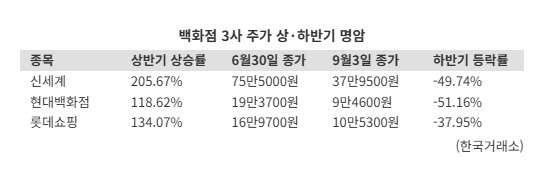
[Financial News] The wealth effect, which grew alongside the sharp rise in stock markets during the first half of the year, has rapidly weakened in the second half. As volatility has increased, led by market-leading stocks, consumer stocks such as department stores have also undergone a steep correction.■ Consumer Stocks, Including Department Stores, Enter Correction PhaseAccording to the Korea Exchange (KRX) on the 3rd, Shinsegae closed at 379,500 won on the KOSPI, down 1.81% from the previous trading day. Compared with 755,000 won on June 30, the stock has plunged 49.74% in just over two months. During the same period, Hyundai Department Store fell 51.16%, from 193,700 won to 94,600 won, while Lotte Shopping dropped 37.95%, from 169,700 won to 105,300 won.
This is the opposite of the trend seen in the first half. Shinsegae surged 205.67% during the first half of this year, while Lotte Shopping and Hyundai Department Store rose 134.07% and 118.62%, respectively. Their share prices, which had climbed as much as two- to threefold on the stock market rally and increased spending by foreign tourists, have given back a substantial portion of those gains in just over two months.
The strengthening won is cited as the direct cause of the sharp decline in department store stocks. The won-dollar exchange rate, which had risen to the 1,550-won range in early July, has recently fallen to the 1,360-won range. When the won appreciates, foreign tourists’ purchasing power in Korea declines, affecting sales at department stores and duty-free shops.
The higher earnings base is also a burden. Same-store department sales continued to grow by double digits year on year from the fourth quarter of last year through the second quarter of this year, prompting forecasts that growth will slow from the third quarter. Analysts expect the same-store sales growth rate, which exceeded 20% in July, to decline gradually through August and September.■ 'Wealth Effect' Turns Into 'Negative Wealth Effect'Attention has recently focused on the impact of the stock market correction on consumer sentiment. When prices of financial assets such as stocks rise, the resulting increase in asset values can boost consumption—a phenomenon known as the wealth effect. Conversely, a rapid decline in asset prices can produce a negative wealth effect, prompting consumers to cut spending.
An industry official in the securities sector said, "If the stock market correction continues for an extended period, investors’ perceived decline in wealth could affect consumption as well. In particular, investors using credit or leverage may suffer losses larger than the decline in the index, causing their spending capacity and sentiment to weaken relatively quickly."
Some analysts, however, say it is too early to conclude that the recent plunge in department store stocks signals an actual deterioration in consumer conditions. Demand for luxury goods and fashion, which has driven department store sales over the past year or so, remains strong, while the share of sales to foreign customers rose to 7-8% in the first half. Foreign consumption contributes about 2 percentage points to same-store sales growth.
Seo Jeong-yeon, a researcher at Shinyoung Securities, said, "Korean department stores’ same-store sales growth has been in the double digits since October last year and exceeded 20% this year, marking an unusually strong boom not seen in 20 years. This trend remained intact through June, and growth in the main product categories is understood to have remained solid in the third quarter as well."
[email protected] Choi Do-sun Reporter