Korea Customs Service Launches 'Trade-Based Fiscal and Financial Crimes Special Investigation Team'... Dedicated Investigations into Capital Market Disruption and Subsidy Fraud
- Input
- 2026-09-03 14:07:52
- Updated
- 2026-09-03 14:07:52
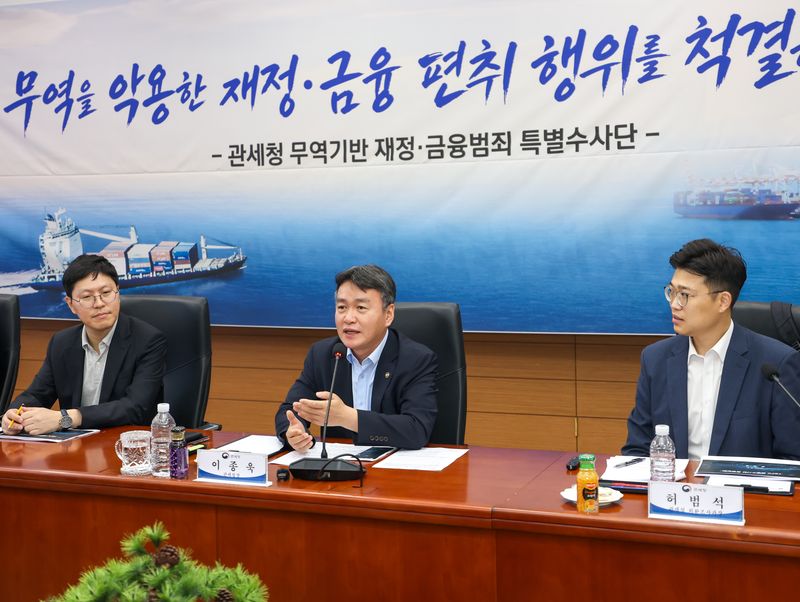
The Korea Customs Service announced on the 3rd that it held an inauguration ceremony for the 'Trade-Based Fiscal and Financial Crimes Special Investigation Team (TBFC Special Team)' at the Seoul Customs Office together with related agencies including the Financial Intelligence Unit (FIU), the Ministry of SMEs and Startups, and the Public Procurement Service (PPS), and has begun full-scale crackdown activities.
Recently, trade crimes have evolved beyond simple customs evasion into sophisticated offenses that threaten the national fiscal foundation, including disruption of capital markets, fraudulent delivery in public procurement, and the embezzlement of government subsidies and policy financing. Over the past five years, the amount of trade manipulation crimes detected by the Korea Customs Service reached 2.6664 trillion won, with the embezzlement of public finances totaling 74.5 billion won and fraudulent procurement crimes disguised as domestic products amounting to 173.4 billion won.
The TBFC Special Team will establish the 'TBFC Information Analysis Center' under its umbrella to comprehensively combine and analyze information on capital markets, public procurement, subsidies, and policy finance shared by relevant agencies, along with import/export and foreign exchange transaction data from the Korea Customs Service. Through this process, it will conduct investigations and foreign exchange inspections on selected suspicious companies, and establish an 'Integrated Joint Inspection System' that shares the results with relevant ministries to swiftly carry out follow-up measures, such as the recovery of illegal profits and bidding restrictions.
The major types of crimes handled by the special investigation team include capital market disruption activities such as inflating sales through false or fictitious trade to boost stock prices or obtain fraudulent listings, and fraudulent public procurement activities such as supplying low-priced foreign products to public institutions by falsely claiming them to be domestic. In addition, they include acts of unjustly receiving state or local government subsidies by manipulating import and export records, as well as obtaining illegal loans or securing trade financing through the manipulation of import and export prices.
For example, Busan Customs recently uncovered a company that attempted to list on KOSDAQ under the technology special exemption by generating 7.3 billion won in fictitious sales through a revolving transaction scheme—inflating the export prices of worthless battery components and re-importing them via overseas shell companies—and embezzling 2.1 billion won in government subsidies and trade finance loans. The Seoul Customs Office also uncovered a company that embezzled 2.7 billion won from the National Health Insurance fund by inflating the import price of adult walkers by 1.5 times.
Korea Customs Service Commissioner Lee Jong-wook stated, "We will prevent leakage in national finances and establish a sound trading order in the capital market through the TBFC Special Team and the TBFC Information Analysis Center," adding, "We will create a fair economic environment to ensure that government benefits fully reach legitimately qualified, conscientious companies and the public."
[email protected] Kim Won-jun Reporter