Camp Kim Act and Urban Improvement Act Fail to Reach Plenary Agenda; Only Noncontroversial Bills Processed
- Input
- 2026-09-03 14:53:22
- Updated
- 2026-09-03 14:53:22
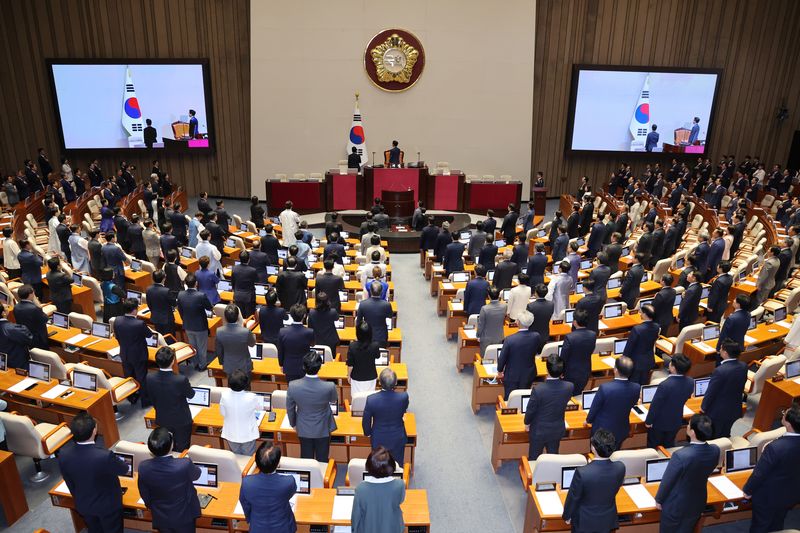
[Financial News] The first plenary session since the opening ceremony of the September regular session was held, but bills related to housing supply were not placed on the agenda. The ruling and opposition parties failed to narrow their differences over amendments to the Act on the Improvement of Urban Areas and Residential Environments, among other legislation. The Democratic Party of Korea proposed to the People Power Party (PPP) a compromise that would add private-sector developers to those eligible for a higher floor-area ratio, while lowering the cap from 1.3 times to 1.2 times. The PPP is now weighing whether to accept the Democratic Party of Korea’s compromise or offer an alternative.
The National Assembly of the Republic of Korea convened a plenary session on the 3rd and passed 17 noncontroversial bills by agreement. The Yongsan Park Special Act (Camp Kim Act), the Act on the Improvement of Urban Areas and Residential Environments, and amendments to the Act on the Promotion of Urban Renewal, all of which had already been referred to the plenary session, were not placed on the agenda.
The passage of the amendment to the Yongsan Park Act, known as the Camp Kim Act, which would ease requirements for securing parks and green areas at the Camp Kim site, has run into an obstacle. Kim Yun-duk, Minister of Land, Infrastructure and Transport of South Korea, decided not to push ahead with a plan to supply housing at Yongsan Children’s Garden and elsewhere in Yongsan Park after discussions with Seoul Mayor Oh Se-hoon. Although the Camp Kim Act is a separate bill, analysts say it has lost momentum.
The ruling and opposition parties are also engaged in heated debate over the Act on the Improvement of Urban Areas and Residential Environments. The version currently referred to the plenary session would ease the floor-area ratio for public redevelopment and reconstruction projects by 1.3 times. The Democratic Party of Korea is understood to have proposed including private-sector developers while lowering the ratio to 1.2 times. Seoul’s Gangnam 3 districts and Yongsan-gu would be excluded from the areas eligible for the relaxation. In addition, the relaxed floor-area ratio would be limited to housing with exclusive floor space of 60 square meters or less.
The PPP, however, maintains that private-sector developers should also be allowed a floor-area ratio of up to 1.3 times. Im Lee-ja, the PPP’s policy committee chair, urged, "Let’s allow private developers the same 1.3 times." In response to the proposal to build only small homes of 60 square meters or less, Im objected, "You might as well say that the floor-area ratio will be relaxed only when rental housing is built."
The PPP is nevertheless reportedly considering whether to accept the Democratic Party of Korea’s proposal or present a new alternative. A PPP official on the Land, Infrastructure and Transport Committee explained, "We are discussing internally whether to ease the requirement for homes of 60 square meters or less, accept it with a floor-area ratio of 1.25 times, or propose including overheated speculation zones among the areas eligible for the relaxation." There are also reportedly calls to send the Act on the Improvement of Urban Areas and Residential Environments, which has been referred to the plenary session, back to the Land, Infrastructure and Transport Committee.
The Democratic Party of Korea continues to maintain that it must wait and see the discussions between MOLIT and the Seoul Metropolitan Government. Jeon Eun-su, a floor leader’s spokesperson for the Democratic Party of Korea, stated, "Negotiations between the MOLIT minister and the Seoul mayor over the Act on the Improvement of Urban Areas and Residential Environments and the Yongsan Park Special Act are still underway. We will watch the outcome of the negotiations." However, MOLIT, currently headed by Kim Yun-duk, faces a difficult process, including a confirmation hearing, as it is among the ministries subject to a Cabinet reshuffle under the Lee Jae-myung administration. As a result, the prevailing view is that action on the housing supply bills will be delayed until the next minister is appointed.
[email protected] Lee Hae-ram Reporter