"Be Wary of Clinics That Simply Plant as Many Grafts as Possible": Everything About Crown Hair Transplants [Kim Jin-oh’s Hair-Loss Escape]
- Input
- 2026-09-03 14:29:14
- Updated
- 2026-09-03 14:29:14
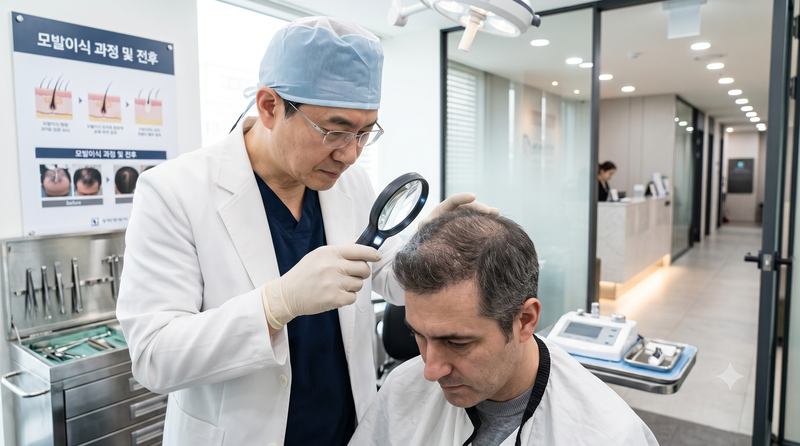
[Financial News] Crown hair loss can feel particularly unfair. It is your own hair, yet you are often the last person to notice it. You check your hairline in the mirror every morning, but the crown is suddenly revealed by ceiling lights or a photo someone else took. Once you realize what is happening, you may want to undergo a hair transplant immediately to fill in the thinning area. Crown hair transplantation, however, is not that simple.
Surgical methods vary from person to person... Why crown hair transplantation is challenging
First, crown hair transplantation requires more hair follicles than many people expect. Because hair loss appears in a circular pattern, the surgical area expands rapidly even with a slight increase in the diameter of the thinning region. A circle with a diameter of 8 centimeters has an area of about 50 square centimeters, while a 10-centimeter circle covers about 79 square centimeters. The diameter increases by only 2 centimeters, but the area requiring transplantation grows by more than half.
The results may also be less noticeable than those of a hairline transplant. Hair growing at the crown spreads in multiple directions from the whorl. In other words, it cannot simply be gathered and covered in one direction. Unless a certain level of density is achieved, the scalp may still show through between the hairs after transplantation.
That does not mean planting grafts as densely as possible is always the answer. Each person has a unique whorl at the crown. Some people’s hair rotates clockwise, while others’ rotates counterclockwise. Some have two centers, while in others, progressive hair loss makes the original whorl difficult to identify. Hair patterns differ from person to person. If the pattern is not analyzed and the area is filled indiscriminately with densely packed grafts, the direction of the hair may look unnatural as it grows.
The edges of the thinning area also require close attention when deciding on surgery. If the surrounding hair is thick and the extent of hair loss has stabilized, restoring the existing bald spot alone may allow the boundary to blend naturally. Conversely, if the hair along the edges is also becoming thinner, transplanting only the bald area may not be enough. If the hair outside the transplanted area falls out over time, another empty ring may form around the transplant.
Medication may be used before surgery... to reduce complications after the procedure
If the crown has expanded rapidly in recent months, or if the hairline and other areas are also becoming thinner, it is advisable to begin medication before considering a hair transplant. Stabilizing the progression of hair loss to some extent first makes it possible to determine the transplant area and use the limited supply of follicles more efficiently. Moreover, if many surrounding hairs have already become thin, undergoing surgery too aggressively can lead to shock loss after the transplant.
If both the hairline and crown have thinned, priorities must be established. The number of follicles that can be harvested from the back of the head is limited, and a follicle used once does not grow back. If many follicles are used to fill the crown at high density, there may not be enough left to address further recession of the hairline later. In such cases, the hairline and top of the scalp are generally considered first. The areas visible from the front have a greater impact on one’s appearance, and hair extending backward can cover a wider area.
Conversely, if the hairline is stable, hair loss is progressing only at the crown, and the donor area is sufficient, surgery can begin at the crown. The order should not be determined by age alone; the rate of hair-loss progression, donor-area density, and hair thickness must all be considered.
If you hear an explanation about “3,000 hairs” during a consultation, you should confirm whether it means 3,000 individual hair strands or 3,000 follicular units. A follicular unit may contain a single strand or two or three strands growing together. Even when the number is described as 3,000, the actual amount transplanted can differ substantially depending on what the term refers to.
In summary, the key to crown hair transplantation is not simply filling the area that is currently empty. A good plan should leave enough room to address the hairline and upper scalp when necessary, without making the appearance look unnatural even if hair loss progresses further. Therefore, it is not enough to ask only how many grafts will be implanted in the current procedure. You should also confirm how much donor-hair capacity will remain after surgery.

/Director of New Hair Hair Transplantation Clinic
[email protected] Kim Hyun-sun Reporter