SMEs Set $180 Billion Export Target for 2030, Expanding K-Fashion and K-Food
- Input
- 2026-09-03 13:59:25
- Updated
- 2026-09-03 13:59:25
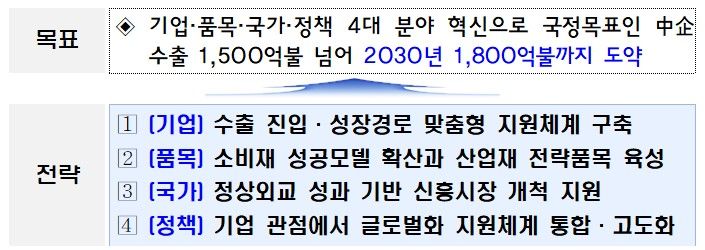
The Ministry of SMEs and Startups announced the government’s four-pronged innovation strategy for SME exports at the 13th National Policy Coordination Meeting, chaired by Han Seong-sook, on the 3rd. The strategy was jointly prepared by relevant government ministries.
The government plans to bring forward its target of achieving $150 billion in SME exports from 2030 to 2028. It will then raise exports to $180 billion by 2030.
The number of exporting SMEs will increase from 98,000 last year to 112,000 by 2030. The government also aims to raise the number of companies with annual exports of at least $10 million from 2,279 to 2,900 over the same period.
The Ministry of SMEs and Startups plans to extend the success of K-beauty exports to other consumer goods, including beauty devices, fashion, food, and household products. To that end, it will identify 1,000 SMEs with strong growth potential and develop them into strategic products for next-generation K-brands.
These companies will receive support for joint overseas expansion by leveraging distribution networks and business connections held by large companies. The Ministry of SMEs and Startups is collaborating with MUSINSA in fashion, CJ Olive Young in beauty, and Emart and Lotte Mart in food. It plans to expand the range of partners to include convenience-store chains.
The government will also actively support the industrial-goods sector, which accounts for more than 70% of SME exports but has recently seen its growth stagnate.
Taking overseas industrial policies and changes in supply chains and technology into account, the government will develop 500 industrial-goods and technology-services companies with strong growth potential into strategic K-tech products. Selected companies will receive support to upgrade their technologies and products in cooperation with large domestic and overseas companies, as well as to conduct local demonstrations. The government will also help them secure export contracts through participation in overseas trade fairs, buyer discovery, and credit verification.
The government will establish Global Scale-up 500, a program providing intensive support to 500 companies selected for their strong growth potential.
The current support system, centered on single-year and individual projects, will be reorganized into multi-year, bundled support based on each company’s export roadmap. The scope of assistance will expand beyond marketing to cover the entire supply chain, including the procurement of raw and subsidiary materials and overseas market entry.
The government will also introduce Export ON 2000 to help diverse groups—including youth-led companies, small businesses, regional companies, and firms that have suspended exports—enter export markets. It will develop 1,000 young global pioneers and 500 prospective global small businesses, while supporting 300 companies belonging to regional specialized export alliances and 200 companies seeking to resume exporting.
The government also aims to diversify SME export markets, which are heavily concentrated in China, the United States, Vietnam, and Japan.
Next year, the Ministry of SMEs and Startups will establish an integrated support hub for SMEs in India, equipped with manufacturing, demonstration, exhibition, and warehousing functions. In Brazil, it will support the online and offline expansion of K-beauty brands and strengthen regulatory cooperation with the Brazilian Health Regulatory Agency (Anvisa). It will also open two permanent K-Brand pop-up stores next year in major European beauty and fashion hubs.
The fragmented export-support system operated by individual ministries and agencies will also be reorganized around companies to facilitate exports. Starting next year, application forms for export-support programs will be standardized across agencies and projects. In 2028, the government plans to issue an integrated announcement of public- and private-sector programs supporting SME exports and overseas expansion.
GobizKOREA, an online export platform, will be upgraded into a comprehensive SME export-support platform offering AI-powered export-capability assessments, consultations on business difficulties, and the discovery and matching of overseas buyers.
No Yongseok, First Vice Minister of SMEs and Startups, emphasized, "We will swiftly establish the four-pronged innovation strategy for SME exports in the field and concentrate our policy capacity so that SME exports can leap to $180 billion by 2030."
[email protected] Kim Hyeon-cheol Reporter