Ministry of Justice and Ministry of Gender Equality to Move to Sejong... Ministry of Foreign Affairs and Ministry of Unification Also Considering Relocation
- Input
- 2026-09-03 12:32:59
- Updated
- 2026-09-03 12:32:59
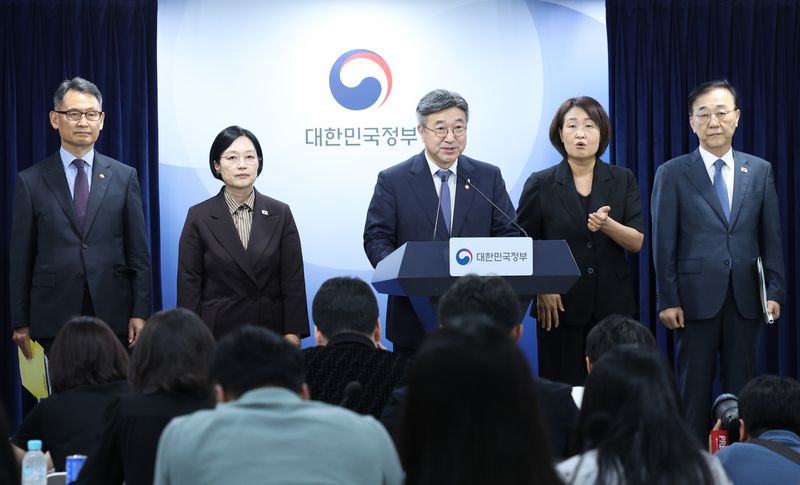
[Financial News] The government plans to sequentially proceed with the relocation of central administrative agencies in the capital area, including the Ministry of Justice and the Ministry of Gender Equality, to Sejong City starting in the first half of 2027. The Ministry of Foreign Affairs (MOFA) and Ministry of Unification (MOU) will review whether to relocate in alignment with the timing of the relocation of the Presidential Office and the National Assembly of the Republic of Korea. Although the Financial Services Commission (FSC) was not specifically named as a relocation target on this day, the government stated that it has not been excluded from the relocation list.
Minister of the Interior and Safety (MOIS) Yun Ho-jung announced the "Direction for the 2nd Relocation of Central Administrative Agencies" at a press conference on "Relocation of Administrative and Public Institutions and Functional Reform of Public Institutions" held at Government Complex Seoul on the 3rd.
Minister Yun said, "We will pursue the second relocation of central administrative agencies to strengthen the Sejong City-centered state administration system and enhance the efficiency of collaboration and communication among ministries."
The government is reviewing whether to relocate central administrative agencies and affiliated organizations located in the capital area to Sejong City. It plans to determine the relocation targets by comprehensively considering factors such as the functions and nature of the agencies and their operational connectivity with other agencies.
Amend the Special Act on the Construction of Administrative City to relocate the Ministry of Justice and the Ministry of Gender Equality first
First, the government is moving forward with an amendment to the Special Act on the Construction of Administrative City to facilitate the relocation of the Ministry of Justice and the Ministry of Gender Equality to Sejong City. The Special Act on the Construction of Administrative City, officially titled the "Special Act on the Construction of the Multifunctional Administrative City in the Yeongi-Gongju Area for Follow-up Measures for the New Administrative Capital," stipulates the central administrative agencies subject to relocation to Sejong City and the procedures for establishing relocation plans. Currently, Article 16 of the Special Act on the Construction of Administrative City excludes the Ministry of Foreign Affairs (MOFA), Ministry of Unification (MOU), Ministry of Justice, Ministry of National Defense, and Ministry of Gender Equality and Family from relocation to Sejong City. To facilitate the relocation of the Ministry of Justice and Ministry of Gender Equality, the government is pushing for an amendment to remove these ministries from the list of excluded agencies.
The specific targets, methods, and timing of the relocation have not yet been finalized. According to the Special Act on the Construction of Administrative City, the Minister of the Interior and Safety (MOIS) must formulate a relocation plan containing the agencies to be relocated, as well as the methods and timing, and obtain the President's approval. When preparing the relocation plan, public hearings must be held to gather opinions and consultations with relevant central administrative agencies must be conducted; following approval, the plan is required to be published in the Official Gazette.
FSC: No Exclusions... Relocation of Government Ministries Confirmed for Q4
The government plans to finalize the relocation plan and target institutions in the fourth quarter of this year following these procedures.
The Ministry of Foreign Affairs (MOFA) and Ministry of Unification (MOU) are also considering relocating to Sejong City. Since both ministries are exempt from relocation to Sejong City under the current Special Act on the Construction of Administrative City, an amendment to the law is required for the actual move.
When asked about the relocation of the Ministry of Foreign Affairs (MOFA) and Ministry of Unification (MOU), Minister Yun said, "The relocation will be reviewed in accordance with the timing of the Presidential Office's relocation and the opening of a branch of the National Assembly of the Republic of Korea in 2033."
The Financial Services Commission (FSC), which had been mentioned as a strong candidate for relocation to Sejong City, was not cited as a target for relocation in this announcement. Regarding this, Minister Yun explained that this does not mean the FSC has been excluded from the relocation list. He added, "I stated that we would finalize and announce the relocation plan and the institutions subject to relocation in the fourth quarter."
Agencies requiring separate buildings, such as the Public Prosecution Office, Serious Crime Investigation Agency, and Korean National Police Agency, will proceed with relocation after constructing new buildings. The plan is to relocate agencies in stages, rather than moving all of them at once, depending on each agency's operational conditions and readiness.
Measures will also be prepared by each agency to prevent administrative gaps during the transition process. Plans will be established to ensure business continuity so that tasks directly related to people's lives, such as civil complaints, licensing, and policy implementation, are not interrupted or delayed.
Support for the settlement of relocated employees and their families will also be provided. The government has decided to inspect living conditions, including housing, education, childcare, and transportation, and to create a working environment so that relocated institutions can resume normal operations as soon as possible.
The plan is to reflect the budget required for the relocation of central administrative agencies in the 2027 budget and to request cooperation from the National Assembly of the Republic of Korea for the amendment of the Special Act on the Construction of Administrative City. A task force composed of relevant ministries, led by the Ministry of the Interior and Safety (MOIS) and the Office for Government Policy Coordination, will be formed to review relocation plans for each agency, secure office buildings, and measures to ensure business continuity.
Minister Yun stated, "The relocation of central administrative agencies is not merely a matter of moving government space," adding that it is "an endeavor to enhance the efficiency of national administration, strengthen Sejong City's function as a multifunctional administrative city, and further solidify the foundation for balanced national growth."
Meanwhile, 43 agencies relocated to Sejong City between 2012 and 2021. The government plans to strengthen the Sejong City-centered national governance system by additionally relocating central administrative agencies remaining in the capital area.
[email protected] Lee Bo-mi Reporter