Han Seong-sook: "President's Executive Office in Sejong City to Be Built by August 2029; National Assembly Complex to Be Completed in 2033"
- Input
- 2026-09-03 11:44:20
- Updated
- 2026-09-03 11:44:20
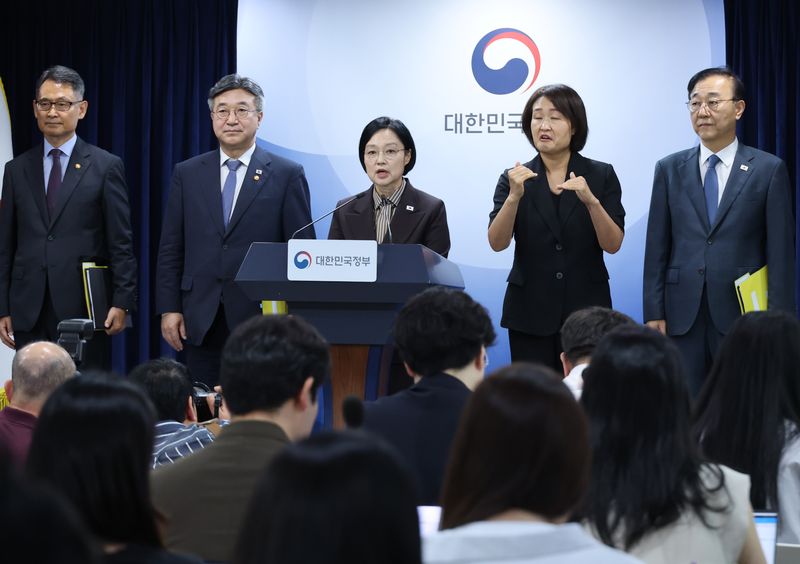
[Financial News] The government will complete the President's Executive Office in Sejong City by August 2029. The National Assembly Sejong Complex will also be completed in 2033. Public institutions in the Seoul metropolitan area will begin relocating next year, with the institutions subject to relocation to be announced in the fourth quarter. The government will also reduce 109 public institutions—the largest reduction ever—by consolidating similar and overlapping functions, including through the merger of the five power generation companies.
On the 3rd, Prime Minister Han Seong-sook held a press conference at Government Complex Seoul and announced the government's second-phase plans for relocating central administrative agencies and public institutions, along with measures to reform public institution functions. Yun Ho-jung, Minister of the Interior and Safety; Kim Yun-duk, Minister of Land, Infrastructure and Transport of South Korea; and Heo Jang, Second Vice Minister of the Ministry of Economy and Finance, explained matters under their respective ministries.
Prime Minister Han said, "Balanced growth is a survival strategy for a sustainable Republic of Korea," adding, "This will be a symbolic and practical turning point in easing overcrowding in the Seoul metropolitan area and creating new regional growth engines." She also requested that the National Assembly review and approve the necessary budgets and swiftly revise relevant laws concerning the relocation of the government and public institutions.
The government has first finalized plans to relocate the President's Office and the National Assembly to Sejong City.
Prime Minister Han said, "We will build the President's Executive Office, Sejong, in August 2029, placing the administrative center in Sejong City, and will proceed without disruption with the completion of the National Assembly Sejong Complex in 2033."
Prime Minister Han continued, "We will complete the Administrative City as the undisputed center of national administration," adding, "Beginning in the first half of next year, we will prioritize relocating central administrative agencies currently based in the Seoul metropolitan area to Sejong City, starting with those whose relocation would have the greatest scale and impact."
The relocation of public institutions will also gain momentum next year.
Prime Minister Han said, "Under the principle of minimizing the number of public institutions that remain in the Seoul metropolitan area, we will announce a relocation plan in the fourth quarter of this year covering approximately 350 public institutions and begin the relocations in 2027."
Prime Minister Han added, "We will avoid allocation based on dividing up shares among stakeholders and instead cluster institutions around Innovation Cities to maximize the strength of regional hubs." She said the government had been preparing relocation plans with local governments since last year.
Public institutions will also undergo extensive mergers and consolidations.
Prime Minister Han said, "Through strategic structural reform to strengthen global competitiveness, the consolidation of similar and overlapping functions, and the merger of small institutions, we will reduce 109 public institutions—the largest reduction ever." She continued, "Along with guaranteeing the succession of public institution employees' jobs, we will also devise various support measures, including compensation, benefits and incentives."
The government is preparing implementation procedures, including functional reform road maps, for each ministry. Institutions that do not require procedures such as legislative amendments will begin implementation immediately.
Prime Minister Han emphasized, "There will inevitably be disagreements and conflicting interests among some parties," adding, "We will listen carefully to a wide range of views, including those of local governments and labor groups, and create a reasonable relocation plan that the majority can support."
The government plans to minimize inconveniences caused by the large-scale relocation of institutions and expand its support.
Prime Minister Han said, "To ensure that employees of relocating institutions face no inconvenience, we will provide substantial support for relocation expenses and housing costs, while also making significant improvements to living conditions, including education and medical services."
[email protected] Jung Sang-gyun Reporter