Foreign Exchange Reserves Hit Record Increase, but BOK Quietly Removes Global Ranking
- Input
- 2026-09-03 15:50:57
- Updated
- 2026-09-03 15:50:57
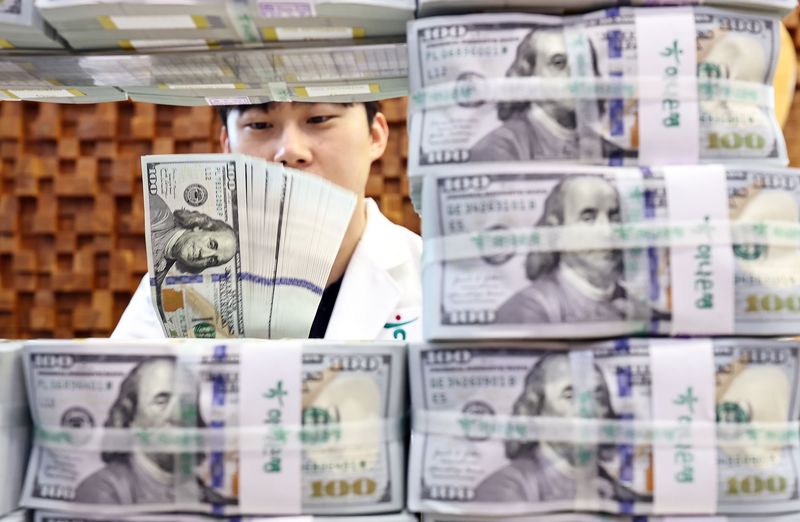
According to the BOK on the 3rd, South Korea’s foreign exchange reserves stood at $442.28 billion at the end of August. This was an increase of $14.33 billion from the previous month and the largest monthly gain on record.
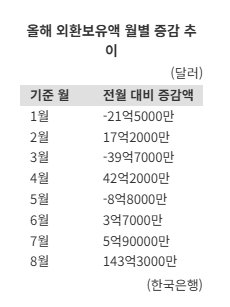
The monthly changes have fluctuated this year: down $2.15 billion in January, up $1.72 billion in February, down $3.97 billion in March, up $4.22 billion in April, down $880 million in May, up $370 million in June, and up $590 million in July.
The BOK attributed the increase to a sharp rise in foreign-currency deposits held by financial institutions, along with higher investment returns and an increase in the U.S.-dollar value of foreign-currency assets denominated in other currencies.
Within the foreign exchange reserves, deposits rose by $7.17 billion to $30.3 billion. Securities also increased by $7.07 billion to $387.07 billion. Special Drawing Rights (SDRs) and the IMF position—the claims held by International Monetary Fund (IMF) member countries through capital subscriptions and lending—rose by $600 million and $300 million, respectively. Gold remained unchanged at $4.79 billion.
However, the BOK suddenly stopped disclosing South Korea’s foreign exchange reserve ranking among major countries. The measure came 25 years and six months after the statistic was first published in February 2001.
The main reason was the possibility that the indicator could be misinterpreted in the market, even though it is not a representative measure for assessing foreign-currency liquidity.
A BOK official explained, "The international ranking is a simple comparative statistic that does not control for differences in economic size or external positions at all, so it cannot provide insight into potential shocks such as a foreign-currency liquidity crunch. South Korea ranked sixth during the Global Financial Crisis in 2008 and recently ranked 13th, but its fundamentals are far stronger now."
The issue is that materials with the ranking removed were distributed without prior notice, and an explanation was provided only the following day. As a result, critics say the move was inadequate from the standpoint of central bank communication, regardless of the information value of the international foreign exchange reserve ranking.
A BOK official said, "Discussions had already been underway because, as the ranking changed more frequently this year due to factors such as fluctuations in gold prices, temporary rises or falls in the ranking could have been interpreted as being linked to changes in foreign exchange soundness. The information is publicly available, so it can be checked individually."
South Korea ranked 10th globally at the end of July. It fell one place from ninth in January to 10th in February, then dropped to 12th in March and remained there for three months. It fell to 13th in June but recovered three places at once at that point.
[email protected] Tae-il Kim Reporter