China Secures Land Access Route to Tibet Disaster Zone, Intensifies Search for 541 Missing People
- Input
- 2026-09-03 10:57:25
- Updated
- 2026-09-03 10:57:25
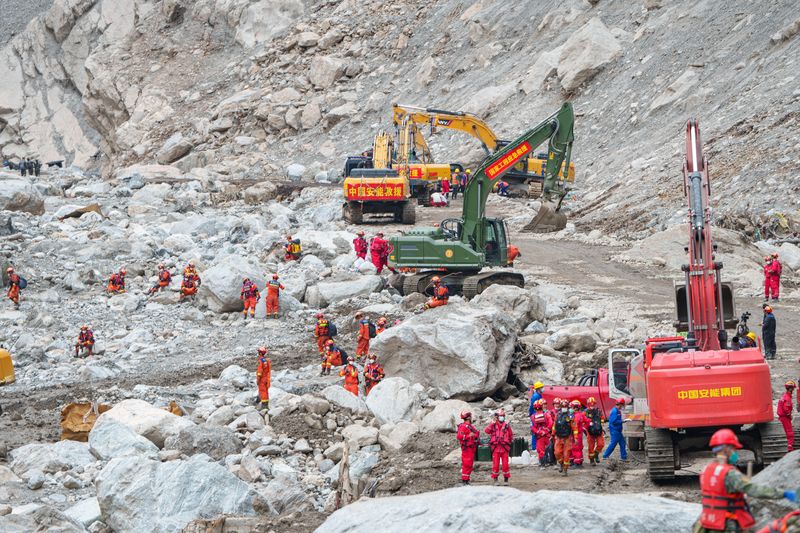
[Financial News] A land access route has been secured to the main disaster zone on the Chinese side, which was hit by massive debris flows triggered by severe flooding in the Himalayan mountain region along the China-Nepal border. The development is accelerating search and rescue operations.
China Central Television (CCTV) and the state-run Xinhua News Agency reported on the 3rd that Chinese rescue authorities had secured a land route to the main disaster zone at Gyirong Port in the Tibet Autonomous Region the previous day.
Rescue workers, relief supplies, and search equipment have since entered the site by land. Large pieces of heavy equipment, including excavators, are also conducting full-scale searches in the main disaster zone.
The heavy equipment is removing large rocks and mud piled around the Gyirong Port immigration office and other areas in search of missing people buried beneath the debris.
The debris deposits accumulated near Gyirong Port are reportedly an average of 4 meters thick, reaching 16 meters at their deepest points.
Authorities are concentrating their searches on areas where missing people are most likely to be found, including the immigration office and accommodation buildings.
China had faced major difficulties reaching the main disaster zone after sections of the national road leading to Gyirong Port were washed away by the debris flow.
Rescue workers continued operations by approaching the site along mountain roads and using helicopters and drones to drop equipment and relief supplies from the air.
Authorities explained that, after securing the land route, they had begun deploying rescue personnel and heavy equipment in earnest to search for missing people, restore roads, manage the damage, and prevent secondary disasters simultaneously.
So far, more than 2,300 rescue personnel, about 400 rescue vehicles, and more than 8,000 pieces of various search and rescue equipment have been deployed. Drones have also been operated approximately 800 times.
Authorities announced that, as of noon the previous day, casualties in Tibet related to the severe flooding in Nepal stood at 21 dead and 541 missing.
A total of 847 items that could be used to identify the missing have also been recovered at the site.
Authorities are continuing to monitor the natural dam formed upstream and areas at risk of landslides.
The water in the natural dam drained naturally on the 30th of last month, eliminating the risk of collapse. Water pools formed by glacier and bedrock collapses were also reportedly drained completely.
However, authorities are continuously monitoring precipitation, river levels, and landslide-risk areas in preparation for the possibility of additional debris flows caused by ongoing rain and high temperatures.
The disaster occurred on the 26th of last month when a glacier on Langtang Lirung in Nepal collapsed at an elevation of approximately 5,200 meters.
The massive landslide and debris flow caused by the glacier collapse swept rapidly down approximately 22 kilometers and struck Gyirong Port, located at an elevation of about 1,800 meters.
The affected area is estimated to have been roughly the size of 100 soccer fields.
[email protected] Lee Seok-woo, International Affairs Specialist Reporter