Electric Vehicle Charging Rates to Be Discounted by Up to 32% This Fall During Daytime Hours on Weekends and Public Holidays Starting September 5
- Input
- 2026-09-03 12:00:00
- Updated
- 2026-09-03 12:00:00
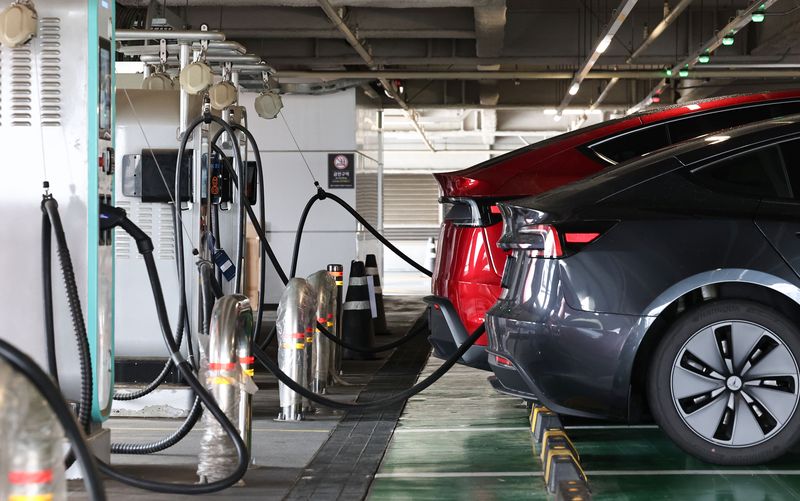
[Financial News] The government will discount public electric-vehicle charging rates from 11 a.m. to 2 p.m. on weekends and public holidays from September 5 through October 31. The measure is intended to encourage electricity use during daytime hours, when solar power generation leaves more electricity available. It is the second seasonal discount, following the one introduced last spring.
The Ministry of Climate, Energy and Environment announced on the 1st that it will resume discounts on electric-vehicle charging electricity rates for three hours from 11 a.m. to 2 p.m. on 21 weekend and public-holiday days, beginning with the first weekend of September 5 and continuing through October 31. The measure is linked to the seasonal and time-of-use electricity-rate reform implemented on April 16. It is designed to encourage electricity use during periods when supply is relatively abundant, providing consumers with meaningful savings while helping create conditions for stable operation of the national power grid. During the first spring trial, held from April 18 to May 31, electricity charges were discounted by 50%, lowering consumer charging rates by up to 15%. The number of charging sessions also rose by approximately 9.2% per day on average compared with before the discount.
The discount will apply to both the self-consumption tariff and the tariff for charging-service providers offered by Korea Electric Power Corporation (KEPCO). The self-consumption tariff is available to private homes, companies and some apartment complexes. The charging-service-provider tariff is offered to the Ministry of Climate, Energy and Environment, public institutions, local governments and private charging operators, and accounts for approximately 35% of consumer charging rates. Charging stations using self-consumption tariffs at homes and companies will immediately receive discounts of 40.1 to 48.6 won per kWh starting September 5. More than 14,000 public fast chargers operated by the ministry and KEPCO, along with approximately 3,400 KEPCO slow chargers, will also receive the discount from the same day.
In particular, approximately 9,600 fast chargers operated by the Ministry of Climate, Energy and Environment will combine KEPCO's 50% discount with an additional in-house discount, reducing total rates by up to 32%. The discount will expand to 22% to 32%, compared with a maximum of 15% in spring, and will be implemented temporarily this fall to examine shifts in charging demand resulting from price changes. KEPCO-operated chargers will receive discounts of 40.1 to 48.6 won per kWh, while ministry-operated fast chargers without slow-charging facilities will receive discounts of 85.4 to 97.2 won per kWh.
Nineteen private charging companies, including Everon, PLUGLINK, Chaebi, SK charging, Hyundai Engineering and GS ChargEV, will also reflect the discounts in consumer rates. The size and method of the discount will vary by company. Everon will offer discounts of 50 to 70 won for slow charging and 148 won for fast charging, while Korea Electric Vehicle Infrastructure Technology will provide 40 won in points. Hyundai Engineering will offer a 15% discount per kWh, and EVSIS will provide points equivalent to 50% of the electricity charge.
The Ministry of Climate, Energy and Environment plans to continue reforming the rate structure so electric-vehicle users can benefit from charging discounts. It will also conduct a comprehensive analysis of the spring and fall discount programs and use the findings as basic data for designing a seasonal and time-of-use electric-vehicle charging tariff system that it is considering introducing next year.
Jung Sun-hwa, Director of Green Transition Policy at the Ministry of Climate, Energy and Environment, said, "We aim to expand on the results confirmed during the spring program this fall, and we expect user benefits to grow as many private companies join the initiative." She added, "We will closely analyze the results of this fall's program and design a time-of-use charging tariff system that achieves both user benefits and grid stability."
[email protected] Lee Yu-beom Reporter