Yeongtong Home Prices Hit 'Nationwide High' as Samsung Electronics Co., Ltd. Lifts Internal Loans... Gangnam-gu and Seocho District Fall for 4th Consecutive Week
- Input
- 2026-09-03 14:00:00
- Updated
- 2026-09-03 14:00:00
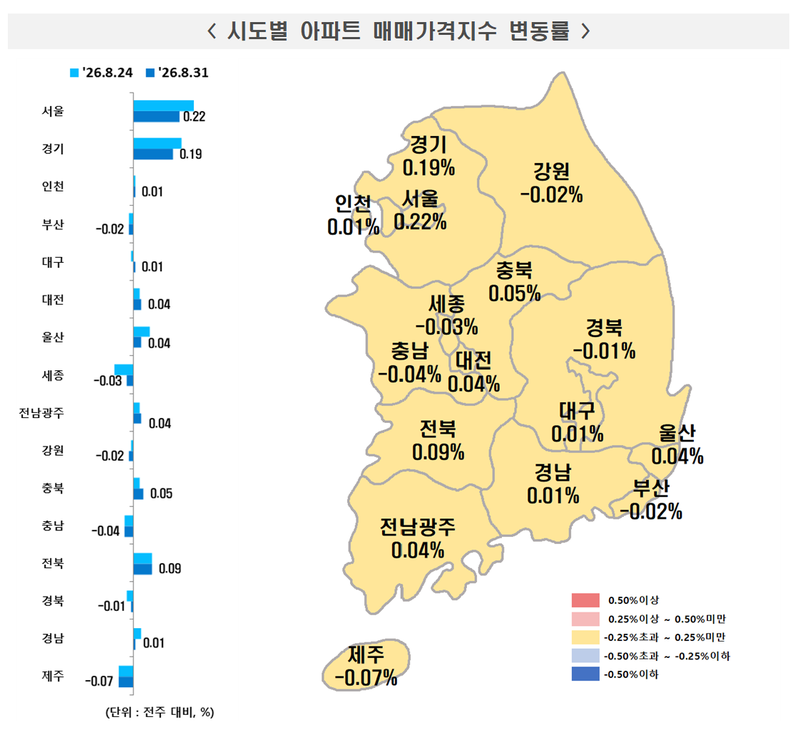
According to the Korea Real Estate Board (KREB) on the 3rd, the sales price of apartments in Seoul rose 0.22% in the 5th week of August (as of August 31) compared to the previous week. Although the margin of increase narrowed from 0.29% the previous week, the upward trend continued for the 82nd consecutive week.
Among Seoul's 25 autonomous districts, Gangnam-gu and Seocho District were the only ones where prices fell. Gangnam-gu recorded -0.41% and Seocho District -0.23%, marking a downward trend for four consecutive weeks since turning downward in the first week of August. Songpa District also rose by only 0.01%, effectively remaining flat.
The weakness in the Gangnam area is analyzed to reflect a wait-and-see sentiment resulting from the fact that the government's direction for tax reform has not yet been finalized. Nam Hyuk-woo, a real estate researcher at Woori Bank, stated, "It is estimated that this reflects the selling movements of owners in Songpa District who wish to switch to properties available through distressed sales in Gangnam-gu and Seocho District."
Analysis suggests that a wait-and-see attitude will persist, as while tax reforms have been partially eased, key factors determining the tax burden, such as the introduction of a limit on comprehensive real estate tax credits and the differential application of deduction rates based on residency and holding periods, still remain. Researcher Nam predicted, "We must watch for further easing during the upcoming legislative process," adding that "the slowdown in transactions and weak price trends in the region will continue for the time being."
Relatively high growth rates continued in the Gangbuk area. Seongbuk District saw the largest increase in Seoul at 0.54%, followed by Jungnang-gu at 0.52%, Nowon District at 0.50%, and Gangseo District and Gangbuk District at 0.45% each.
Nationwide apartment sales prices rose by 0.09%, a smaller increase than the 0.11% rise from the previous week. Prices in the Seoul metropolitan area increased by 0.17%, Gyeonggi Province by 0.19%, and Incheon Metropolitan City by 0.01%.
In Gyeonggi Province, strength was observed centered on regions affected by semiconductor industry conditions. Suwon's Yeongtong District recorded the highest increase nationwide, rising by 0.65%. It is interpreted that the price increase was driven by the inflow of liquidity through sources such as Samsung Electronics Co., Ltd.'s internal loans and real demand.
This was followed by Jungwon District in Seongnam-si at 0.54%, Bundang District at 0.53%, Gwonseon District in Suwon-si at 0.49%, and Giheung-gu in Yongin-si at 0.43%, in that order.
Researcher Nam observed, "Overall, there is a shortage of listings leading to high asking prices, and the fact that there are still newly built apartments priced around 1 billion won remaining, resulting in steady transactions centered on actual buyers working in the semiconductor industry, has been reflected in the price."
Nationwide apartment jeonse prices rose by 0.10%. While the metropolitan area increased by 0.17%, Seoul and Gyeonggi Province rose by 0.22% and 0.19%, respectively, and Incheon Metropolitan City increased by 0.01%.
[email protected] Choi Ga-young Reporter