“All-Out Effort to Contain Pine Wilt Disease”: Korea Forest Service Launches National Task Force and Plans 800-Kilometer Control Belt
- Input
- 2026-09-03 11:07:11
- Updated
- 2026-09-03 11:07:11
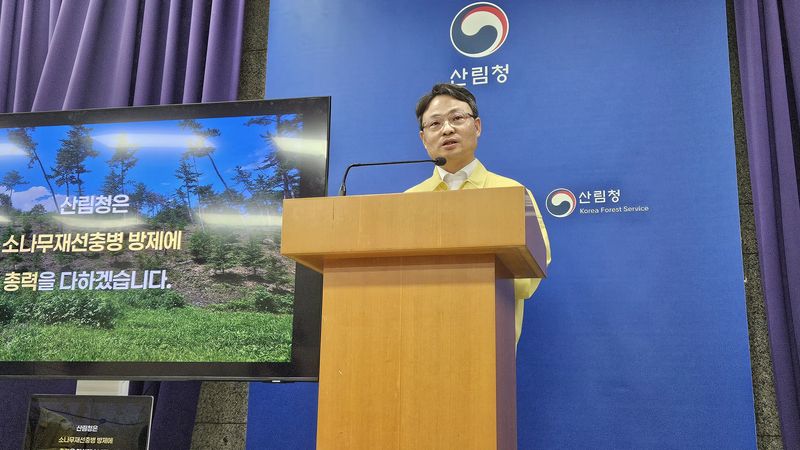
KFS chief Park Eunsik held a press briefing at Government Complex Daejeon on the 3rd and announced the “measures to strengthen the implementation of the national control strategy.” The measures are designed to strengthen implementation of the national pine wilt disease control strategy established in January this year.
The centerpiece of the measures is the National Pine Wilt Disease Control Task Force, which was launched on the 1st. The organization brings together all available KFS resources to overcome the wide variation in control results among local governments. The deputy head of KFS will lead the task force, while senior officials at the director-general level or above have been designated as regional coordinators after the country was divided into four regions. The task force consists of the northern region (Seoul and Gyeonggi), eastern region (Gangwon), central and western region (Chungcheongnam-do, Chungcheongbuk-do, Jeollanam-do, Gwangju, and Jeollabuk-do), and southern region (Gyeongsangbuk-do and Gyeongsangnam-do). It will establish a new cooperation system with metropolitan and local governments.
In particular, task forces responsible for management will be concentrated in 103 areas with relatively light infestations, where control is highly effective in the early stages of an outbreak. These areas account for 61% of all cities, counties, and districts affected by the disease, and the government plans to convert them into disease-free areas within three years. In addition, it will create a national control belt 4 kilometers wide and 800 kilometers long, regardless of whether the forests are state-owned or privately owned. Pilot projects will begin next year in key areas of concern, including northern Gyeongsangbuk-do and the west coast, with construction scheduled for completion by 2030 to fundamentally block the disease’s spread inland.
Control methods will also be upgraded. Moving beyond management by individual damaged trees, forests will be divided into 1-hectare units and assigned unique identification numbers through a precision management system. Pilot operations will begin in the second half of this year, combining advanced information and communications technologies—including satellites, helicopters, drones, and artificial intelligence—to automate the entire process from surveillance to follow-up management.
Customized control measures based on the extent of damage will be implemented in parallel. In the severely affected Gyeongsang region, the government will protect major pine forests, remove hazardous trees, and promote species conversion. In the west coast region, it will designate special control zones and ease restrictions on the movement of damaged trees, expanding “non-budget industrialized control,” under which timber companies directly carry out control measures and utilize the wood. Forests with high conservation value, including Geumgangsong Forest, temple forests, and national parks, will be designated as nationally conserved forests and intensively managed in cooperation with relevant agencies.
Park said, “With the disease’s spread now concentrated in certain areas, this is the last window of opportunity to reverse the spread of pine wilt disease. We will mobilize all of KFS’s capabilities to ease public anxiety and inconvenience.”
Meanwhile, pine wilt disease is a major forest pest and disease that has threatened pine forests nationwide since the first domestic case was confirmed in Busan in 1988. It spreads through the insect vectors Monochamus alternatus and Monochamus saltuarius. Because infected pine trees usually die without any effective treatment, control efforts have focused on detecting infected trees early and then felling and fumigating them. However, as outbreaks have expanded repeatedly each year, the need for a state-led, wide-area response has continued to be raised.
[email protected] Kim Won-jun Reporter