Regional Flagship Universities See Higher Competition and Cutoffs—Is the Seoul-Centered Admissions Trend Easing?
- Input
- 2026-09-03 09:52:23
- Updated
- 2026-09-03 09:52:23
■ Regional flagship universities draw attention amid employment difficulties and opportunity costs; tuition policies also a factor
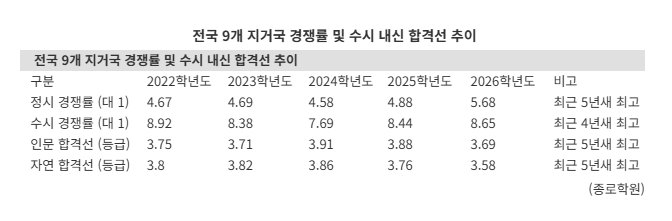
According to data on nine regional flagship national universities analyzed by Jongno Academy on the 3rd, the average competition rate for regular admissions in the 2026 academic year was 5.68 to 1. This was the highest level following 4.67 to 1 in 2022, 4.69 to 1 in 2023, 4.58 to 1 in 2024, and 4.88 to 1 in 2025. The early-admissions competition rate also reached a four-year high of 8.65 to 1.
School-record cutoffs for early admissions also rose. Based on the 70th-percentile cutoff among final enrollees in the 2026 academic year's general early-admissions track, the average student-record cutoff was 3.69 for humanities and 3.58 for natural sciences. The humanities average improved from 3.91 in 2024 to 3.88 in 2025 and 3.69 in 2026. The natural sciences average likewise rose from 3.86 to 3.76 and then 3.58 over the same period.
Jongno Academy interpreted the trend as reflecting, in part, efforts to reduce the opportunity costs of moving to the Seoul metropolitan area while employment difficulties continue for university graduates in both Seoul and the provinces. Lim Seong Ho, head of Jongno Academy, analyzed that "Interest in regional flagship national universities may be higher than in the past among applicants who can consider both universities in Seoul and regional flagship national universities." He also identified tuition-free policies at national universities as a factor that could affect future application patterns.
■ Applying based only on September mock-exam results?—"The overall score trend must also be considered"
However, applicants should be cautious about designing their early-admissions applications based solely on their September mock-exam results. Jinhak analyzed 24,731 students who entered both their September 2025 mock-evaluation results and their CSAT scores for the 2026 academic year. The average percentile scores in Korean, mathematics, and elective subjects fell on the CSAT compared with the September mock evaluation for 14,880 students, or 60.2%. The figure was 56.1% among current students and 69.1% among repeat test takers.
Repeat test takers also experienced a larger decline. Their average percentile score fell by 7.34 points, from 82.47 on the September mock evaluation to 75.13 on the CSAT—about 1.9 times the 3.87-point decline among current students. Jinhak explained, however, that percentile scores are relative indicators that vary depending on the test-taking population and exam difficulty. It cautioned that differences between the two tests should not be interpreted simply as an individual's change in academic performance.
Woo Yeon-cheol, director of the Jinhak Institute for Admissions Strategy, said, "The estimated score from the September mock evaluation taken immediately before early-admissions applications open is an important resource for assessing the likelihood of meeting minimum CSAT requirements." He added, "However, September mock-evaluation scores cannot be assumed to carry over unchanged to the actual CSAT. It is therefore not advisable to structure all six early-admissions applications on the assumption that applicants will meet high minimum CSAT requirements, or conversely, to focus exclusively on universities without such requirements." He advised, "Applicants should review their score trends, including their June mock-evaluation results, and appropriately balance applications with a high likelihood of meeting minimum CSAT requirements against more challenging applications that take into account the possibility of improving their scores."
[email protected] Kim Man-ki Reporter