“Data Centers Bring Prosperity” — U.S. Government and AI Industry Move to Soothe Public Anger
- Input
- 2026-09-03 09:20:20
- Updated
- 2026-09-03 09:20:20
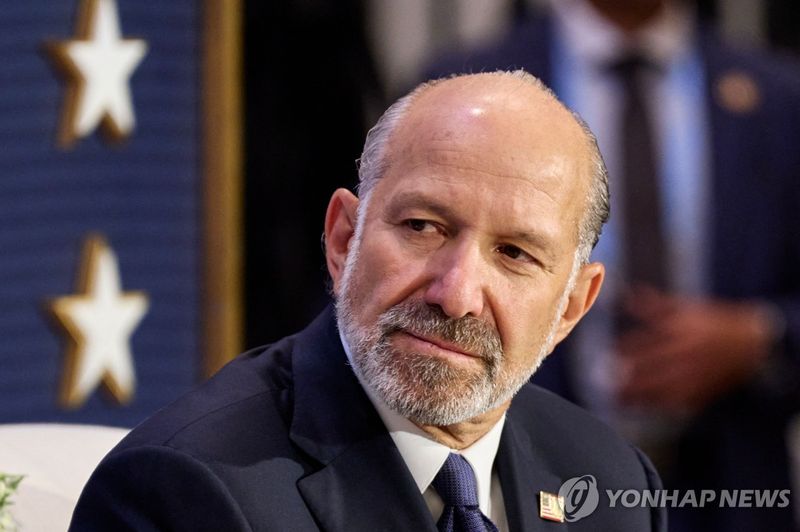
At an event with AI industry leaders on the 2nd (local time), U.S. Commerce Secretary Howard Lutnick directly pushed back against negative public sentiment surrounding data centers, saying they would “bring prosperity to local communities.”
“Data centers will not raise electricity costs in the areas where they are located. They will actually lower them,” Lutnick said. He added, “They will bring prosperity to local communities because they will generate enormous tax revenue.” In response to criticism that data centers consume vast amounts of water, he cited other water-intensive industries, including almond farming and cattle ranching.
He even claimed that America’s rivals were behind the negative sentiment toward data centers. “Data centers are being unfairly portrayed because our adversaries want to slow the pace of America’s development,” Lutnick said, describing opposition to data centers as “propaganda by our adversaries.”
The AI industry also joined the defense. Tom Brown, a co-founder of Anthropic, said he “really liked” a post by President Trump that recently strongly defended data centers. In a conversation with Lutnick, Brown emphasized that “data centers are a tremendous source of prosperity” and “create enormous numbers of jobs and lower taxes.” He also argued, “When you look at the way we design data centers, they actually end up supplying more power to the grid.”
Trump recently entered the public debate directly as opposition from local communities intensified. In a post on Truth Social on the 31st of last month, Trump claimed that communities that do not want data centers “want to remain backward and poor.” He stressed that accepting data centers would mean they would “be successful and wealthy, taxes will be much lower, and jobs will be created everywhere.”
Trump compared data centers to a “Golden Goose” and linked the issue to the AI power struggle with China. “If we kill the Golden Goose, the responsibility will be yours,” he said. “China could not be happier about this opposition to data centers.”
The Trump administration’s repeated efforts to defend data centers reflect the fact that local opposition to expanding AI infrastructure has grown too strong to ignore. Across the United States, concerns are spreading that data centers’ massive consumption of electricity and water could raise existing residents’ utility bills and place additional strain on the power grid.
Some business leaders have acknowledged the problem as well. Greg Abel, CEO of Berkshire Hathaway, said, “There is much more opposition emerging in communities across the United States.” Although he said he was willing to work with hyperscalers operating large-scale data centers, he added a condition: “provided it has no impact whatsoever on the electricity bills of other customers.”
Josh Shapiro, governor of Pennsylvania, also said, “Far too many data center developers do not care about local communities.” He stated that he did not want data center projects to move forward while ignoring residents’ interests.
U.S. Treasury Secretary Scott Bessent also placed some responsibility for worsening public sentiment around data centers on the AI industry. After a meeting of Group of Twenty (G20) finance ministers and central bank governors in Asheville, North Carolina, on the 1st, he said discussions surrounding AI and data centers needed a “big reset.”
Bessent criticized AI companies, saying, “Whether they are data center builders or AI laboratories, AI companies have done a terrible job explaining themselves to the American people.” He stressed that companies must convince the public that the benefits of AI development “will not flow only to a small number of people,” but will spread throughout society.
Lutnick agreed with Bessent’s criticism that day. “It is a good idea for the companies building data centers to step forward themselves and explain these points clearly,” he said.
Jim Prosser, a communications strategist who has worked with Google and Twitter, told Axios, “The controversy surrounding data centers is structural and substantive, so it requires solutions suited to those problems.” He added, “This is not an issue that can be resolved through persuasion or explanation alone.”
[email protected] Correspondent Lee Byung-chul Reporter