First Provincial Government Questioning Focuses on Jeju Second Airport... 4 out of 8 Ask About 'Timing and Method of Decision'
- Input
- 2026-09-03 09:11:25
- Updated
- 2026-09-03 09:11:25
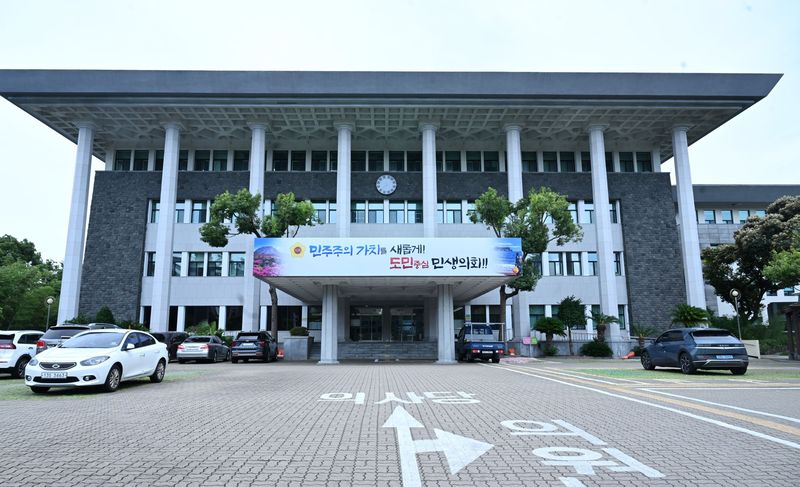
[Financial News Jeju = Reporter Jeong Yong-bok] The first administrative questioning of Jeju Governor Wi Seong-gon of the 9th popular election is focused on the Jeju Second Airport. With four out of the eight Jeju Provincial Assembly members taking the lead in questioning—half of them—directly bringing up the Jeju Second Airport, the biggest points of contention have emerged as 'when the decision will be made' and 'how the opinions of the residents will be verified.'
According to the Jeju Special Self-Governing Provincial Council on the 3rd, at the 2nd plenary session of the 454th 1st regular session at 10 a.m. on that day, eight members will ask a total of 48 questions regarding provincial administration to Governor Wi Seong-gon.
Assembly members Jeong Da-woon, Kim Gyeong-ae, Yang Gyeong-ho, Yang Hong-sik, and Ko Seok-jun will proceed via a Q&A format, while Assembly members Kim Hyo, Jang Jeong-hun, and Kang Dong-woo will proceed via a collective question and answer method.
The focus of the questioning is the Jeju Second Airport. Assemblywoman Kim Kyung-ae asks whether a concrete plan regarding conflict management for the Jeju Second Airport can be presented by the first half of 2027 in conjunction with the 100 major tasks of the 9th popular election transition committee. She also asks whether Jeju Province will separately analyze the issue of restrictions on property rights resulting from the long-term designation of the land transaction permit zone and the economic ripple effects of the Jeju Second Airport construction.
Assemblyman Yang Gyeong-ho directly questions the timing and method of the decision. The core issues are whether the Jeju Second Airport issue will be decided by the first half of next year, and whether a referendum or public deliberation will be considered to ascertain the opinions of provincial residents. The gist of his inquiry also includes the methods of public deliberation for other social conflicts, such as the Shin Kori nuclear power plant and the National Pension Service (NPS).
Assemblyman Yang Hong-sik questions the extent of authority to be granted to the tentatively named 'Second Airport Public Conflict Mediation Council' if it is established. He also requests the Governor's judgment on whether it is appropriate for Jeju Province to conduct separate public deliberation procedures, such as resident referendums or opinion polls, regarding a national project promoted by the state. Assemblyman Kim Hyo calls for a policy decision from the Governor to end the conflict over the Jeju Second Airport.
A notable feature is that questions focused more on the decision deadline and procedures than on reaffirming support for or opposition to the Jeju Second Airport. During the last local election campaign, Governor Wi stated his position that while he supports the Jeju Second Airport, he would make a decision after gathering the opinions of provincial residents and would consider various methods, such as referendums and public deliberation surveys.
Therefore, attention is focused on whether the specific timing and method of the 'provincial residents' decision' will become one step clearer in today's response.
The fiscal situation is also a major subject of scrutiny in the first provincial administration questioning of the 9th popular election term. Assemblyman Yang Gyeong-ho diagnoses the fiscal situation based on Jeju Province's revenue and expenditure, the use of the Integrated Fiscal Stabilization Fund, and the status of debt, and asks about the basic principles for formulating the 2027 main budget and measures for fiscal innovation. Assemblyman Go Seok-jun also questions how the provincial administration assesses the current scale and ratio of Jeju Province's debt, and to what extent it plans to manage it in the future.
With the compilation of the 2027 main budget approaching, in which the new provincial administration's pledges and new projects will be fully reflected, attention is focused on how to balance policy expansion with fiscal soundness.
In the transportation sector, Bus Rapid Transit (BRT) and the shortage of airline seats are both under scrutiny. Assembly members Kim Kyung-ae, Yang Kyung-ho, and Yang Hong-sik will focus their questioning on whether to continue promoting BRT, island-style bus stops and double-door buses, route reorganization, and plans for deliberative public consultation. Regarding the decline in airline seats, the key issues are measures to expand supply on Jeju routes and the performance of the task force on aviation supply and demand response.
In the energy sector, the economic viability of Green Hydrogen and follow-up measures for distributed energy specialized zones are under scrutiny. Representative Yang Kyung-ho inquires about Green Hydrogen production costs and price competitiveness, the controversy surrounding the reverse import of gray hydrogen, and plans to expand the hydrogen vehicle and industrial ecosystem, while Representative Ko Seok-jun examines measures to connect distributed energy special zones to actual power trading and industrial growth.
The new Jeju Port and long-stalled development projects will also be brought before the podium for questioning. Assemblyman Koh Seok-jun will examine the financing of the new Jeju Port, its conversion to a state-managed trade port, the timing of the application for a preliminary feasibility study, and the possibility of completion by 2035. Assemblyman Kim Hyo will ask about the direction for the normalization of the Yerae Recreational Housing Complex and the Jeju Healthcare Town, as well as cooperation plans between Jeju Province and the Jeju International Free City Development Center (JDC).
The Artificial Intelligence Transformation (AX), the growth strategy of the 9th popular election administration, is being tested from the perspective of industry and jobs. Councilor Jang Jeong-hun requests measures for application to primary industries such as agriculture, while Councilor Kang Dong-woo demands a Jeju-style AX roadmap and plans for training specialized personnel and creating jobs. In light of recent missing person and crisis incidents, Councilor Jeong Da-woon asks for a plan to establish a Jeju-style safety net that combines inter-agency consultative bodies, integrated manuals, CCTV, and joint public-private patrols.
Issues regarding low birth rates, super-aging, and the primary industry were also included. Assemblywoman Kim Kyung-ae will address health management for the elderly and measures to prevent the closure of daycare centers, while Assemblywoman Yang Kyung-ho will inquire about the effectiveness of low birth rate policies and the necessity of a dedicated organization for population policy. Assemblywomen Jang Jeong-hoon and Kang Dong-woo will focus on examining agricultural management costs, agricultural water resources, and responses to climate change, and will also raise local issues such as easing entry barriers for new female divers, the passenger ferry service between Aewol Port and Jindo Port, and the Gimnyeong public housing district.
The key to the provincial administration questioning on this day lies not in the quantity of the 48 questions, but in how specifically Governor Wi Seong-gon answers regarding 'when, with what resources, and through what procedures' he will implement policies. Rather than repeating general positions, he must present deadlines, resources, and procedures to gauge the execution capability of the 9th popularly elected administration.
In particular, the timing of the decision on the Jeju Second Airport, the method of gathering public opinion, the fiscal management policy for 2027, the schedule for public deliberation on BRT, supplementary measures for the economic feasibility of Green Hydrogen, and the timing of the application for the preliminary feasibility study of the new Jeju Port are key answers that will determine the speed and priorities of future provincial administration. This is why this first provincial administration questioning serves as a test case to transform the 'plans' of major pending issues of the 9th popular election into 'implementation schedules.'
[email protected] Jeong Yong-bok Reporter