The Stock Retreats Despite the Long-Awaited U.S. Order: What Is the Key to a Turnaround for Doosan Fuel Cell?
- Input
- 2026-09-03 08:58:24
- Updated
- 2026-09-03 08:58:24
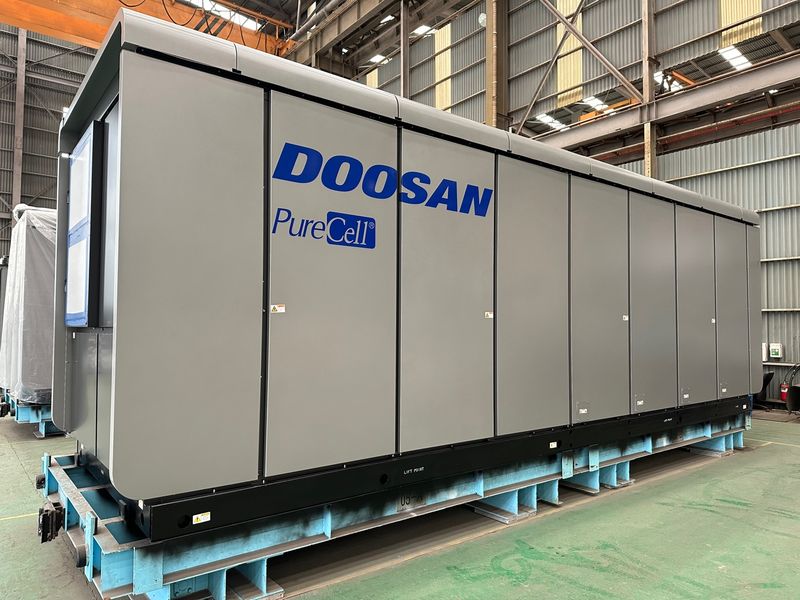
[Financial News] DS Investment & Securities said on the 3rd that Doosan Fuel Cell had laid the foundation for medium- to long-term growth after confirming its entry into the U.S. market. It maintained its “Buy” rating and target price of 47,000 won.
Joo Won Ahn, a researcher at DS Investment & Securities, said, “Following the export of solid oxide fuel cell (SOFC) stacks in early August, the company also secured a U.S. order for phosphoric acid fuel cells (PAFCs). Doosan Fuel Cell had operated its fuel cell business only in South Korea, but its overseas expansion has now been confirmed. Together with Bloom Energy, it has demonstrated its competitiveness as a fuel cell provider.”
The U.S. order is considered significant in terms of scale as well. The supply contract, worth approximately 500 billion won, is for data centers, with deliveries scheduled to begin in March next year. DS Investment & Securities estimated the operating margin at 6% to 7% and analyzed that the supply price was also higher than in South Korea.
The order is not expected to immediately strain production capacity. Doosan Fuel Cell’s PAFC production capacity is expected to reach 350 MW by the end of this year, equivalent to more than 1 trillion won in value. However, analysts said the company may need to expand its production facilities if additional orders of a similar scale continue to come from the United States. Ahn explained, “This was a contract that was essential for medium- to long-term growth as the domestic fuel cell market contracts. Given its large scale, it is clearly a meaningful achievement.”
Despite the U.S. order, the stock remained weak. As moves to restrict data center construction in the United States have spread due to rising electricity rates, environmental pollution and noise, the stock fell 13% despite the overseas order news.
There is also speculation that data center permitting regulations could increase fuel cell demand over the long term. Data center operators may expand “onsite power generation,” producing electricity themselves to reduce permitting risks. In that process, fuel cells could emerge as an alternative.
Ahn said, “Ultimately, for the stock to rebound, there must either be visible progress toward easing data center regulations in the United States or additional orders that can support such a recovery.”
[email protected] Choi Doo-sun Reporter