"I will not hide or cover up wrongdoing"... Acting Commissioner General Kim Jongcheol's first statement is 'police reform'
- Input
- 2026-09-03 09:00:00
- Updated
- 2026-09-03 09:00:00
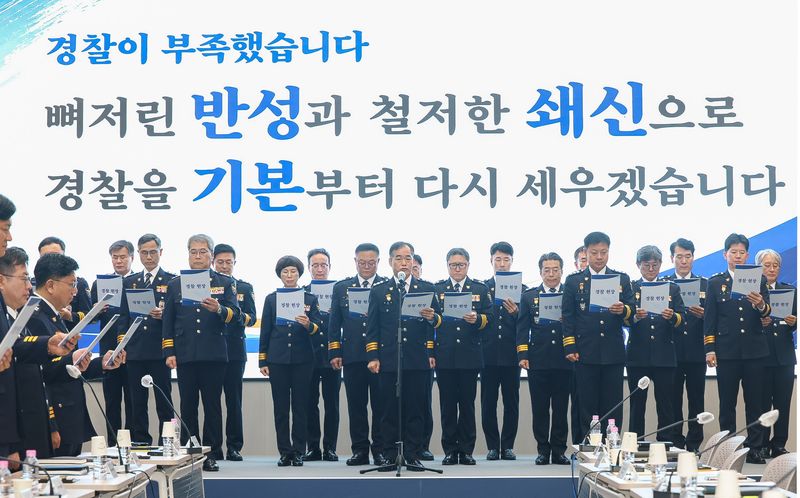
[Financial News] On his first day in office, Kim Jongcheol, the newly appointed Acting Commissioner General of the Korean National Police Agency, apologized for the Jang Yoon-gi case and the cover-up of the disappearance in Jeju, and promised a fundamental overhaul of the police organization. He decided to overhaul the entire process, from the reception of missing person cases to search, investigation, management, and supervision, while also forming a separate 'Police Reform Task Force' to re-examine the organization, systems, and field work methods.
Acting Commissioner Kim Jongcheol presided over a meeting of the national police leadership at the Korean National Police Agency in Seodaemun-gu, Seoul, at 9 a.m. on the 3rd, attended by heads of provincial and city police agencies. He stated, "In the recent Jang Yoon-gi case and the Jeju disappearance cover-up case, the police, who are supposed to protect the lives and safety of the people, failed to fulfill their proper roles and failed to respond properly to the desperate pleas of those anxiously waiting for the fate of their precious family members."
He continued, "The public is asking, 'Can we really trust the police?'" adding, "As the Acting Commissioner General of the Korean National Police Agency, I will not evade this question or make excuses."
Acting Commissioner Kim Jongcheol announced a policy to look beyond holding individual police officers accountable and into the structural causes, including the management and supervision system. He emphasized, "I will thoroughly identify and rectify the causes one by one, including how such incidents were possible in the field, why the management and supervision system failed to function properly, and why the public's voices toward the police were ignored."
Accordingly, the police will first comprehensively overhaul the response system for missing person cases, which has recently been at the center of controversy. To prevent cases from being mishandled or neglected, they plan to review and improve the entire process, from initial response to reporting, command, closure, and final responsibility.
They will also promptly conduct inspections of ongoing nationwide missing persons cases. The policy is to hold everyone strictly accountable, regardless of position or rank, if inappropriate work practices are confirmed.
He is also embarking on reform efforts targeting the entire police organization. Acting Commissioner Kim Jongcheol plans to launch the 'Police Reform Task Force' at the Korean National Police Agency to re-examine crime response methods, systemic and structural issues, police control, and organizational culture from scratch.
He also presented preparations for the reform of the criminal justice system, which is just one month away, as a major task. Acting Commissioner Kim Jongcheol promised, "We will establish institutional safeguards for overall police investigations to dispel concerns about the concealment of cases and inadequate or unfair investigations, and to enhance investigative capabilities and expertise."
At the meeting, major agenda items discussed included measures to overhaul missing persons investigations, follow-up measures to the revised Criminal Procedure Act of the Republic of Korea, and plans to promote police reform. The police set the slogan for the meeting as, "We will rebuild the police from the ground up through painful self-reflection and thorough reform."
Acting Commissioner Kim Jongcheol emphasized, "Without trust, nothing stands; if the police lose the trust of the people, there is no reason for their existence," adding, "I will not stop at mere rhetoric but will certainly demonstrate this through change and action."
Acting Commissioner Kim Jongcheol visited Jeju Province this afternoon for his first field visit since taking office. Immediately after arriving in Jeju Province, he visited the funeral parlor of a man in his 60s who had gone missing and subsequently died to offer condolences to the bereaved family. He then visited the site in Hallim-eup, Jeju-si, where the body of Ms. Jang, a woman in her 30s who had gone missing, was found, and received a briefing on current issues at the Jeju Provincial Police Agency.
Acting Commissioner Kim Jongcheol held a press conference after concluding the briefing on current issues and stated, "I promised the bereaved families that I would definitely set the police straight so that such an incident never happens again." Regarding Ms. Jang's case, he said, "We are investigating while keeping all possibilities open," and promised, "Once the investigation results are released, I will reveal them to the public and the media exactly as they are, without any omissions or additions."
Meanwhile, the Korean National Police Agency has drawn up a budget of 14.9832 trillion won for next year, a 5.1% increase from this year, to respond to crimes affecting public welfare and transnational offenses such as drug trafficking and phishing, protect crime victims, and strengthen on-site response capabilities. The budget for next year will be primarily invested in enhancing response capabilities against transnational and public welfare crimes. The budget to support the entire process of crackdown, detection, and investigation of drug-related crimes has been drastically increased by approximately seven times, from 980 million won this year to 6.83 billion won next year.
[email protected] Kim Ye-ji Reporter