"Cut lending, but increase loans to mid- and low-credit borrowers"—Internet-only banks caught in a squeeze
- Input
- 2026-09-03 17:39:38
- Updated
- 2026-09-03 17:39:38
[Financial News] Internet-only banks have fallen into a lending dilemma. Credit lending to high-credit borrowers increased during the stock-market boom in the first half of the year, causing the share of loans to mid- and low-credit borrowers to decline across the board. In the second half, the banks must manage overall household-loan growth while also meeting the government’s strengthened target for supplying loans to mid- and low-credit borrowers.
Share of mid- and low-credit borrowers stalls amid surge in overdraft accounts
According to financial-sector sources on the 3rd, the share of credit loans extended to mid- and low-credit borrowers by KakaoBank, K Bank, and Toss Bank fell in the second quarter from the previous quarter.
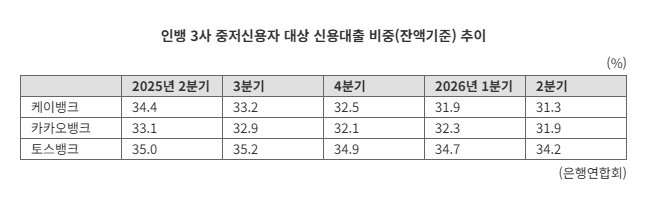
In the second quarter, the shares of credit loans to mid- and low-credit borrowers, based on outstanding balances, stood at 31.9% for KakaoBank, 31.3% for K Bank, and 34.2% for Toss Bank. All three exceeded the 30% target, but each declined by 0.4 to 0.6 percentage points from the previous quarter.
The share of loans to mid- and low-credit borrowers at the three internet-only banks has been declining steadily since last year. In the second quarter of last year, the figures were 34.4% for K Bank, 33.1% for KakaoBank, and 35.0% for Toss Bank.
The share of credit loans to mid- and low-credit borrowers refers to the proportion of a bank’s total outstanding household credit loans accounted for by personal credit loans and personal-business-owner credit loans to borrowers in the bottom 50% of credit scores according to Korea Credit Bureau (KCB), as well as outstanding loans exceeding the guarantee limit among loans under the low-income finance program.
The decline in the share of loans to mid- and low-credit borrowers in the second quarter was driven by an increase in credit lending to high-credit borrowers. Financial institutions explained that demand for investment funds grew amid this year’s stock-market boom, leading high-credit borrowers to use overdraft accounts more frequently.
An industry official at an internet-only bank explained, "As high-credit borrowers took out more credit loans, including overdraft facilities, the overall volume of household credit loans expanded. As the denominator in the calculation grew, it became difficult to exceed the target by a wide margin, no matter how much the outstanding balance of loans to mid- and low-credit borrowers increased."
An analysis of disclosures by the Korea Federation of Banks (KFB) found that the monthly credit scores of borrowers using overdraft accounts at the three internet-only banks, based on simple averages, were 926 in April, 949 in May, and 924 in June. Last month, the average was 907, also above 900.
Managing overall lending while meeting the mid- and low-credit borrower target
The problem is that the burden of inclusive finance has grown further this year as the target for the share of newly originated credit loans extended to mid- and low-credit borrowers was raised. Until last year, the three internet-only banks were required to provide at least 30% of the credit loans newly originated each quarter to mid- and low-credit borrowers. Starting this year, the target has risen to 32% and is scheduled to increase gradually to 35% by 2028. This means that, in 2025, roughly one-third of the credit loans newly issued each quarter must go to mid- and low-credit borrowers.
The internet-only banks face a triple challenge: growing their lending business, meeting inclusive-finance targets, and managing financial soundness.
On top of that, the burden of managing lending will increase in the second half as the banks work to meet their annual household-loan growth targets. They must control the pace of overall credit-lending growth while continuing to supply loans to mid- and low-credit borrowers within limited capacity for new lending. It is also difficult to expand such lending sharply over a short period simply to meet the target. Excessive growth could worsen delinquency rates and other soundness indicators, while a conservative approach could make it difficult to achieve the policy target—leaving the banks caught in a squeeze.
In fact, the ratio of substandard-and-below household loans—classified as nonperforming loans (NPLs)—has been rising at all three internet-only banks. K Bank’s ratio increased from 0.58% at the end of last year to 0.61% in the first half of this year. Over the same period, KakaoBank’s ratio rose from 0.52% to 0.53%, while Toss Bank’s climbed from 0.74% to 0.83%. Substandard-and-below loans are nonperforming loans overdue for at least three months and are a key indicator of a bank’s asset quality.
An internet-only bank official said, "Although the target for managing overall household-loan growth has been eased, it is true that there is not much room to allocate additional capacity to credit loans. Within limited lending capacity, the banks must manage both the supply target for mid- and low-credit borrowers and financial soundness, so the burden of managing their lending portfolios is bound to increase."
[email protected] Lee Hyun-jung Reporter