Ahead of Review of the 162 Trillion-Won Future Response Fund, Ruling and Opposition Parties Clash Sharply Over 30% Increase
- Input
- 2026-09-02 19:05:52
- Updated
- 2026-09-02 19:05:52
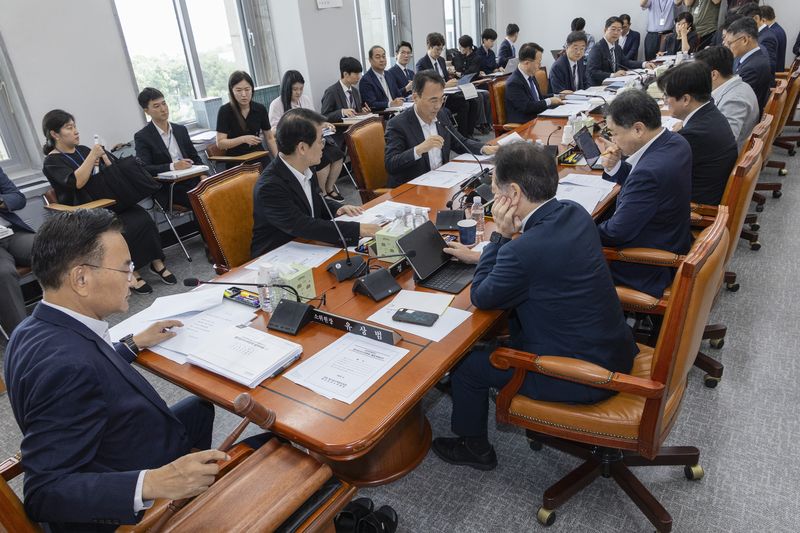
According to a comprehensive review of reporting by Financial News on the 2nd, the ruling and opposition parties have clearly differing positions on the amendment to the National Finance Act for establishing the Future Response Fund, which the Ministry of Planning and Budget announced for legislation last month. A key issue is a flexibility provision that would allow the Future Response Fund to change expenditures for major items by up to 30% without submitting an amended fund-management plan to the National Assembly. The provision is directly linked to the National Assembly’s inherent authority to control the government budget.
The government appears to have classified the Future Response Fund as a financial fund. Funds currently established in South Korea are broadly divided into two categories: financial funds and project funds. In general, financial funds are allowed to make autonomous adjustments within 30%, while project funds are allowed to do so within 20%. In other words, financial funds have greater flexibility than project funds.
The ruling Democratic Party of Korea maintains that the Future Response Fund’s flexibility is not significantly different from that of other existing funds. In effect, the party appears to be backing the flexibility provision prepared by the government. A Democratic Party official explained, “Under the current system, financial funds are allowed to make autonomous adjustments within a 30% limit. The discretion given to other funds has also been operated that way, and the model for the Future Response Fund was created using the 30% standard derived from that practice.”
The official added, “This is a matter of consistency in the standards. The time has come for the government to explain to the opposition party whether the Future Response Fund has the same nature as a financial fund,” but also said, “This is not an issue that requires that much deliberation.”
Another Democratic Party official said, “It will be adjusted during the review of the amendment,” while stating, “In general, 20% to 30% flexibility also exists in existing funds.”
Analysts say the reason the government and ruling party are emphasizing flexibility rather than placing the Future Response Fund under the National Assembly’s control is that the fund is designed to prioritize speed. Given the characteristics of rapidly changing future industries such as Artificial Intelligence (AI) and semiconductors, as well as the nationwide crisis of regional extinction, the argument is that the fund must be given flexibility to enable swift execution and an agile government response.
The opposition People Power Party, however, opposes not only the 30% flexibility provision in the amendment to the National Finance Act for establishing the Future Response Fund but also the creation of the fund itself. It criticizes the provision as a procedural trick that would effectively circumvent the National Assembly’s inherent authority to control the budget. The party also points out that the fund’s purpose itself is unclear.
A People Power Party official said, “The items for spending surplus tax revenue are already stipulated under the National Finance Act. The money is to be distributed to local governments or used to repay government bonds. But the Future Response Fund would create a second accounting system with an unclear purpose, and on top of that, the government intends to simplify the procedures.”
The official continued, “The Democratic Party is staking its political life on establishing the Future Response Fund. It is trying to set up another ‘budget pot’ worth roughly 162 trillion won,” and argued, “Even in the case of a supplementary budget, passing 1 trillion won requires a government policy speech, approval by the standing committee and the Special Committee on Budget and Accounts of the National Assembly, and passage by the plenary session. Wouldn’t the Future Response Fund effectively allow those procedures to be bypassed?”
In fact, South Korea’s national debt is projected to approach 1,700 trillion won by 2030. Fiscal spending is also expected to reach 1,000 trillion won that year. As a result, some argue that excess tax revenue should first be used to repay government bonds rather than as a source of domestic investment. Based on this analysis, the People Power Party is expected to argue against establishing the fund during future deliberations on the amendment.
[email protected] Kim Hyeong-gu Reporter