The Paradox Brought About by the High-tech Industry Boom... Why Are Young People Finding No Places to Work? [Editorial Office News Analysis]
- Input
- 2026-09-02 19:05:26
- Updated
- 2026-09-02 19:05:26
■ Two Ghosts Haunting the Labor Market
Two specters are haunting Korea's employment market. The first is "jobless growth." With Samsung Electronics and SK Hynix successively breaking quarterly earnings records this year, it is predicted that the "era of 300 trillion won in operating profit" is on the horizon. Nationally, the growth rate is also on an upward curve. Major domestic and international institutions that have raised their forecasts for Korea's economic growth to the 3% range may raise them further. This represents a complete reversal of the situation, especially when recalling the talk of zero growth just a few years ago.
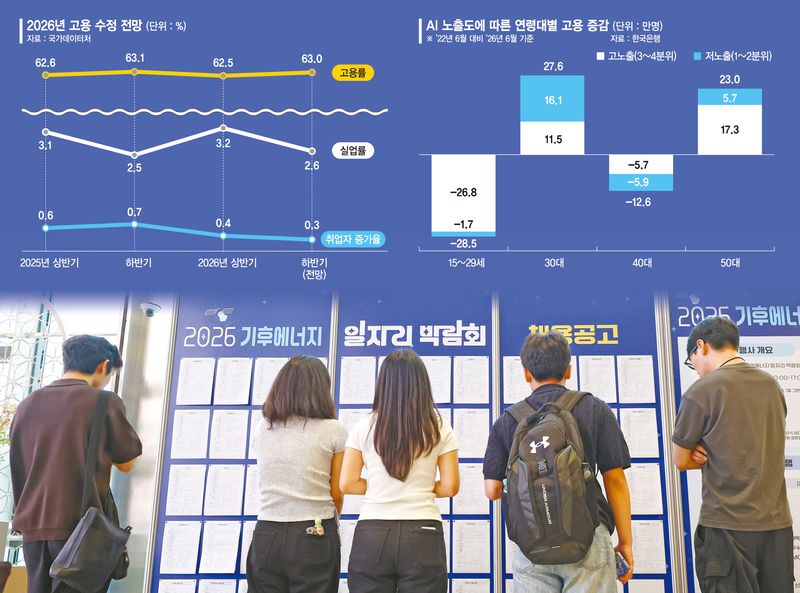
At this point, one would expect warmth to spread through the job market. However, the actual employment outlook has moved in the exact opposite direction. The Korea Labor Institute’s recently published report, "Assessment of the Labor Market in the First Half of 2026 and Outlook for the Second Half," projected that the number of employed people would increase by 103,000 in the second half of the year. This is a significant decrease compared to last year's increase of 193,000. Furthermore, it represents a downward revision of 50% from the forecast of 210,000 released by the institute at the end of last year. The current reality of the labor market is that while growth forecasts are on an exceptionally upward curve, the employment outlook has actually been cut in half.
The concept that objectively reveals this phenomenon is employment elasticity. Employment elasticity is measured by the ratio of the increase in the number of employed people to the economic growth rate. According to the economic outlook released by the Korea Development Institute (KDI) last May, this year's employment elasticity is estimated at 0.24. Historically, employment elasticity was recorded at 0.13 in 2018, 1.03 in 2022, 0.27 in 2024, and 0.64 in 2025. Compared to these trends, this year's employment elasticity can be seen as the lowest level in eight years since the introduction of the 52-hour workweek in 2018. "Jobless growth," where jobs do not increase in tandem with the scale of economic growth as industries become more capital- and technology-intensive, is occurring in our country.
Along with jobless growth occurring across the labor market, the employment crisis concentrated in youth jobs is even more shocking. According to an issue note released by the Bank of Korea last month, jobs for young people (aged 15–29) decreased by 285,000 over the past four years. Of these, 268,000—or 94%—disappeared in sectors heavily exposed to AI. During the same period, jobs for those in their 50s increased by 230,000, with 173,000 (75.2%) of these increases occurring in sectors highly exposed to AI. This suggests that as the adoption of AI in the workplace spreads, jobs for the youth are shrinking, while the workload for seniors has increased because tasks requiring an understanding of organizational nature and context are difficult for AI to replace. This phenomenon is explained as "seniority-biased technological change." It is easy to assume that when new technology is introduced, the younger generation moves ahead while the older generation is pushed aside. However, in the early stages of the spread of generative AI, a paradox is unfolding where junior employment is decreasing, while senior employment is being maintained or increasing.
■ The youth employment crisis leads to mutual destruction for all
Although the structural crisis in the employment market is reaching its peak, no progress has been made in finding a solution. This is because while technological advancements and demographic shifts triggering changes in the job market are accelerating, Korea's labor market issues remain stuck in the past. Professor Park Ji-soon of Korea University Law School analyzed this distorted reality of the Korean labor market by dividing historical changes into four stages. Labor 1.0 was characterized by survival and protection during the nascent stages of the Factory Act; Labor 2.0 was a negotiation centered on collective bargaining and strikes; and Labor 3.0 was an era of autonomy and participation where workers take part in management decision-making. The Labor 4.0 we are currently facing is a stage where we must address coexistence with AI. The problem is that Korea handles labor issues by relying entirely on the tools of collective bargaining and strikes between employers and workers. Professor Park pointed out, "There was a time when the negotiation tools available during the Labor 2.0 phase were effective," adding, "However, it is failing to function as a substantive body for discussing significant changes, such as the introduction of AI, in advance. Since the problems of Labor 4.0 are being attempted to be solved using Labor 2.0 tools, only confrontation and struggle are repeated, and the actual direction does not change." This diagnosis suggests that the negotiation issues and settlement methods between labor and management remain stuck in a pre-AI environment, making it impossible to cope with the current major changes.
Of course, labor unions can use strikes and other measures to push through their demands in the face of labor market changes triggered by the new technology of AI. However, the reality is that this does not go beyond protecting the jobs of existing union members to safeguarding the jobs of workers at small and medium-sized partner companies and young people who are about to enter the workforce. Similarly, for companies, using AI instead of hiring new graduates is a rational choice in terms of work efficiency and labor cost reduction.
The issue of youth unemployment, left neglected in the blind spots of the labor system, is bound to accelerate. However, there are serious concerns that the choices made by large corporate labor unions, which are becoming increasingly entrenched in the AI era, and by companies pursuing organizational efficiency will ultimately cause a decline in national competitiveness. If the industrial sector fails to recruit young people capable of accumulating work experience and know-how for the next decade, the nation will be unable to secure a skilled workforce. This effectively severs the talent pipeline that will lead the nation's future industries. While AI automation is currently advantageous for efficiency, warnings are emerging that it will remain merely "so-so automation"—failing to significantly boost productivity and simply replacing workers. We may end up paying the price for neglecting talent development in a desperate pursuit of short-term profits.
■ When disruptive labor innovation is implemented
The youth employment crisis is not merely a problem for one generation, but leads to the mutual destruction of our society. To establish a virtuous cycle ecosystem for securing a skilled workforce, merely overhauling existing systems is insufficient. Innovation is needed to restructure systems stuck in Labor 2.0 to align with Labor 4.0. We must identify and examine ideas that disruptively innovate existing systems.
In this regard, the role of private companies is being raised. Providing regular full-time jobs within the private sector is the standard approach. However, it is not realistic for the government to intervene and demand job creation from the private sector. Instead, it is more rational to develop proven private education models into national infrastructure. A prime example cited as a success model is the Samsung Youth Software & AI Academy (SSAFY), established by Samsung in 2018. According to Samsung Electronics, the cumulative number of graduates who have completed the course up to the 13th cohort has reached approximately 11,000. The cumulative employment rate for graduates is about 85%, with the number of companies employing them totaling over 2,600. The education is entirely free, and educational support funds are also provided. This success is attributed to the provision of high-quality educational programs, which are superior to the simple administrative support jobs offered to youth in public institutions. The proposal is to implement such dynamic education programs within major corporations. The plan involves spreading the development of industry-leading conglomerates—such as semiconductor companies focusing on AI and semiconductor design, automotive companies on physical AI and mobility, and the financial sector on AI fintech—to create training programs tailored to their respective fields. The government would provide incentives for private companies to offer such training. Professor Park Ji-soon emphasized, "Companies need training that goes beyond the stage of providing basic education merely as part of social contribution programs," adding, "If Samsung's successful model is extended to other industries, it will not only foster talent but also increase the likelihood of actual employment."
There are also suggestions that it is necessary to keep open the possibility of operating the current fixed-term employment system flexibly. Professor Park pointed out the limitations of the current system, stating, "The recruitment market for experienced workers typically requires 3 to 5 years of experience, but fixed-term employment is capped at 2 years, forcing young people to move on to another job before they can accumulate sufficient experience." However, Professor Park also emphasized the need for caution regarding the potential side effects of applying the 2-year fixed-term limit flexibly. Professor Jeong Heung-jun of Seoul National University of Science and Technology also expressed concern that indiscriminately relaxing the current 2-year fixed-term limit could disadvantage existing workers.
There are also arguments that the status of social dialogue bodies currently in operation, such as the Economic, Social and Labor Council (ESLC), needs to be elevated. Professor Jeong pointed out, "Since the ESLC is an organization directly under the President, it faces a limitation where discussions are active and gain momentum in the early stages of an administration, but the momentum drops sharply once the term passes the midpoint." Accordingly, he suggests that it is time to consider measures to secure an independent status, similar to that of the National Human Rights Commission or the Anti-Corruption and Civil Rights Commission.
There are arguments that the retirement age extension system, currently being pushed for introduction within the year, should also be viewed in conjunction with youth employment. The point is that the situation must not devolve into a zero-sum scenario where jobs for middle-aged and older workers increase while the youth suffer disadvantages.
To make Jevons' paradox apply to the labor market, we must confront the issue of youth employment head-on. Now is the time to push forward with youth policies to the point where they may seem excessive. We are at a crossroads between mutual destruction and coexistence.