Lee Hyoung-il: “Even if the Tax Gap for Non-Resident One-Home Owners Is Eased, a Distinction Should Remain” [Real Estate Tax Reform Faces Headwinds]
- Input
- 2026-09-02 11:40:00
- Updated
- 2026-09-02 11:40:00
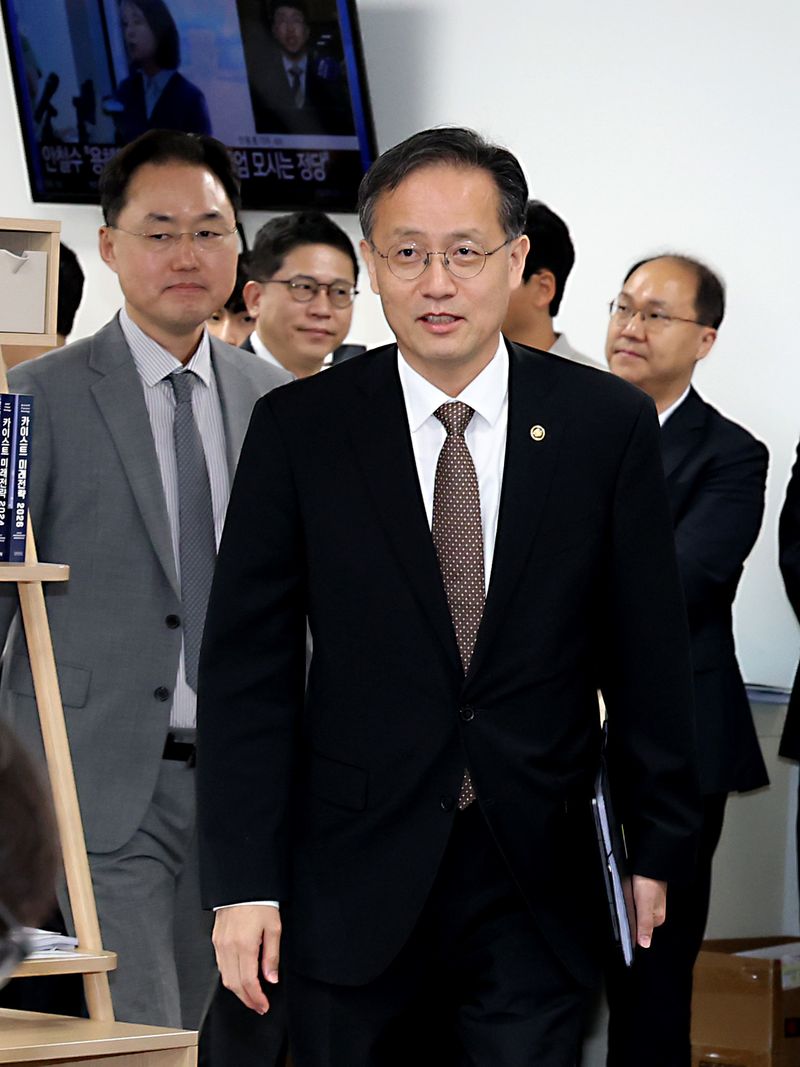
Meeting reporters at Government Complex Sejong on the 2nd, Lee said, "To create a housing market centered on owner-occupiers, we concluded that excessive tax support needed to be reduced to some extent and announced the measures as part of the normalization process. Among the revisions, the market judged that the difference between owner-occupiers and non-resident owners was excessive. We eased the differential treatment to reflect that view, but we believe some distinction should remain, so we maintained a distinction."
Lee placed the greatest emphasis on increasing supply as a means of stabilizing the real estate market.
"Housing supply must increase for the real estate market to stabilize. That is the fundamental answer," Lee said. He added, "If we can increase housing supply, there is no reason to rule out tax measures."
Lee nevertheless indicated that the plan could be revised during deliberations in the National Assembly.
"While maintaining the broad policy framework of owner-occupier-focused housing as much as possible, we are prepared to continue making revisions if reasonable points are raised," Lee said. "When the bill reaches the National Assembly, we are willing to accept valid points raised during the deliberation process."
Lee’s remarks were interpreted as leaving open the possibility of further revisions during the National Assembly’s deliberations, following the government’s decision the previous day to ease the difference in the comprehensive real estate tax’s basic deduction between resident and non-resident one-home owners in its finalized tax reform plan for next year.
Lee also emphasized the need for the Ministry of Economy and Finance to fully perform its role, signaling plans to strengthen its function as the economic control tower.
In particular, he plans to significantly strengthen the Council of Economic Ministers’ prior review and coordination functions and establish ad hoc meetings on urgent economic issues, allowing him to focus on his role as the head of economic policy.
"The Ministry of Economy and Finance must truly be the Ministry of Economy and Finance," Lee emphasized. "That is because it performs the function of the deputy prime minister for economic affairs. The point is to exercise leadership in important decision-making."
Lee’s remarks are understood to reflect awareness of criticism that, under the Lee Jae-myung administration, the center of economic policy coordination has shifted toward Cheong Wa Dae.
However, the plan is not for the Ministry of Economy and Finance to hold all authority and coordinate everything on its own. Instead, it aims to improve the speed and momentum of policymaking by strengthening cooperation among ministries.
"We will significantly strengthen the Council of Economic Ministers’ prior review and coordination functions so that major economic policies can be closely coordinated and reviewed with the ministries and Cheong Wa Dae before being submitted to the Cabinet or announced publicly," Lee explained. "For key issues involving sharp disagreements among ministries and significant repercussions, we will establish ad hoc meetings on urgent economic issues. Relevant ministers and Cheong Wa Dae officials will meet frequently in small groups by issue to coordinate their views more closely."
Lee also indicated that he would work closely with the new head of the policy office at Cheong Wa Dae once appointed. "The Cabinet needs to respond nimbly first. When issues arise among major ministries or matters have significant repercussions, the relevant ministers and senior officials will come in advance to coordinate," Lee said. "Once a new policy chief is appointed at Cheong Wa Dae, we will work closely together."
[email protected] Reporters Seo Young-jun and Kim Chan-mi