Inflation Rears Amid Fiscal Deficit... Government Bond Yields in U.S., Japan, and Others Surge [Turbulent Bond Market]
- Input
- 2026-09-02 19:05:16
- Updated
- 2026-09-02 19:05:16
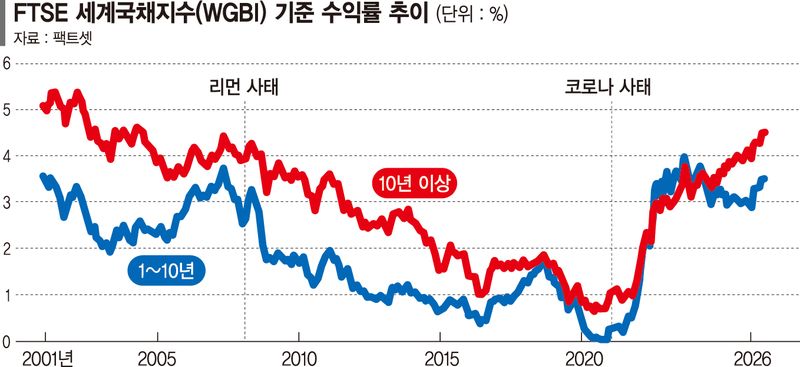
■ Government bond yields in major countries surge across the board
On the 1st (local time), government bond yields in major countries including the U.S., Japan, Germany, and the U.S. surged across the board. The U.S. 10-year yield rose to 4.798% during trading, reaching its highest level since January of last year, while the 30-year yield soared to 5.27%. The German 10-year yield reached 3.35%, its highest level since 2011, and the U.S. 10-year yield reached 5.25%, its highest level since 2008. On the 2nd, in the Japanese bond market as well, the 10-year government bond yield briefly rose to 3.015%, once again breaking the record high since 1996.
The first factor pushing interest rates up is the resurgence of inflation. As tensions in the Middle East escalate, Brent crude has surpassed $92 per barrel, and European natural gas prices have risen to their highest levels since last March. If rising energy prices spill over into inflation, central banks will have less room to cut interest rates. The bond market is reflecting the possibility that major central banks, including the U.S. Federal Reserve, may maintain high interest rates for a longer period or embark on further tightening.
However, it is difficult to explain the recent rise in bond yields solely through inflation originating from the Middle East. In the United States, analysis suggests that national debt exceeding $40 trillion and massive fiscal deficits are structurally driving up long-term interest rates.
The shock is spreading to U.S. households as well. The average interest rate for 30-year fixed-rate mortgages, which moves closely with the U.S. 10-year Treasury yield, reached 6.66% as of the 27th of last month. If you borrow $500,000 for 30 years at this rate, the monthly principal and interest repayment alone amounts to approximately $3,210, which is more than $820 higher than at a 4% rate.
The burden on the U.S. government is greater. According to the Congressional Budget Office (CBO), the federal government's net interest spending is projected to rise from $970 billion in 2025 to over $1 trillion this year. This is roughly half of the $1.9 trillion fiscal deficit expected this year.
David Kracauer, Vice President of Portfolio Management at Mercer Advisors, assessed that "it is primarily an internal U.S. issue, and global trends are amplifying it." He cited the fiscal deficit, interest costs on national debt, and changes in the demand structure of the U.S. Treasury market as key factors driving the rise in interest rates.
On top of this, the demand for funds from Big Tech companies that have jumped into the AI investment race is skyrocketing. According to the London Stock Exchange Group (LSEG), the five major AI hyperscalers—Alphabet, Amazon, Meta, Microsoft, and Oracle—have issued $250 billion in corporate bonds this year alone. This already exceeds double the total annual issuance amount from last year. Global corporate bond issuance also reached a record high of $4.9 trillion this year, up 14% from the same period last year.
■ Shockwaves from Japan's interest rate hike spread
Changes in Japan are also altering the structure of the global bond market. The yield on Japan's 10-year government bonds jumped from about 2% at the beginning of the year to 3%. As interest rates rise in Japan—which has served as a source of global capital for decades due to ultra-low rates—the incentive for Japanese investors to withdraw funds from U.S. and European bonds and return them to their home country increases.
The shock of rising interest rates is rapidly spreading within Japan to the government, businesses, and households. The Japanese government is taking the direct hit. The 3% 10-year bond yield matches the projected rate applied by the government when formulating this year's budget.
The Japanese Ministry of Finance raised its projected interest rate to 3.8% in its budget request for next year. Consequently, interest payments are expected to rise by 27% from this year to 16.5888 trillion yen (approximately 144 trillion won), while government debt, including principal repayments, is projected to balloon to a record high of 36.6386 trillion yen (approximately 319 trillion won). As government debt exceeds even the requested social security expenditures, such as pensions and healthcare, the fiscal capacity available for tax cuts, defense spending, and growth investments has diminished.
Companies are responding by switching variable-rate borrowings to fixed rates and extending loan maturities. The burden of mortgage loans is now spreading to households in earnest. As approximately 80% of Japanese homebuyers choose variable rates, the burden of principal and interest payments on a wide range of households is bound to increase.
[email protected] None Reporter