NXT Reduces the Number of Tradable Stocks to Comply with Volume Cap as It Grows
- Input
- 2026-09-02 19:05:12
- Updated
- 2026-09-02 19:05:12
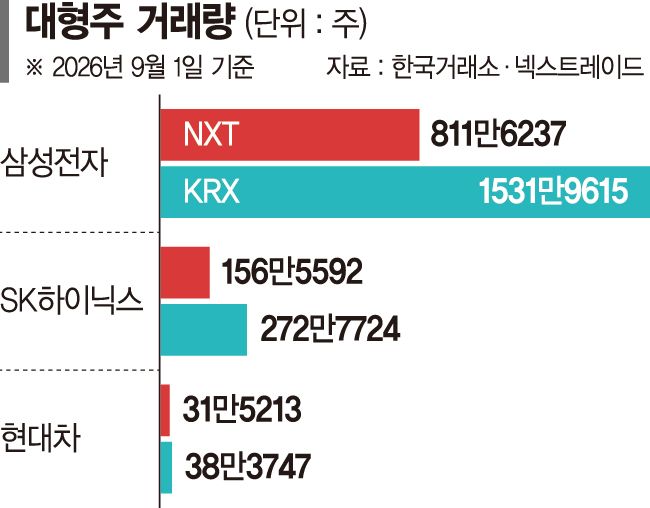
According to the Korea Exchange (KRX) and NXT on the 2nd, Hyundai Motor’s NXT trading volume on the 1st was 315,213 shares, equivalent to 82.1% of its KRX volume of 383,747 shares. Samsung Electro-Mechanics also recorded 479,845 shares traded on NXT, or 80.5% of its KRX volume of 595,818 shares. NXT trading volumes for SK hynix and Samsung Electronics also exceeded half of their respective KRX volumes.
Under the current Financial Investment Services and Capital Markets Act, an alternative trading platform must keep its average daily trading volume over the previous six months within 15% of KRX’s total market volume and within 30% for individual stocks. However, in a no-action letter issued last September, financial authorities said they would maintain the 15% market-wide cap but would not impose sanctions on individual stocks as long as NXT’s volume remained below 100% of their KRX volume. The authorities recently extended the measure for another year, although it had been scheduled to expire this month.
NXT’s trading volume remains high despite the market’s recent correction. According to SK Securities, NXT’s average daily trading value last month was 17.7 trillion won, or 55.7% of KRX’s 31.8 trillion won.
The issue is that NXT must adjust the stocks available for trading because the market-wide 15% cap remains in place even though restrictions on individual stocks have been eased. In fact, NXT reduced the number of stocks eligible for trade execution in the third quarter from 642 to 610, cutting 32 stocks, and did not add any new ones. It has continued adjusting the list to manage the trading-volume cap.
NXT also announced on the 24th of last month an “Adjustment of Stocks Eligible for Trade Execution to Manage the Cap.” In effect, it is responding by adjusting the stocks available for trading to comply with the market-wide volume regulation.
An industry official said, “Now that NXT has established itself in the market, it is time to examine whether the current trading-volume cap is excessively restricting market competition.”
[email protected] Doo-sun Choi Reporter