Domestic Banks’ Non-Performing Loans Near 19 Trillion Won [Bond Market in Turmoil]
- Input
- 2026-09-02 19:05:08
- Updated
- 2026-09-02 19:05:08
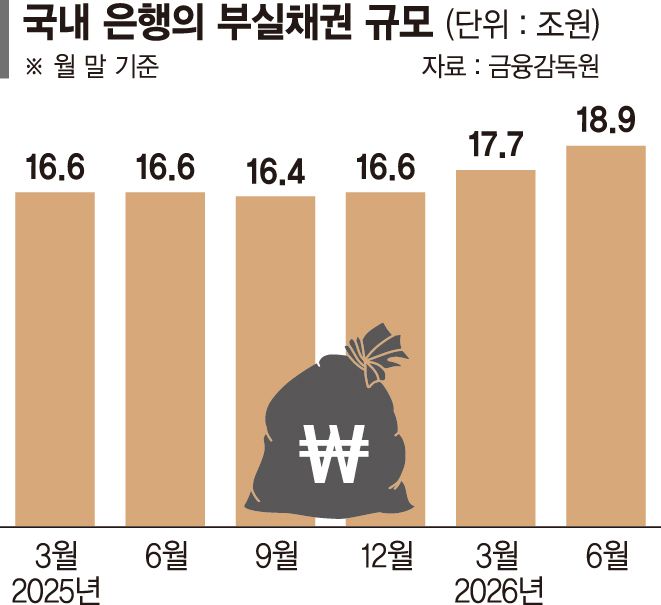
According to data on domestic banks’ non-performing loans released by the Financial Supervisory Service on the 2nd, the non-performing loan ratio stood at 0.63% at the end of June, up 0.03 percentage points from 0.60% at the end of March. The volume of non-performing loans reached ₩18.9 trillion, an increase of ₩1.2 trillion over the previous quarter. This was the highest level in eight years, since ₩19.4 trillion in June 2018.
The expansion of non-performing corporate loans drove the overall increase. Such loans totaled ₩15.2 trillion, up ₩1 trillion from the previous quarter. This marked the highest level in seven years and three months, since March 2019. Non-performing household loans rose by ₩100 billion to ₩3.4 trillion, while credit card receivables remained unchanged from the previous quarter at ₩300 billion.
New non-performing loans also surged. New NPLs in the second quarter totaled ₩7.2 trillion, up ₩1.7 trillion from the previous quarter. Of this amount, new non-performing corporate loans accounted for ₩5.7 trillion, an increase of ₩1.6 trillion, while new non-performing household loans rose by ₩100 billion to ₩1.4 trillion.
The increase in defaults among SMEs was particularly steep. New non-performing loans among SMEs totaled ₩4.5 trillion, up ₩1.2 trillion from the previous quarter. New non-performing loans among large companies increased by ₩400 billion to ₩1.2 trillion.
Banks resolved ₩6.1 trillion in non-performing loans during the second quarter, an increase of ₩1.7 trillion from the previous quarter. Even so, they failed to keep pace with the rise in new non-performing loans.
The non-performing loan ratio for small and medium-sized corporations rose by 0.05 percentage points to 1.08%, while that for loans to individual business owners increased by 0.01 percentage points to 0.67%. The non-performing loan ratio for household loans rose by 0.01 percentage points to 0.33% from the previous quarter. The ratio for mortgage loans remained unchanged at 0.22%, while that for other credit loans and similar products rose by 0.01 percentage points to 0.67%. The non-performing loan ratio for credit card receivables increased by 0.06 percentage points to 1.88%.
An official from the Financial Supervisory Service said, "Considering the long-term average non-performing loan ratio and the banking sector’s loss-absorbing capacity, soundness remains at a favorable level." The official added, "However, proactive management is necessary given the continued rise in non-performing loan ratios in some vulnerable sectors, as well as the possibility of a prolonged situation in the Middle East and rising interest rates at home and abroad."
[email protected] Park Moon-soo Reporter