Inflation Returns to the 3% Range After Two Months, Reflecting the Base Effect of Telecommunications Fee Reductions
- Input
- 2026-09-02 18:32:38
- Updated
- 2026-09-02 18:32:38
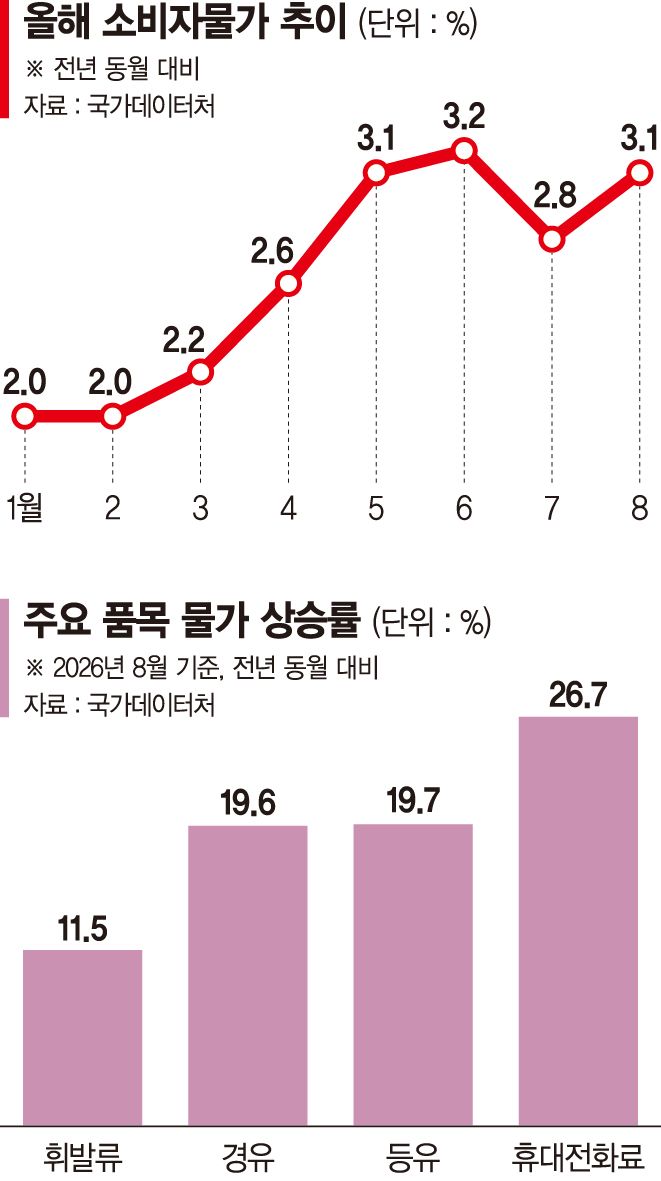
According to the August Consumer Price Trends released by the Ministry of Data and Statistics on the 2nd, the consumer price index last month rose 3.1% from a year earlier. The consumer inflation rate had remained in the 3% range for two consecutive months in May (3.1%) and June (3.2%), before slowing to 2.8% in July.
Public services led the increase. Public-service prices rose 6.5% last month from a year earlier, marking the highest increase in 25 years since August 2001, when they rose 7.2%. Their contribution to the overall consumer inflation rate reached 0.72 percentage points.
Mobile-phone fees surged 26.7%. The increase reflected the base effect of SK Telecom’s telecommunications fee reduction. After a hacking incident triggered a mass exodus of subscribers, SK Telecom cut telecommunications fees by 50% for all of its more than 20 million subscribers for one month in August last year. Lee Doo-won, director of economic trends and statistics at the Ministry of Data and Statistics, explained, "Telecommunications fees contributed 0.58 percentage points to inflation. Excluding them, the inflation rate appears to have been around 2.5%."
Personal-service prices rose 3.5%, contributing 1.20 percentage points to the overall inflation rate. Among personal services, overseas group-tour costs (14.9%) and insurance service fees (13.4%) posted particularly sharp increases.
Oil prices jumped 14.2% in August from a year earlier. Although the increase slowed from 15.5% in July, prices continued to rise at a high rate. The government estimates that the price cap system reduced the inflation rate by 0.5 percentage points. Without the system, it estimated that August inflation would have reached 3.6%.
By contrast, prices of agricultural, livestock, and fishery products fell 2.6%, limiting the overall increase in consumer prices. Prices of napa cabbage (-26.2%), tomatoes (-24.8%), and apples (-8.9%) declined, while rice (6.2%), domestic beef (3.3%), and eggs (5.2%) became more expensive.
Core inflation excluding food and energy rose 3.4% from a year earlier, the highest increase since May 2023. The index excluding agricultural products and oil also rose 3.1%, recording an increase in the 3% range.
Lee Ji-ho, Assistant Deputy Governor of the Bank of Korea (BOK), said at a meeting to review inflation conditions that "the September inflation rate will be lower than August’s as the base effect fades." He added, "Consumer prices are expected to continue rising at a high rate, particularly core inflation, amid still-high uncertainty related to the war in the Middle East, as cost shocks pass through to prices and demand-side pressures increase."
[email protected] Chan-mi Kim Reporter