Seoul Villas and Officetels Sent to Auction in Large Numbers as They Become White Elephants
- Input
- 2026-09-02 18:27:35
- Updated
- 2026-09-02 18:27:35
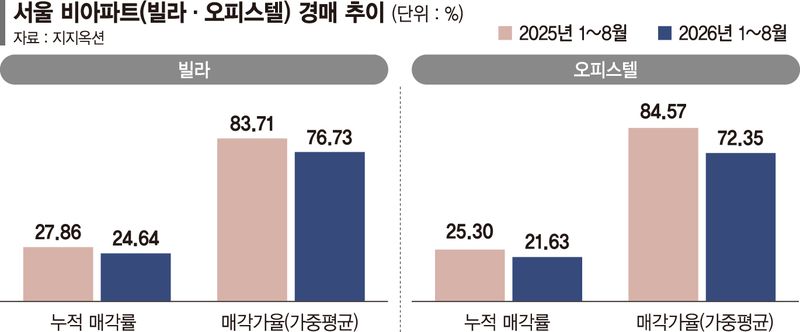
According to data from GG Auction on the 2nd, the number of non-apartment properties put up for auction in Seoul—including villas (row houses and multi-family homes) and officetels—increased 67.8% to 20,385 in the January-August period this year, from 12,152 during the same period last year. Villa auctions rose 58.8%, from 9,124 to 14,494, while officetel auctions jumped 94.5%, from 3,028 to 5,891.
The increase resulted from the combined effects of jeonse fraud, concentrated demand for apartments, lawsuits seeking the return of deposits, and delinquencies on high-interest loans. The rise in auction listings can also be interpreted as a sign that these assets are not being recognized for their value in the sales market. When demand from buyers is strong, properties are sold at high prices and avoid being sent to auction.
The sale-price-to-appraisal ratio also fell below the 80% mark. For villas, it dropped 7.0 percentage points in one year, from 83.7% to 76.7%; for officetels, it fell 12.2 percentage points, from 84.5% to 72.3%. A multi-family home in Banghwa-dong, Gangseo District, had an appraised value of 202 million won but was sold that day for approximately 88 million won, or 43.5% of its appraised value, after failing to attract a bid four times.
The sale rates during the January-August period this year were also lower than last year, at 24.6% for villas and 21.6% for officetels, compared with 27.8% and 25.3%, respectively. One expert noted, "Except for properties with redevelopment potential, villas do not attract much attention even at auctions." The expert added, "Officetels are difficult to remodel or rebuild, and whether they are counted as housing is always a variable, so there is a strong perception that they are a burden."
The government previously announced on May 22 its "measures to supplement non-apartment housing supply" and last month's "August 13 plan for the rapid supply of housing," pledging to support the construction of 130,000 non-apartment housing units in the Seoul metropolitan area by 2030. The measures center on expanding the maximum building area for multi-household and multi-family homes from 660 square meters to less than 1,000 square meters, and raising the permitted number of floors for multi-household homes from no more than three to no more than four.
However, observers say it remains uncertain whether the measures will stabilize the market because demand is concentrated on apartments.
An industry official expressed concern, "In the Seoul metropolitan area, what is in short supply relative to demand is apartments, not non-apartment housing." The official added, "Non-apartment properties can be difficult to resell and are sometimes treated as white elephants, so the polarization between them and apartments may only worsen."
[email protected] Min-kyung Jeon Reporter