K-Alcohol Goes Global: Taiwan Drinks Korean Beer, U.S. Turns to Soju
- Input
- 2026-09-02 18:12:49
- Updated
- 2026-09-02 18:12:49
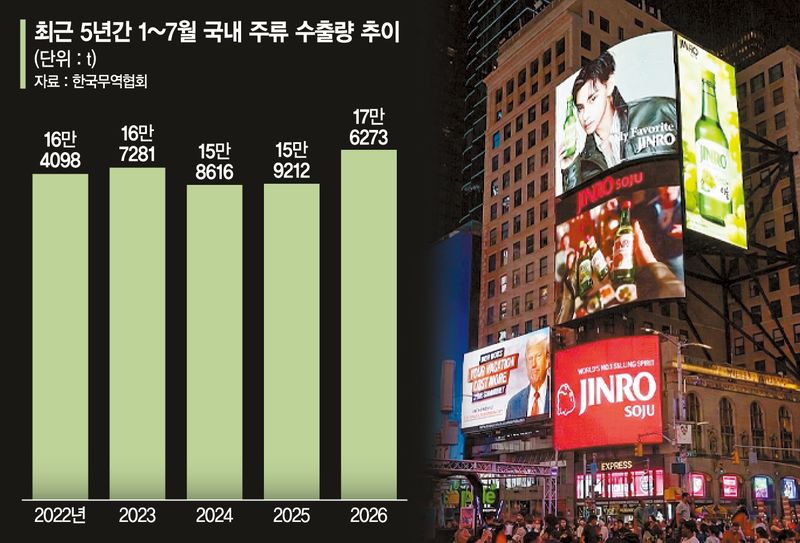
Liquor industry, battered at home, finds a breakthrough overseas
The liquor industry, which has struggled with declining domestic consumption, is gaining momentum by turning to overseas markets. As the popularity of the Korean Wave boosts the standing of K-alcohol, soju sales are rising sharply in North America, while beer exports are growing mainly in Greater China.
According to the Korea International Trade Association (KITA) on the 2nd, exports of liquor—including soju, beer and other liqueurs—totaled 176,273 tons from January to July this year, up 17,061 tons, or 10.7%, from 159,212 tons during the same period last year. Over the past five years, liquor exports have also generally trended upward. From January to July, exports totaled 164,098 tons in 2022, 167,281 tons in 2023, 158,616 tons in 2024 and 159,212 tons in 2025, increasing each year except in 2024.
Beer exports are increasing particularly to Greater China, while soju exports are expanding mainly to the United States. Beer exports to Greater China—China, Taiwan and Hong Kong—rose from 29,292 tons in the first seven months of last year to 52,334 tons this year, an increase of 23,042 tons, or 78.6%, in one year. Exports to Taiwan alone nearly doubled, climbing from 13,679 tons to 26,169 tons. The increase is attributed to a spillover benefit for Korean beer after Taiwan imposed anti-dumping tariffs of up to 64.15% on Chinese beer late last year. Korean beer, geographically close to Taiwan and supported by well-established export infrastructure, filled the gap.
Films and dramas amplify K-culture’s influence
Exposure through films, dramas and social media to Korea’s somaek culture—soju mixed with beer—also helped increase interest in K-alcohol among consumers in Taiwan and elsewhere in Greater China. Companies’ global star marketing campaigns played a role as well. HiteJinro selected soccer player Son Heung-min as the model for Terra and has been targeting global markets since July by appointing BTS member V as a brand ambassador. Lotte Chilsung Beverage is also working to raise its profile overseas by featuring aespa member Karina as the model for its beer Krush.
For soju, HiteJinro is targeting the U.S. market with its global brand Jinro, while Lotte Chilsung Beverage is promoting Sunhari. Soju exports to the United States rose by 62 tons, or 1.2%, from 5,271 tons in 2023 to 5,333 tons this year. The industry views this as a relatively strong performance in North America despite the overall decline in soju exports.
The liquor industry is looking overseas because of the structural downturn in the domestic market. According to the National Tax Service (NTS), domestic liquor shipments fell below 3 million kiloliters last year for the first time since the 1998 Asian financial crisis, reaching 2.988 million kiloliters. Several factors contributed, including the spread of health-conscious lifestyles, the establishment of the 52-hour workweek and changes in company dining culture following the COVID-19 pandemic.
An industry official said, "Food and beverage companies, including liquor makers, are now in a situation where it is difficult to expect significant growth in the domestic market. As Korean samgyeopsal and somaek culture have become popular through dramas and films, the liquor industry is also benefiting. We are using this as a springboard to accelerate our push into global markets."
[email protected] Park Kyung-ho Reporter