490 Regional Physicians with “10 Years of Local Service” Begin First Early Admissions on the 7th
- Input
- 2026-09-03 06:00:00
- Updated
- 2026-09-03 06:00:00
[Financial News] Starting on the 7th, 31 medical colleges and graduate schools of medicine excluding Seoul will begin selecting regional physicians through early admissions.
The Ministry of Health and Welfare (MOHW) and the Ministry of Education announced on the 3rd the “2027 Academic Year Regional Physician Selection Application Guide (FAQ),” which contains answers to questions from applicants and parents, ahead of the first early admissions for the 2027 academic year Regional Physician Selection.
For the 2027 academic year, a total of 490 regional physicians will be selected for the first time at 32 medical colleges and graduate schools of medicine excluding Seoul. CHA University Graduate School of Medicine accepted applications from the 4th to the 6th of last month according to a separate schedule, while the remaining 31 universities will begin selecting their first regional physicians through early admissions starting on the 7th.
Tuition support and 10 years of mandatory service are the key points of the Regional Physician System.
The Regional Physician System is a program in which students who grew up in a region are selected through a separate Regional Physician Selection process, supported by the national and local governments in their education and capacity building, and required to work in the designated region for a certain period after obtaining their medical licenses.
It was introduced to alleviate the imbalance in medical personnel between regions and to stably secure the medical personnel needed in each region. In the 2027 academic year, a total of 490 people will be selected, including 359 from medical service areas and 131 from metropolitan areas.
Students selected through the Regional Physician Selection process receive financial support for tuition, textbooks, practical training, and dormitory fees, as well as additional educational and practical training opportunities to develop the competencies necessary for regional healthcare alongside the medical school curriculum.
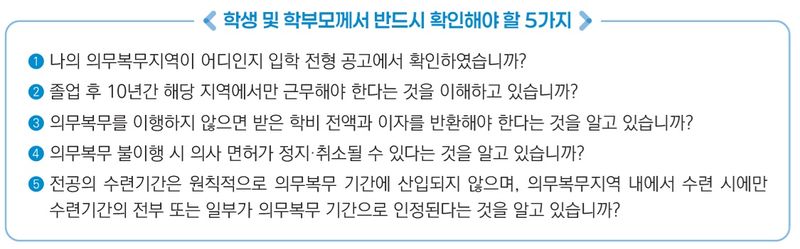
After obtaining a medical license, they are required to serve for 10 years in the mandatory service region announced at the time of selection. When granting a medical license, the Minister of Health and Welfare imposes the condition of serving for 10 years in the relevant mandatory service region. If this condition is violated, measures such as corrective orders, suspension of license qualifications, and license revocation may be taken in accordance with the law.
The government plans to provide support throughout the entire process so that regional physicians can grow into capable medical professionals who lead regional healthcare during their mandatory service period and subsequently settle stably in the region.
Following a public competition in the second half of this year, the government plans to select Regional Physician Support Centers and systematically provide support through them, including career counseling and information, job training, career development, domestic and overseas training, and housing stability.
Regional physicians who complete their mandatory service may receive preferential treatment, such as priority hiring at the medical institution where they served or at public health and medical institutions in the region. Legal grounds have also been established to allow local governments to provide administrative and financial support when physicians establish and operate medical institutions in medically underserved areas.
Check the FAQ for residency requirements frequently asked about by applicants.
The newly released “2027 Academic Year Regional Physician Selection Application Guide (FAQ)” was prepared to explain eligibility requirements and selection criteria more easily and specifically, focusing on matters frequently raised by applicants, parents, universities, and education offices after the guidance materials were distributed.
The application guide (FAQ) contains key questions, answers, and examples concerning △applications and obligations under the Regional Physician Selection process, △middle and high school locations and residency requirements, △differences between medical service areas and metropolitan areas, and △recognition of training periods as mandatory service.
In particular, it provides detailed guidance on school and residency requirements, as well as cases involving relocation and school transfers, which are frequently asked about by applicants. Eligibility for the Regional Physician Selection process is not determined solely by current residence or the high school from which an applicant graduated. Applicants must satisfy both the legally prescribed middle and high school attendance requirements and the residency requirements during their enrollment period. Transferring schools or moving does not, by itself, restrict eligibility; applicants must confirm whether the school’s location and their place of residence during enrollment meet the requirements of the recruitment unit to which they wish to apply.
The Ministry of Health and Welfare (MOHW) and the Ministry of Education plan to continue providing relevant information in cooperation with related organizations, including universities and city and provincial offices of education, so that applicants can accurately understand and apply through the Regional Physician Selection process.
In the second half of this year, the government plans to establish the “Implementation Guidelines for the Regional Physician System” and select Regional Physician Support Centers. It will also build an implementation framework without disruption so that the system can operate stably from post-selection education and support through training, mandatory service, and settlement in the region.
Minister of Health and Welfare Jeong Eun-kyeong said, “After extensive discussion and preparation, a meaningful first step is being taken to select regional physicians for the first time in our country,” adding, “The government will be a reliable partner in education, training, career development, and settlement so that students selected as regional physicians can grow into outstanding medical professionals who will lead regional healthcare in the future.”
She continued, “The principled choices of students who love their regions and wish to take responsibility for the health of local residents will shape the future of regional healthcare,” and added, “I hope for the interest and support of many students who are interested in and committed to regional healthcare, and I look forward to welcoming you as the future leaders of regional healthcare.”
Key Questions in the Regional Physician Selection Application Guide
―What is different about entering through the Regional Physician Selection process compared with being a regular medical student?▲The degree and curriculum are the same as those for graduates of regular medical schools. However, students selected through the Regional Physician Selection track receive support for tuition and other educational expenses while enrolled. After passing the national examination, they receive a “conditional license” subject to mandatory service. After working for 10 years in the mandatory service region, the license is converted into a regular medical license. Unlike the regular admissions track, failure to fulfill the mandatory service may result in sanctions such as repayment of financial support or suspension or revocation of the license.―Can I apply if I retook the entrance examination, including multiple attempts, after graduating from high school?▲If you meet the middle and high school attendance and residency requirements for the Regional Physician Selection process, your eligibility is not restricted merely because you retook the entrance examination once or multiple times after graduating from high school.―If I am selected for a “metropolitan area,” will I also work in a metropolitan city?▲“Metropolitan area” refers to the city or provincial unit defining the scope of application eligibility, not the place of work. The actual mandatory service of students selected for a metropolitan area takes place in one of the medical service areas within the province covered by the relevant medical school’s selection. Metropolitan cities themselves, such as Daejeon and Busan, are not included as workplaces. Although residents may train at hospitals located in metropolitan cities, that training period is generally not counted toward mandatory service because metropolitan cities are not mandatory service regions.―What happens if there are fewer applicants selected than the quota in the Regional Physician Selection process?▲If the Regional Physician Selection process falls short of its quota, the university may carry the shortfall in regional candidates over to the admissions process two years later, within 10% of the admission quota of the relevant medical school. Carried-over candidates are not included in calculating the selection ratio for that year’s Regional Physician Selection process.―Can applicants who obtained a high school equivalency certificate also apply?▲No. The Regional Physician Selection process requires applicants to attend and graduate from middle and high schools in the relevant region, from admission through graduation. Those who obtained their academic qualifications through a high school equivalency examination are therefore not eligible for selection.―Does the financial support have to be repaid later?▲It does not have to be repaid if the educational curriculum is completed normally and the mandatory service is fulfilled. However, it becomes subject to repayment in cases such as expulsion or withdrawal, failure to pass the national examination within three years of graduation, or failure to fulfill the mandatory service.[email protected] Jeong Myeong-jin, Medical Specialist Reporter