Fabless and Foundry Companies Post Strong Results... System Semiconductors Take Flight After Memory [The Semiconductor Division of Labor Comes Back to Life (Part 1)]
- Input
- 2026-09-02 18:09:44
- Updated
- 2026-09-02 18:09:44
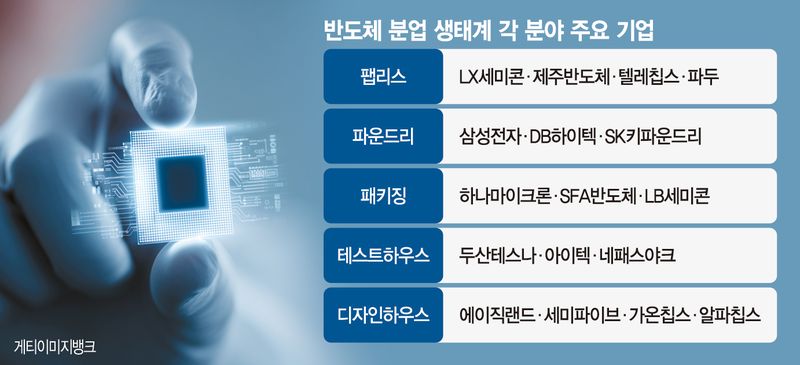
According to industry sources on the 2nd, domestic fabless companies saw their profitability improve rapidly in the second quarter of this year. LX Semicon, the country’s largest fabless company, posted sales of 401.2 billion won during the period, up 6% from a year earlier. Operating profit surged 115% to 22 billion won. The recovery in demand for its main product, display driver ICs (DDIs), drove the improvement in results.
FADU, which focuses on semiconductors for data centers, recorded even stronger growth. Second-quarter sales rose 209% year on year to 73.2 billion won, while operating profit reached 16.3 billion won, turning profitable from an operating loss of 12.6 billion won in the same period last year. Automotive semiconductor maker Telechips also maintained its profitable trend for a third consecutive quarter, with sales up 34% to 59.2 billion won and operating profit reaching 3.2 billion won.
The improved performance of fabless companies is translating into higher utilization rates and increased investment across the foundry industry. Samsung Electronics’ foundry business is being discussed as a potential candidate for a return to profitability, supported by improved yields and higher utilization.
Samsung Electronics said during a conference call in July, "The utilization rate of our foundry business has improved this year compared with last year." It added, "Profitability is improving thanks to better yields and the effects of price increases, and a return to profitability could be possible in the near future."
DB HiTek, a foundry specialist, is also benefiting from the same trend. Its second-quarter sales rose 23% year on year to 414.5 billion won, while operating profit increased 43% to 105.2 billion won. Its operating margin reached 25%. The improvement is attributed to growing demand from new applications, including data centers and robots.
Moves to expand production capacity are also gaining momentum.
SK keyfoundry, a subsidiary of SK hynix, recently held a board meeting and decided to invest 90 billion won in capacity expansion. The investment will continue through April next year. The company currently has monthly production capacity of about 100,000 200-millimeter (8-inch) wafers at its facility in Cheongju, North Chungcheong Province. Through the expansion, it plans to respond to growing demand for system semiconductors.
Industry observers are paying attention to the possibility that this trend could lead to structural changes in South Korea’s semiconductor industry, rather than merely signaling a recovery in market conditions. South Korea has secured world-class competitiveness in memory semiconductors led by Samsung Electronics and SK hynix. However, its system semiconductor ecosystem—from fabless companies and foundries to back-end processes—has long been considered relatively weak.
The importance of system semiconductors is bound to grow as new sources of demand expand, including AI, autonomous driving, robotics, and data centers. Analysts say the industry’s competitiveness can improve only if links among domestic companies are strengthened from design through manufacturing and back-end processes, since a memory-centered industrial structure alone cannot fully absorb high-growth advanced demand. If a virtuous cycle takes hold in which fabless companies’ growth generates demand for foundries and back-end processes, it is expected to help diversify the revenue sources of South Korea’s semiconductor industry.
Jonghwan Lee, a professor in System Semiconductor Engineering at Sangmyung University, said, "After entering the semiconductor supercycle, benefits are spreading across the entire semiconductor ecosystem—not only to Samsung Electronics and SK hynix, but also to fabless companies, foundries, packaging companies, and test houses." He added, "In particular, many fabless companies are focused on system semiconductor businesses, so we can also expect South Korea’s system semiconductor competitiveness, which has lagged significantly behind memory semiconductors, to strengthen."
[email protected] Kang Kyung-rae and Lim Soo-bin Reporter