'MU:CON' KIM JAE JOONG Calls for Infrastructure to Lower Failure Costs Rather Than Subsidies
- Input
- 2026-09-02 19:06:35
- Updated
- 2026-09-02 19:06:35
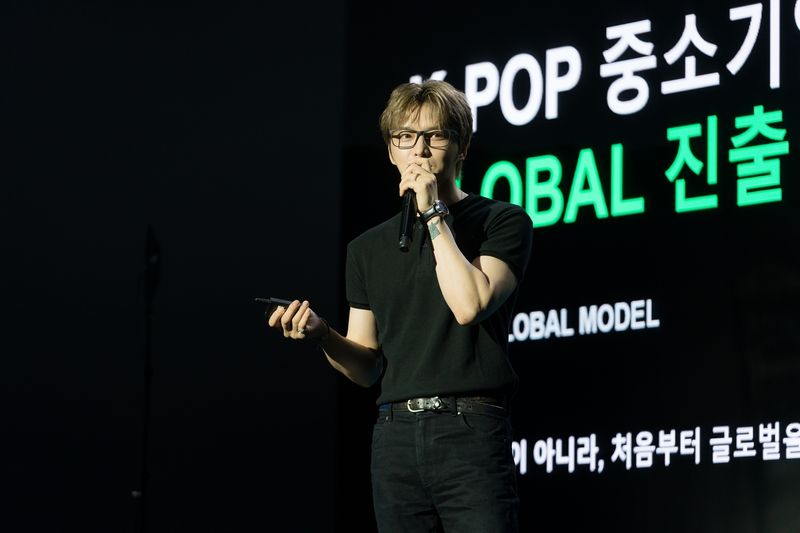
[Financial News] Singer and producer KIM JAE JOONG urged the government and the Korea Creative Content Agency (KOCCA) to establish infrastructure that can reduce the cost of failure for small and midsize content companies, rather than provide one-off subsidies.
He served as a keynote speaker at MU:CON 2026, the 2026 Global Music Fair, held on the 2nd at CUBE Convention Center in Sangam-dong, Mapo District, Seoul.
In his keynote speech, titled "Global Expansion Strategies for Small and Midsize K-pop Companies," he stressed, "Rather than taking singers who are popular in Korea and expanding them overseas, companies should design for the global market from the outset." He added, "Trying to imitate the strategies of large entertainment agencies on a smaller budget is the riskiest approach." Small and midsize agencies, he said, should identify their target markets and fan bases before forming a group, then tailor everything from music and content to platforms, local partners, and revenue models.
He also said, "The real weapon of small and midsize companies is the speed of decision-making," adding, "They must compete through an advantage in learning speed, not capital." This means they should be able to quickly change not only their target markets but also their music and content when necessary.
KIM JAE JOONG said his perspective on the market also changed as he transitioned from singer to producer and business executive. "When I was working as an artist, I thought about where my fans were most numerous. But while running a company, I began considering how much it would cost to reach those fans and whether we could sustain the relationship," he said. "Now I look for markets that are commercially sustainable, rather than simply markets with large numbers of fans."
He continued, "The bigger problem than failure itself is continuing to invest capital without confirming that a failure has occurred." He emphasized, "Companies should invest in stages, assess the response, and then adjust the market, music, and content." He described this as a strategy of "failing cheaply and trying again quickly."
Call for infrastructure to lower failure costs
He also advised small and midsize entertainment companies not to build every function needed for overseas expansion themselves. Companies should retain their artists, intellectual property, music, content, fan data, and brands, while sharing distribution, promotion, concerts, e-commerce, and media and brand networks with local partners, he said.
"If you establish an overseas subsidiary first and build your own promotion, concert, and marketing teams, your capital will be depleted before anything else," he said. "We also tried handling many things ourselves at first, but the costs were too high to manage everything."
KIM JAE JOONG urged the government and KOCCA to establish infrastructure that can reduce the cost of failure for small and midsize content companies, rather than provide one-off subsidies.
He proposed building a matching platform that would allow companies to jointly use local promoters, creators, and public relations agencies, and providing support to test market responses through small-scale overseas content projects and showcases.
He also proposed an overseas expansion matching fund that could concentrate capital in proven cities and markets, as well as a shared legal, tax, and localization advisory network that companies could use without establishing overseas subsidiaries. He further called for a database that would accumulate information on which cities each company entered, what responses it received, and how much online interest translated into actual consumption and concerts.
He emphasized, "Creating an environment where companies can fail at low cost, learn from that failure, and try again is a more sustainable form of support and investment."
[email protected] Shin Jin-ah Reporter