Caution urged over KFTA, KRX shift to T+1 settlement cycle... Government says it should be brought forward as much as possible
- Input
- 2026-09-02 17:29:54
- Updated
- 2026-09-02 17:29:54
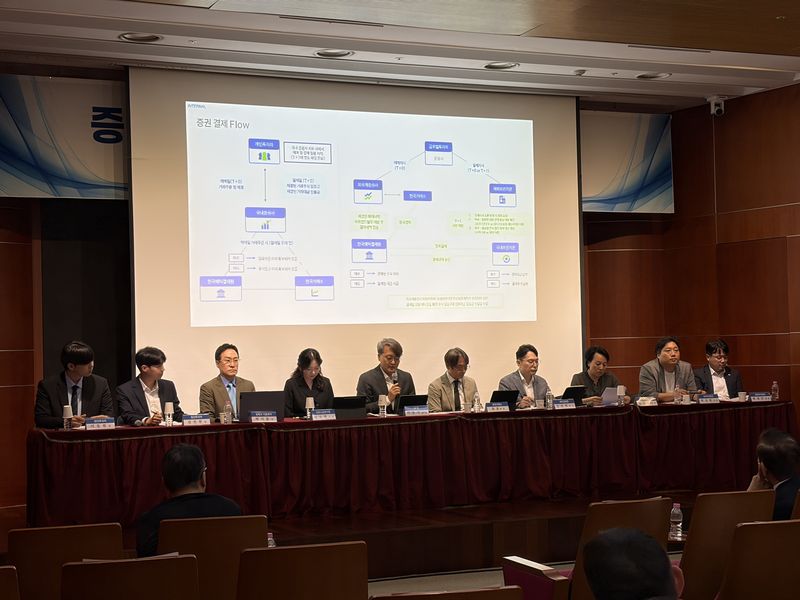
[Financial News] As plans move forward to shorten the settlement cycle in South Korea’s securities market from the current two business days after the trade date (T+2) to one business day (T+1), financial investment firms have called for a cautious approach. They say sufficient preparation is needed because the change would affect systems and trading practices across the market. The government, however, took a different position, saying the institutional change should be brought forward as much as possible.
At a forum on shortening the securities market settlement cycle to T+1, held on the 2nd at the Korea Financial Investment Association in Yeouido, Seoul, experts agreed on the need for the transition but stressed that consultations and testing among market participants must come first.
Discussions on shortening the settlement cycle gained momentum after President Lee Jae Myung proposed the issue as an agenda item at a capital market meeting in March. The first forum was held at the Korea Exchange in May, followed by the second discussion on this day.
Currently, after trades are executed on the trade date (T) in South Korea’s securities market, correction, netting and tax-related procedures are handled on T+1, while stocks and funds are exchanged on T+2. Under a T+1 system, these tasks would have to be completed on the trade date or by the following morning. Foreign institutional investors also face issues involving operations between domestic and overseas custodians, time differences and currency conversion, making automation of back-office operations and institutional reform necessary.
If the transition to T+1 is implemented, individual investors will be able to withdraw proceeds from stock sales one day earlier or use them for other investments. Financial companies will also face a lower burden in funding settlements. The United States switched to a T+1 system in May 2024.
The Korea Financial Investment Association and the Korea Exchange agreed on the need for the transition but emphasized that it should be pursued cautiously. Baek Dae-man, a team leader at the Korea Financial Investment Association, said, "Foreign investors also support the transition to T+1 from the standpoint of settlement-fund efficiency, but they are calling for a detailed roadmap that takes into account South Korea’s time difference, account allocation and currency conversion issues." Choi Hoon, a deputy director at the Korea Exchange, said, "South Korea does not face an urgent need to shorten the cycle because settlement risks are being managed stably, but the transition is necessary in light of global trends and other factors."
The securities industry also stressed the need for an adequate preparation period. Park Sang-hyun, a deputy director at NH Investment & Securities, said, "Since the relevant systems and business practices were established after T+2 was adopted, changing the settlement cycle would inevitably require changes to everything else as well." He added, "Because this is like replacing a foundation stone while the market is operating, all securities firms and related institutions must prepare together."
Experts also said perceptions of settlement failures need to change. Kang So-yeon, head of the Capital Market Division at the Korea Capital Market Institute, said, "In the United States, securities settlement failures occur in roughly 2% to 3% of cases, but they are viewed not as financial company insolvencies but as issues involving the costs of market operations and risk management." She added, "South Korea should also quickly address the causes and discuss how the costs should be allocated."
Park Yong-jin, vice chairman of the Presidential Regulatory Rationalization Committee, said, "President Lee Jae Myung is also interested in this issue, and the government considers it important." He called for the timing of the institutional change to be brought forward as much as possible, provided that stability and investor protection are ensured.
Hwang Seong-yeop, chairman of the Korea Financial Investment Association, emphasized, "Shortening the settlement cycle is a large-scale task involving changes across trading, clearing and settlement procedures, as well as the entire information technology system." He added, "More important than the speed of institutional reform is whether the market can accept it with sufficient confidence."
[email protected] Lee Jeong-hwa Reporter