Jeonnam-Gwangju Integrated Metropolitan City to Establish a Full-Cycle Demonstration System for Smart Agriculture
- Input
- 2026-09-02 16:13:08
- Updated
- 2026-09-02 16:13:08
【Financial News Jeonnam-Gwangju = Hwang Tae-jong, Reporter】Jeonnam-Gwangju Integrated Metropolitan City (Gwangju Metropolitan City) is moving to establish a full-cycle demonstration system for smart agriculture.
Gwangju Metropolitan City said on the 2nd that the ‘Smart Agriculture Regional-Linked Regulatory Free Zone,’ jointly promoted with Jeonbuk State and South Chungcheong Province, was designated on the 1st as the nation’s first ‘Regional-Linked Regulatory Free Zone’ at the 19th Regulatory Free Zone Committee meeting hosted by the Office for Government Policy Coordination and the Ministry of SMEs and Startups.
The ‘Regional-Linked Regulatory Free Zone’ is a system that moves beyond the existing demonstration model, which focuses on a single region and individual technologies. Under the system, two or more local governments cooperate to jointly demonstrate specialized technologies from each region and related regulations.
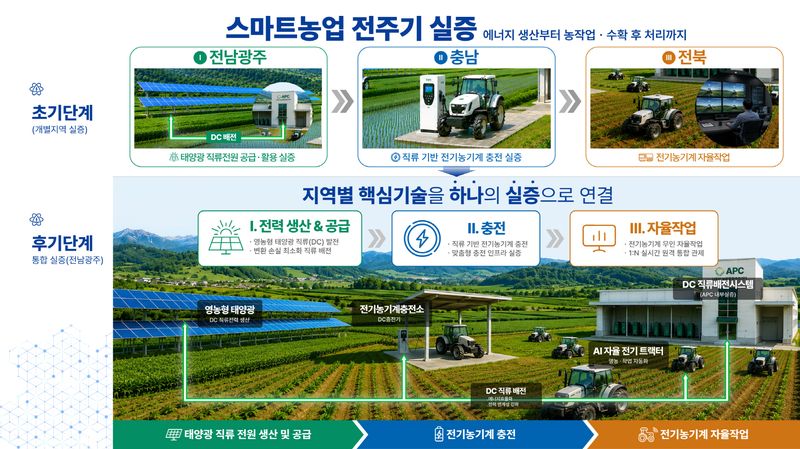
The ‘Smart Agriculture Regional-Linked Regulatory Free Zone’ will be led by Gwangju Metropolitan City, with Jeonbuk State and South Chungcheong Province participating. From 2027 to 2030, a total project budget of 43.3 billion won will be used to demonstrate each region’s specialized technologies and then link them in Jeonnam-Gwangju into a single smart agriculture system through an integrated demonstration project.
First, Jeonnam-Gwangju will invest 23 billion won to demonstrate an energy-efficiency technology based on direct-current distribution. The technology supplies direct-current power generated by agrivoltaic systems directly to agricultural facilities and electric farm machinery without a separate conversion to alternating current. Jeonnam-Gwangju will also conduct an integrated demonstration by linking Jeonbuk’s demonstration of fully unmanned autonomous agricultural machinery and multi-machine control technology with South Chungcheong Province’s verification of an electric farm machinery charging system based on an agrivoltaic direct-current power source.
The main demonstration projects include △supplying and improving the efficiency of agricultural energy through direct-current distribution △establishing and operating a direct-current charging system for electric farm machinery △operating fully unmanned autonomous agricultural machinery △multi-machine control, in which one operator controls multiple agricultural machines △and integrated operation of smart agriculture by linking technologies from each region.
In particular, the ‘Smart Agriculture Regional-Linked Regulatory Free Zone’ will be subject to eight regulatory exemptions under the jurisdiction of the Ministry of Climate, Energy and Environment, the Ministry of Agriculture, Food and Rural Affairs (MAFRA), and the Ministry of Trade and Industry. This will allow new smart agriculture technologies that have been difficult to apply in the field due to the absence of relevant standards and systems to be tested in actual farming environments.
Following the designation, Gwangju Metropolitan City plans to work with Jeonbuk State and South Chungcheong Province to establish a full-cycle smart agriculture demonstration system spanning solar power generation, direct-current power supply, electric farm machinery charging, and unmanned autonomous operations. The initiative is expected to address labor shortages in rural areas, improve agricultural productivity and energy-use efficiency, and contribute to establishing safety standards and national standards for direct-current distribution and electric farm machinery.
The city also plans to leverage Jeonnam-Gwangju’s strengths in both energy industry infrastructure and agricultural operations to actively support technology development by local energy and smart agriculture companies, commercialization of demonstration products, investment attraction, and entry into domestic and overseas markets.
Yoo Hyun-ho, Director-General of the Energy Industry Bureau of Gwangju Metropolitan City, said, "A foundation has been established to link Jeonnam-Gwangju’s energy industry capabilities with the smart agriculture technologies of Jeonbuk and South Chungcheong and verify them in actual farming environments." He added, "We will successfully carry out the integrated demonstration, secure the safety and efficiency of agrivoltaic and direct-current distribution technologies, and develop Jeonnam-Gwangju into a hub for the demonstration and commercialization of new direct-current distribution industries."
[email protected] Hwang Tae-jong Reporter