Himalayan Flood Disaster Enters Eighth Day as 600 Remain Trapped in Tunnels in Desperate Fight for Miraculous Rescue
- Input
- 2026-09-02 16:23:55
- Updated
- 2026-09-02 16:23:55
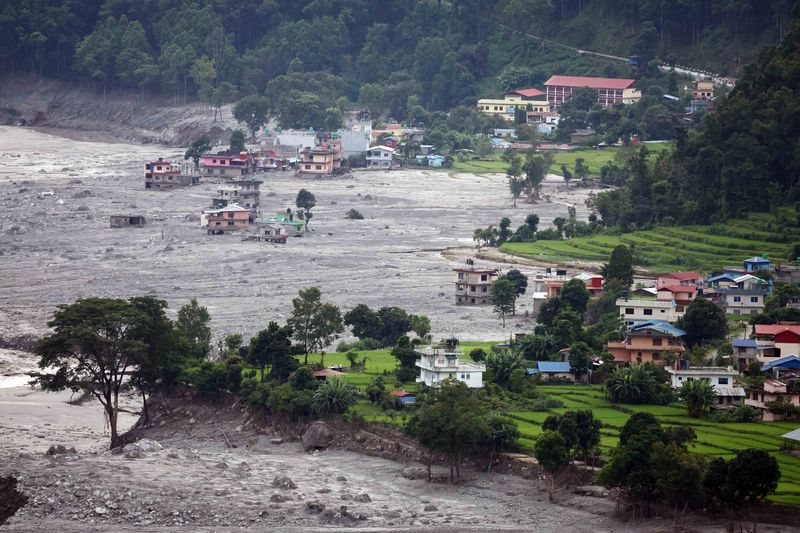
[Financial News] On the 2nd, eight days after catastrophic flooding swept through the Himalayan mountain region along the Nepal-China border, rescue authorities were racing against time to bring about the miraculous survival of missing people trapped at six or more hydropower plants. However, the operation has been hampered by flowing debris and boulders larger than houses.
The Nepal Disaster Management Authority said the death toll in Nepal had risen to at least 1,114 as of that day. The number of missing people stood at 3,916, including 590 foreigners. Adding 546 people missing in China, including 261 foreigners, and 16 deaths there, the total death toll reached 1,130, while 4,462 people remained missing.
The Nepal Army and mountain rescue teams deployed to China and India are attempting to enter several hydropower-plant tunnels while carrying out blasting and excavation work to rescue at least 600 workers trapped inside. Nepalese authorities confirmed that at least 639 people were stranded at several hydropower plants. Most are trapped inside tunnels, leaving a faint glimmer of hope that they may still be alive.■ Air Injected into the Upper Trishuli 1 Tunnel Where Missing South Korean Workers Were EmployedNepalese authorities said they were inserting pipes and pumping air into the tunnels of the Upper Trishuli 1 and Trishuli 3A power plants in the Rasuwa area of Bagmati Province. Search and rescue operations for the missing were also under way. Upper Trishuli 1 was where nine missing South Korean workers were employed. Rescuers used explosives to blast through the mountainside and then pumped air into the tunnel at the Trishuli 3A power plant. Eleven hydropower-plant projects in Nepal have been damaged by the flooding.
Foreign media, including the BBC, reported that rescue teams were blasting away large boulders blocking the tunnels, removing thick mud and debris covering the surrounding area, and digging holes. However, the tunnels were already filled with mud, and large amounts of water flowed into the excavated holes, flooding them and making the work difficult.
Ashish Gurung, a mountain guide who took part in rescue operations at one hydropower-plant tunnel, told foreign media, "It is still difficult to enter the tunnel. Equipment such as bulldozers and excavators is needed, but it is difficult to bring in heavy machinery because roads have been washed away."■ 2.2 Million Tons of Rock and Mud Washed into Disaster-Hit Areas of NepalThe United Nations Development Programme (UNDP) said the various deposits covering the disaster-hit areas—including building debris, rocks, and mud—amounted to at least 2.2 million tons after the flooding. In terms of cement, that would be enough to build 1,800 20-story apartment buildings—enough to construct the entire Bundang New Town and still have material left over. It is equivalent to the amount needed to build two Unjeong New Towns in Paju.
Meanwhile, the catastrophic flooding in the Himalayan mountain region along the Nepal-China border has renewed fears of major glacial lake outburst floods caused by climate change in countries across the Andes Mountains in South America.
Local media reported that Argentina, Chile, and Peru are being left defenseless against the risk of devastating floods and landslides as global warming accelerates the melting of glaciers in the Andes.
According to UPI and other outlets on the 1st (local time), Chile, home to more than 26,000 glaciers, was on high alert. Not only remote areas of Patagonia but also hydropower plants and mines in the capital region and central areas, as well as drinking-water infrastructure serving millions of people, depend on the Andes watershed. A glacial collapse could therefore cause serious economic and social damage.■ Chile, Argentina, and Peru Face Risk of Glacial Lake Outburst FloodsIf rock slopes or ice walls weakened by glacial melting collapse and fall into lakes, enormous volumes of water and debris could surge downstream, creating a risk of Nepal-style glacial lake outburst flooding. In Peru, 528 lakes are also at risk of overflowing, 58 of them classified as high-risk. El Chaltén, a tourist town in Argentina’s Patagonia that is popular with South Korean visitors, is also exposed to the threat of collapses involving Lake Torre and other lakes. A considerable number of cities in South America face potential disasters caused by the melting of high-altitude glaciers and lake overflows.
Experts pointed out that climate disasters flowing down mountain valleys would continue to threaten the energy and drinking-water networks of some South American cities, as well as the lives of their residents.
Juan Pablo Milana, a researcher at Argentina’s National Council for Scientific and Technical Research, warned, "Nepal’s tragedy is a reality that could be repeated in the Andes of South America. Without continuous monitoring and preventive infrastructure, climate disasters surging through mountain valleys will threaten the energy and drinking-water networks of major South American cities, as well as the lives of their residents."
Meanwhile, a United Nations official warned that millions of people in the Himalayan region face the risk of severe flooding caused by glacial lake collapses.
[email protected] Lee Seok-woo, International Affairs Specialist Reporter