'Climate Red Line' of 1.5°C Will Ultimately Be Breached... UN Says, 'How Quickly We Return Below It Is What Matters'
- Input
- 2026-09-02 15:23:29
- Updated
- 2026-09-02 15:23:29
[Financial News]
The United Nations says humanity will ultimately breach the 1.5°C increase in the global average temperature from preindustrial levels, long regarded as the 'climate red line.' Even under the most optimistic scenario, the temperature increase is projected to reach 1.8°C. The warning is now to minimize both the extent and duration of the overshoot before bringing temperatures back below 1.5°C.
The United Nations Environment Programme (UNEP) released a report titled 'Limiting Overshoot: Preparing for and Recovering from a 1.5°C Overshoot' on the 2nd.
UNEP concluded that it will be impossible to avoid the global average temperature increase exceeding 1.5°C within the next few years because greenhouse gas reductions are not progressing quickly enough. Given current policies and short-term emissions-reduction pathways, a 1.5°C overshoot is effectively unavoidable.
The 1.5°C threshold is a central climate goal of the Paris Agreement, adopted in 2015. Although the global annual average temperature in 2024 was more than 1.5°C above preindustrial levels, that was a record for a specific year. The Paris Agreement's 1.5°C target refers to the average level of warming over an extended period, not a single year.
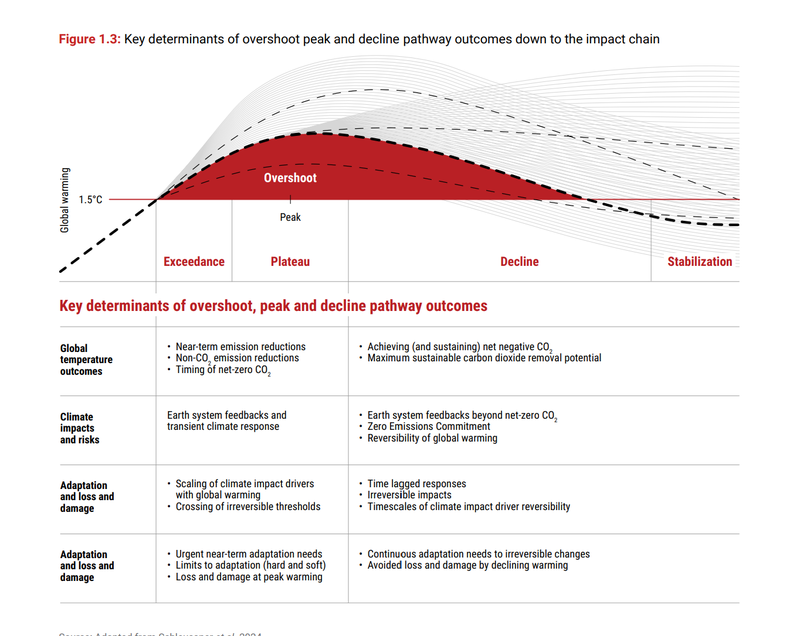
UNEP projected that, even under the most optimistic scenario, the global average temperature increase would peak at around 1.8°C. Under most other scenarios, peak temperatures are expected to exceed 2°C.
Accordingly, UNEP presented 'overshoot → peak → decline' as the best response pathway. The approach is to rapidly cut greenhouse gas emissions to keep peak warming as low as possible, then lower temperatures and return them to around 1.5°C.
The later mitigation is delayed, the greater the damage. The report analyzed that each additional five years of greenhouse gas emissions remaining at current high levels could raise peak warming by about 0.1°C. Additional warming beyond 1.5°C would intensify extreme weather and ecosystem losses, while increasing the risk of crossing difficult-to-reverse 'tipping points.'
Inger Andersen, executive director of UNEP, stressed, "There is no good outcome from remaining above 1.5°C," adding, "We must minimize the extent and duration of the 1.5°C overshoot as much as possible while reducing emissions and strengthening resilience and adaptation."
Experts pointed out that the prospect of eventually bringing temperatures back down to 1.5°C must not become a justification for delaying current mitigation efforts.
Kook Jong-sung, a professor in the Department of Earth and Environmental Sciences at Seoul National University, said, "Given current emissions trends, we should be more seriously concerned about how close warming will come to 2°C or whether it will exceed 2°C than about the possibility of returning to 1.5°C." He added, "The possibility of temperatures falling in the future must not justify delaying mitigation today." He emphasized, "The key is how low we can keep the peak temperature and how briefly we can maintain the overshoot period."
[email protected] Park Ji-young Reporter