A ‘Markup Frenzy’ Defying the Anti-Scalping Law... ‘Zero’ Weekend Listings at Jamsil Below Face Value
- Input
- 2026-09-02 15:48:45
- Updated
- 2026-09-02 15:48:45
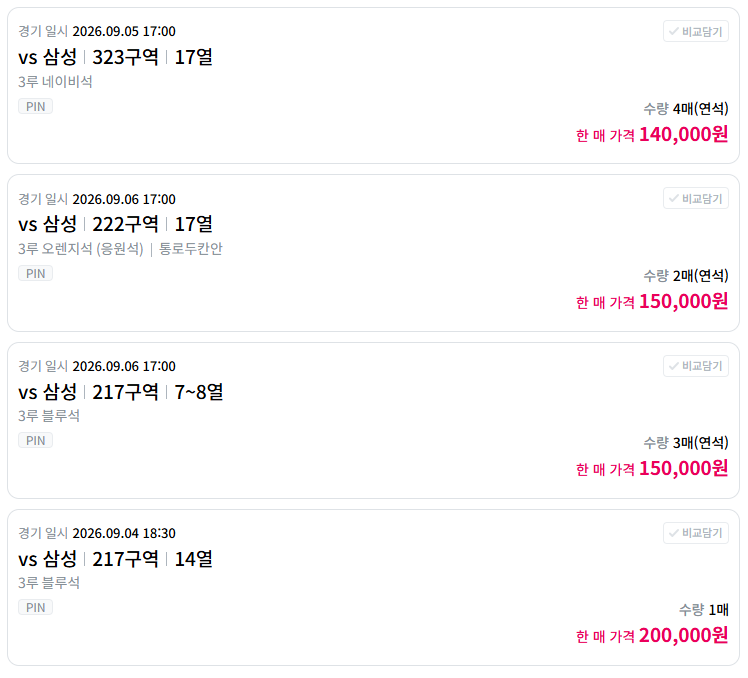
[Financial News] A law banning habitual and commercial ticket scalping for sports events has taken effect, but tickets are still being traded online at several times their face value. Although the government has launched a reporting center and begun enforcement, identifying sellers and imposing actual penalties requires considerable time and procedural steps. This has prompted calls for platform self-regulation to be combined with direct monitoring by relevant authorities.
Financial News found that 120 tickets for games between the LG Twins and Samsung Lions, scheduled to be held at Jamsil Baseball Stadium from the 4th to the 6th, were listed for sale on Ticketbay as of the afternoon of the 2nd. Not a single listing was priced at or below face value.
The face value of weekend tickets at Jamsil Baseball Stadium ranges from 11,000 to 26,000 won, depending on the seat. However, listings on the platform included tickets priced at up to 200,000 won each. Based on the highest price, that is more than seven times the face value. During the same period, a ticket for an away-fan section in the third-base area at Incheon SSG Landers Field, originally priced at 22,000 won, was listed for 130,000 won.
This occurred just five days after the relevant law aimed at eliminating ticket scalping took effect. Since the 28th of last month, the law has completely prohibited the habitual or commercial purchase and resale, or brokering, of tickets to performances or sporting events at prices higher than the purchase price. The Korea Sports Promotion Foundation (KSPO) operates an Online Ticket-Scalping Reporting Center. When illegal resales are detected, it imposes surcharges and pays 50% of the surcharge as a reporting reward.
The problem is that even when suspicious listings are found online, considerable time can be required to identify the seller and impose an actual penalty. On some platforms, including Ticketbay, it is difficult to obtain specific account information about a seller while viewing a listing. Consumers can file reports based on transaction screens and other evidence, but the relevant authorities must separately request data from the platform to identify the seller.
A listing does not necessarily disappear immediately after a report is filed. Ticketbay has announced that restricting a post’s visibility and imposing sanctions may require subsequent steps, including verifying the seller, securing platform data, determining whether the sale constitutes an illegal resale, and conducting investigations. Ultimately, the speed of enforcement after a report is filed depends on the platform’s provision of information and cooperation among the relevant authorities.
Experts say that, rather than relying solely on consumer reports, authorities need to strengthen platform self-regulation and direct monitoring by relevant agencies.
Lee Eun-hee, a professor in the Department of Consumer Studies at Inha University, explained, "Platforms need to establish their own standards to restrict ticket sales with excessive markups and to screen out repeated sales by the same seller first. At the same time, KSPO and the platforms should establish a cooperation system so that seller information can be verified quickly."
There are also calls to improve a system that relies too heavily on consumers to file reports voluntarily. Choi Cheol, a professor in the Department of Consumer Economics at Sookmyung Women’s University, said, "From the perspective of consumers trying to purchase scalped tickets, they may find themselves having to report a ticket they actually need. As a result, relying solely on voluntary reports may not produce sufficient enforcement effects. Relevant authorities need to strengthen their own monitoring and surveillance."
He added, "If these transactions are defined as illegal and regulated, platform operators that broker them should also be given a certain level of responsibility to prevent such transactions from taking place. As the system is still in its early stages, its shortcomings should be continuously addressed while monitoring the actual effectiveness of enforcement."
[email protected] Lee Dong-hyuk Reporter