Ruling and opposition parties: “Hyundai Motor Group’s 2.3 billion kilometers of hydrogen vehicle driving data is a competitive advantage... Legislative and budgetary support will continue”
- Input
- 2026-09-02 15:12:46
- Updated
- 2026-09-02 15:12:46
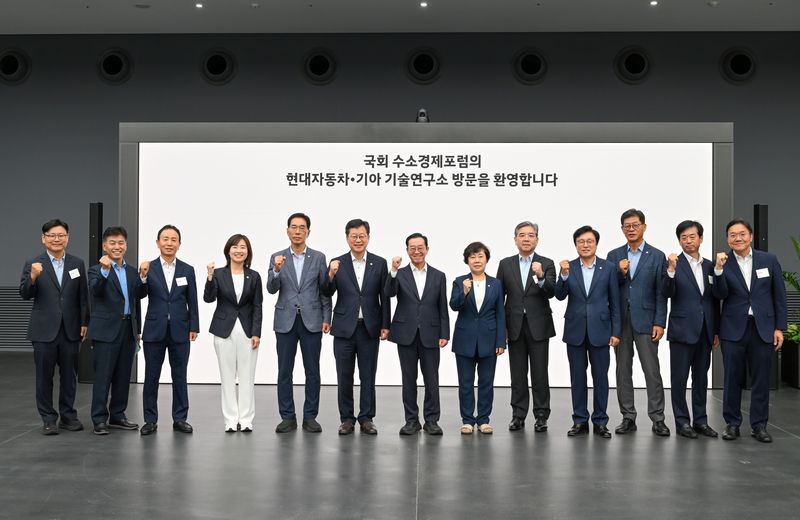
The National Assembly Hydrogen Economy Forum, a parliamentary research group, announced on the 2nd that it had visited the Hyundai-Kia Namyang R&D Center. The visit was intended to inspect advanced technology development sites and explore ways for the National Assembly to support the hydrogen ecosystem.
Seven lawmakers from the forum attended, including Lee Jong-bae, Cho Bae-sook, Ahn Ho-young, Kim Joo-young, Park Hyung-soo, and Kim Sohee. Industry representatives included Korea Hydrogen Alliance Chairman Kim Jae-hong and Korea Hydrogen Fuel Cell Association Vice Chairman Seo Heung-won. Jang Jae-hoon, vice chairman of Hyundai Motor Group, and other executives also took part.
The lawmakers toured technologies spanning the entire hydrogen cycle, from production to transportation, storage, and utilization. They assessed the development level and industrial applicability of key technologies supporting the hydrogen economy through Hyundai Motor Group’s technological achievements, including fuel cell systems, water electrolysis equipment, hydrogen refueling solutions, and battery systems.
Particular attention was drawn to the development of next-generation fuel cells, which incorporate nearly 30 years of accumulated technological expertise. Hyundai Motor Group explained that it is working to reduce costs and size while increasing output and durability.
The lawmakers praised South Korea’s lead in the hydrogen vehicle market, achieved through such technological development, as well as its accumulation of the world’s largest real-world driving dataset, totaling 2.3 billion kilometers. Based on these achievements, they held in-depth discussions on support measures to further enhance global competitiveness.
Hyundai Motor Group emphasized that a predictable and consistent policy environment is essential for revitalizing the hydrogen ecosystem and ensuring stable investment. It proposed effective policy support for the growth of mobility sectors—including hydrogen passenger and commercial vehicles and rail vehicles—as well as the water electrolysis industry. The group also presented the Saemangeum AI Valley, an innovation and growth hub combining energy, AI, data centers, and robotics, as a representative model of public-private cooperation. It further outlined plans to pursue a “hydrogen ecosystem package” export business based on domestic demonstration experience, with the aim of expanding into global markets and strengthening national competitiveness.
Jang Jae-hoon, vice chairman of Hyundai Motor Group, said, “The success or failure of the hydrogen economy depends not only on technological and industrial capabilities but also on the predictability and consistency of the policies that support them. When the government and industry cooperate in the same direction, companies can continue to invest. On that basis, it will also be possible to secure leadership in the global hydrogen industry and strengthen national competitiveness.”
The Korea Hydrogen Alliance conveyed specific challenges facing the industry, along with concrete examples. Because the energy industry takes a long time to develop markets and requires supply and demand infrastructure to be established simultaneously, the alliance called for sustained and comprehensive support across the entire value chain. Korea Hydrogen Alliance Chairman Kim Jae-hong proposed the introduction of hydrogen production subsidies, the construction of hydrogen pipeline networks, and the expansion of refueling infrastructure, saying, “To revitalize the hydrogen market, the government must establish a stable demand base and maintain policy consistency.”
Following the visit, the forum agreed to continue legislative and budgetary support for research and development efforts in the field and the expansion of the hydrogen industry. In particular, it plans to accelerate the enactment of the Hydrogen Business Act and the Hydrogen City Act, which are currently under discussion. The two laws are expected to speed up the expansion of the hydrogen market and the formation of regional hydrogen supply and demand hubs once enacted.
Lee Jong-bae, the forum’s representative lawmaker, emphasized, “The hydrogen industry is a national strategic industry that must be developed into a new export industry for South Korea, beyond being merely an energy industry for carbon neutrality. We must create a stable domestic market and successful examples, then support companies so they can enter global markets on that foundation.”
Ahn Ho-young, the forum’s lead researcher, stated, “I hope the success of Hyundai Motor Group’s hydrogen business in Saemangeum, along with the AI data centers and physical AI projects that use it, will become a new turning point for the hydrogen industry as a whole.”
[email protected] Kim Dong-chan Reporter