"A 91 Trillion-Won Business Aviation Market Is Taking Off"—Incheon Airport Corporation Bets on Becoming a Northeast Asian FBO Hub
- Input
- 2026-09-02 14:42:26
- Updated
- 2026-09-02 14:42:26
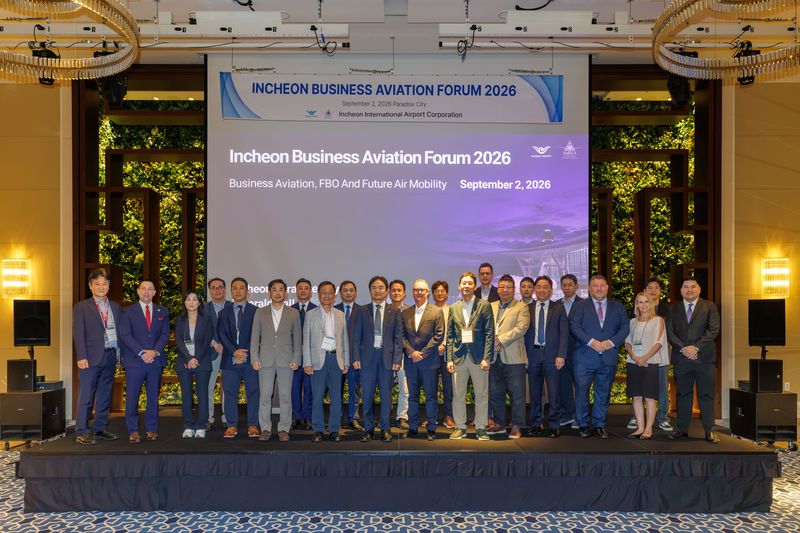
[Financial News] Incheon International Airport Corporation has formally entered the global business aviation market, which is projected to expand to 91 trillion won by 2032. The corporation plans to overcome Incheon Airport’s disadvantage—being the only major airport in the world without facilities supporting private jets, known as fixed-base operators (FBOs)—by linking them with Urban Air Mobility (UAM) infrastructure. Ahead of a large-scale FBO developer recruitment process in the second half of this year, the corporation brought together major global industry players and intensified the competition to lead the Northeast Asian hub market.
Incheon International Airport Corporation announced on the 2nd that it had held the 2026 Incheon Business Aviation Forum at Paradise City in Incheon and unveiled the master plan for developing the Incheon Airport Business Aviation Complex.
Business aviation refers to customized air transportation in which corporate executives, very important persons and others travel by private jet rather than on regular passenger flights.
The FBO industry, which oversees aircraft refueling, parking and maintenance, is a lucrative, high-value market expected to grow by an annual average of 12.3% and reach approximately 91 trillion won by 2032.
Incheon International Airport has long been considered urgently in need of related infrastructure because, unlike most major airports worldwide, it does not yet have an independent FBO.
About 60 key stakeholders attended the forum, including Philip John Balmer, chairman of the Asian Business Aviation Association (AsBAA), and Paul de Groselier, its finance director, as well as executives from global FBO companies and heads of private-jet divisions at major Korean conglomerates. Their presence underscored the market’s strong interest.
Following a keynote speech and panel discussion, the corporation announced the guidelines for its FBO operator recruitment process, scheduled for the second half of this year, and began its full-scale campaign to attract investment.
The most notable aspect was the plan for infrastructure linked to UAM, extending beyond a simple private-jet terminal.
The corporation presented a blueprint to transform the Incheon Airport FBO into a future mobility hub by absorbing existing business aviation demand while integrating it with the UAM network expected to be commercialized in the future.
In the afternoon, officials personally guided participants to the planned FBO site for an on-site briefing, strongly highlighting the project’s feasibility.
Lee Sang-yong, executive vice president of new business at Incheon International Airport Corporation, said, "We will create a future-oriented aviation complex that leads the global market, building on Incheon Airport’s world-class competitiveness." He added, "Starting with this forum, we will establish a business aviation hub representing Northeast Asia and create a new driving force for the development of the nation’s aviation industry."
[email protected] Kim Dong-ho Reporter