“Simply Stockpiling GPUs Won’t Make Us One of the World’s Top Three AI Powers... Open AIDCs and Network Support Are Needed”
- Input
- 2026-09-02 15:55:20
- Updated
- 2026-09-02 15:55:20
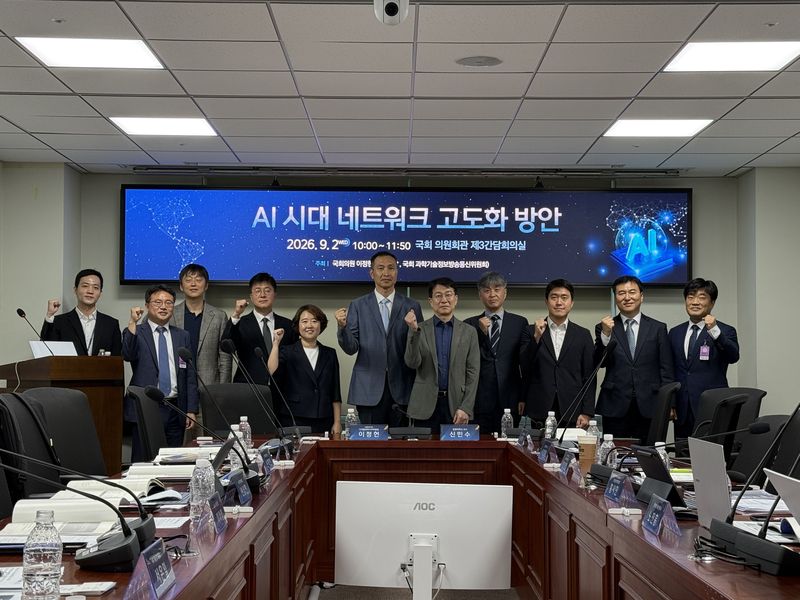
[Financial News] Experts say South Korea needs a package of policies encompassing tailored support for AI data centers (AIDCs) and investment in network infrastructure, rather than simply securing large quantities of graphics processing units (GPUs), if it is to become one of the world’s three leading AI powers. They called for open and colocation (leased) facilities, which account for most domestic AIDCs, to be included in tax-support programs. They also urged parallel investment in networks that can reliably deliver AIDC computing resources to industrial sites and users.
Open AIDCs Account for 91%... Left Outside Tax Support
Mo Jeong-hun, a professor in the Department of Industrial Engineering at Yonsei University, stressed at the “Plans for Advancing Networks in the Age of AI” forum held at the National Assembly of the Republic of Korea in Yeouido on the 2nd that a support system is needed to ensure stable operations after construction, given AIDCs’ massive upfront investment and power costs, as well as uncertain demand.
He specifically proposed broadly including open AIDCs, which lease computing resources to multiple companies, in tax-support programs. Under the current system, large companies can receive a 15% tax credit when investing in facilities that commercialize national strategic technologies, including AIDCs. However, they must have used the AI themselves for more than 50% of the total operating time, while leased facilities must prove usage records for each customer. Mo said, “Policy must reflect the fact that 91% of domestic AIDCs are open facilities,” adding, “The standard should not be whether the facility is used by its owner, but how effectively its computing resources are utilized for AI.” Lee A-young, head of external strategy at LG Uplus, also emphasized, “Colocation provides power, cooling, telecommunications, and security infrastructure that AI companies unable to build their own AIDCs can use jointly. Regardless of who directly uses the facility, we should assess whether it is actually being used for AI computing and services.”
The government announced that it plans to include open AIDCs, as well as self-use facilities, in the enforcement decree of the Special Act on AIDCs. Jang Gi-cheol, director of the AI Data Promotion Division at the Ministry of Science and ICT, said, “We are preparing the enforcement decree so that open AIDCs can also be included in the definition under the Special Act,” adding, “If the facilities are used to develop national strategic technologies, it would be desirable to apply tax credits even to leased facilities.”
However, operators must clearly provide evidence that the facilities were used for AI technologies and services. Jang added, “The Restriction of Special Taxation Act presupposes infrastructure outside the Seoul metropolitan area and applies to corporations with their main business locations in South Korea. Therefore, AIDCs that provide resources to overseas companies would not qualify.”
“Building Only AIDCs Would Turn Them into Expensive Warehouses... Network Investment Must Go Hand in Hand”
Calls were also made to designate networks as national strategic infrastructure and expand investment. Shin Sang-min, head of policy development at SK Telecom, said, “The AI-related budget announced by the government totals 9.4 trillion won, but most of it is concentrated on GPUs and AIDCs. AI infrastructure should also include AI radio access networks (RAN), 5G and 6G, and networks connecting AIDCs, and the government should consider tax and investment support for them.”
The transition from legacy networks such as 3G was also presented as a task for building future networks. Shin stressed, “The 3G shutdown should not be viewed merely as an individual operator’s service termination issue. With user protection as a prerequisite, it should be approached as a policy to redirect the frequencies, equipment, and personnel invested in existing networks toward future networks.”
The need for support for submarine cables was also raised. Seo Won-il, in charge of telecommunications policy at KT, said, “About 99% of cross-border data collection is transmitted through submarine cables. An AIDC without connectivity such as submarine cables is merely an expensive warehouse.” He added, “Building submarine cables requires investment on the order of trillions of won, and permits alone take at least two to three years. Tax credits, streamlined permitting, and subsidies are therefore needed.”
The government also said it would consider regulatory improvements to secure room for network investment. Hong Sa-chan, director of the Telecommunications Policy Planning Division at the Ministry of Science and ICT, explained, “We view the 3G shutdown as a process that must be completed for investment in 5G standalone mode (SA) and 6G,” while noting, “A considerable number of 3G lines are used by industry, so users must be able to transition safely to LTE or 5G.” He continued, “The public-private consultative body formed last week will discuss network tax credits, the transition from legacy networks, and regulatory improvements as a package.”
[email protected] Choi Hye-rim Reporter