"If You're in Your 30s Without Parental Support, Give Up on Long-Term Jeonse in Gangnam"
- Input
- 2026-09-02 15:43:18
- Updated
- 2026-09-02 15:43:18
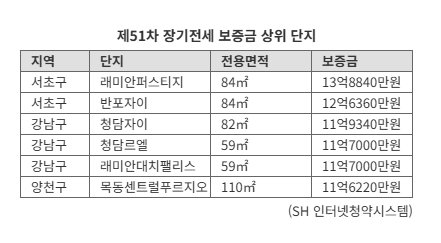
An analysis on the 2nd of the Seoul Housing & Urban Development Corporation (SH Corporation)'s notice for the recruitment of tenants for the 51st long-term Jeonse housing program found that, among the 1,381 households in total, the deposits for 421 households exceeded the 662 million won total-asset threshold for households without children. This represents 30.5% of the total supply, or roughly three out of every 10 households.
There were also 82 units with deposits of 1 billion won or more, accounting for 5.9% of the total. The most expensive unit is in Raemian Firstige in Seocho-gu: an 84-square-meter unit has a deposit of 1.3884 billion won. An 84-square-meter unit at Banpo Xi was also priced at 1.2636 billion won.
By contrast, the combined total-asset threshold for couples without children is 662 million won or less, regardless of housing prices or the supply area. Total assets include not only real estate, savings and time deposits, and stocks, but also financial products that are difficult to convert into cash immediately, such as pensions and insurance. Applicants must also meet income requirements based on factors such as unit size and household type, in addition to the asset criteria.
Even assuming that a household with assets up to the threshold uses all of them for the deposit, a substantial amount of additional funding is required. An additional 726.4 million won would be needed for an 84-square-meter unit at Raemian Firstige, and 601.6 million won for an 84-square-meter unit at Banpo Xi.
If, as a simple assumption, the entire shortfall were financed with a loan at an annual interest rate of 4.5%, the monthly interest excluding principal repayment would be 2.724 million won for Raemian Firstige and 2.256 million won for Banpo Xi. If a large portion of a household's assets consists of funds that cannot be used immediately, such as pensions and insurance, the actual loan requirement and financing costs could be even higher. As a result, some argue that the reduction in housing costs compared with private rental housing may be limited.
The Seoul Metropolitan Government has introduced an installment-payment system for the Mirinae House public housing program, a type of long-term Jeonse housing for newlyweds, to reduce the initial deposit burden. Under the system, 70% of the deposit is paid upon move-in, while the remaining 30% is deferred. However, the housing provider explains that the system does not apply to the 51st long-term Jeonse program because its eligibility extends to a broader range of applicants than the Mirinae House public housing program.
Ultimately, high-priced long-term Jeonse is structured to favor households that meet the asset criteria while also being able to receive cash support from their parents or obtain large bank loans. This is why critics say the actual financing structure does not align with the system's stated purpose of supporting housing stability for middle-class young people.
Park Ji-min, head of WolYong Subscription Research Institute, said, "A system in which applicants must meet the asset criteria but still need hundreds of millions of won in additional funds to actually move in could pose a social problem." He added, "Since young people at the beginning of their careers may have high incomes despite having limited assets, rental terms should be adjusted by lowering the deposit as much as possible and charging monthly rent."
[email protected] Choi Ga-young Reporter