Tire-Derived Pollutants Affect the Early Stages of Pregnancy
- Input
- 2026-09-02 14:01:11
- Updated
- 2026-09-02 14:01:11
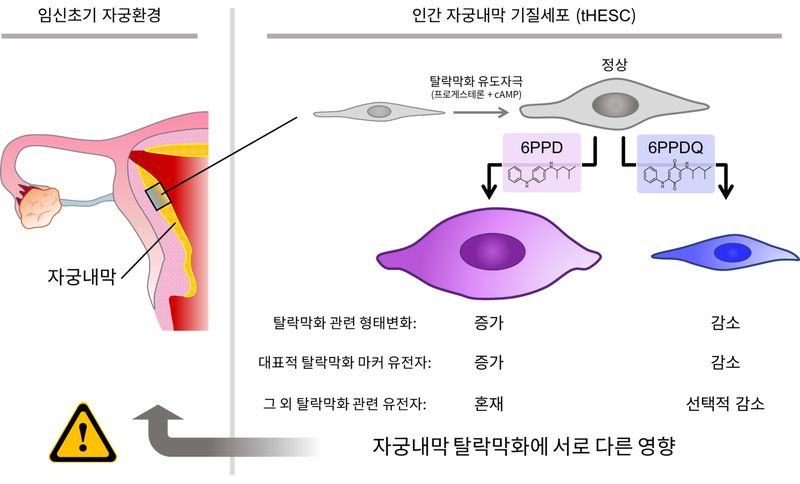
On the 2nd, Hyun Moon-jung, principal researcher at the Biohealth Research Center of the Gyeongnam Bio-Environmental Research Division at the Korea Institute of Toxicology (KIT), said that a research team including Lee Jong-geol, a professor at Kyungpook National University (KNU) College of Medicine, had confirmed that N-(1,3-dimethylbutyl)-N′-phenyl-p-phenylenediamine (6PPD), an antioxidant used in tire rubber, and its oxidation product, 6PPD-quinone (6PPDQ), have different effects on decidualization—the process by which endometrial cells change into a state suitable for embryo implantation and the maintenance of early pregnancy.
6PPD and 6PPDQ are emerging environmental pollutants detected in road dust, airborne particles, aquatic environments and biological samples. The research team analyzed how these substances affect the decidualization of endometrial stromal cells, which is important for forming the uterine environment during early pregnancy.
The results showed that 6PPD increased the expression of some genes involved in decidualization, while reducing the expression of several genes required for normal cell differentiation. This was interpreted as an imbalanced disruption of cellular changes rather than the promotion of normal decidualization. In contrast, 6PPDQ relatively consistently reduced the expression of multiple decidualization-related genes, indicating that the two substances affect endometrial stromal cells through different mechanisms.
The study demonstrates the need to assess not only parent compounds but also oxidation products formed in the environment when evaluating the human health risks of tire-derived chemicals. In particular, it expanded the scope of previous research—from the initial contact between embryos and the endometrium to the decidualization of endometrial stromal cells—broadening the foundation for a stepwise assessment of the female reproductive toxicity of emerging tire-derived pollutants. The findings are expected to serve as basic data for future human health risk assessments, female reproductive toxicity screening and the protection of vulnerable groups.
However, this was an in vitro, cell-level study using a human endometrial stromal cell line, and it did not directly establish a link with infertility or pregnancy complications. Further validation using various models and considering actual exposure levels will be necessary, the researchers explained.
Hyun Moon-jung, a principal researcher at KIT, stated, "We proactively examined the effects of emerging environmental pollutants closely associated with daily life and established a basis for precise risk assessments." The researcher added, "We will continue contributing to the advancement of risk assessments to protect public health through research on emerging harmful factors."
The findings were published on July 31 in the international journal Journal of Environmental Sciences, an environmental science publication with an impact factor of 6.5 and a Q1 ranking.
[email protected] Yeon Ji-an Reporter