'All-Out Effort to Attract Advanced Strategic Industries'—Naju-si Fully Launches Investment Attraction Task Force
- Input
- 2026-09-02 13:17:35
- Updated
- 2026-09-02 13:17:35
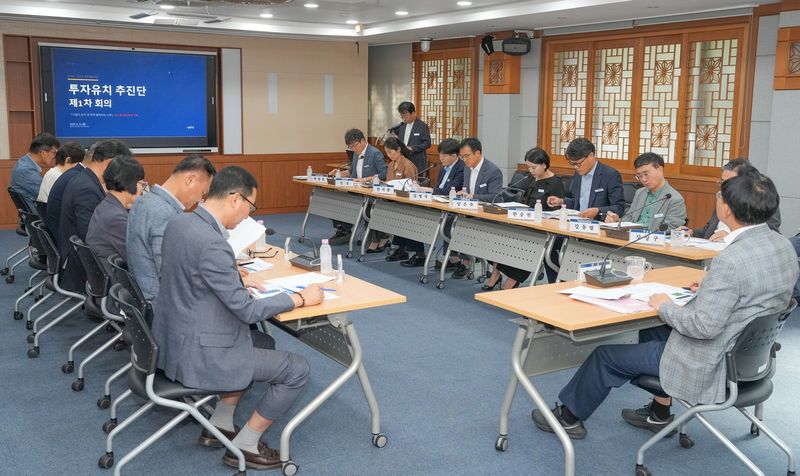
【Financial News Naju = Reporter Hwang Tae-jong】 Naju-si is fully launching its Investment Attraction Task Force to attract advanced strategic industries, including semiconductors and energy.
In line with efforts to develop the semiconductor industry in the Honam region centered on Gwangju and Naju, the city has designated advanced strategic industries such as semiconductors and energy as key areas for attracting investment. It plans to actively leverage the region’s energy infrastructure and industrial base to attract large anchor companies.
To this end, Naju-si held the first meeting of its Investment Attraction Task Force at Ihwa Hall in City Hall on August 31, chaired by Mayor Yoon Byung-tae, and fully launched an interdepartmental cooperation system to attract companies in advanced strategic industries.
The Investment Attraction Task Force is a dedicated one-stop system that supports the entire investment process through interdepartmental cooperation, from companies’ investment inquiries and the signing of memorandums of understanding (MOUs) to site provision, permits, construction commencement, and plant operations.
At the meeting, key senior officials, including the deputy mayor and bureau and department heads, attended and focused on discussing proactive measures to produce tangible investment-attraction results. The agenda included attracting companies in advanced strategic industries, expanding industrial-complex infrastructure, securing available sites, resolving corporate difficulties, and providing post-investment management.
In particular, the city decided to establish a one-stop fast-track administrative support system under which relevant departments will simultaneously review and share information on key infrastructure—including permits, power, water, sewage, and roads—that had previously been examined separately during industrial-complex development and corporate investment processes. The aim is to accelerate companies’ investment decisions and project implementation.
Yoon Byung-tae, Mayor of Naju, emphasized, "To turn major investment opportunities in advanced industries, including the Global Energy Capital, semiconductor cluster, and nuclear fusion energy cluster, into tangible development for Naju, we must prepare in advance the conditions companies require. We will make maximum use of vacant sites in existing industrial complexes and quickly develop new ones. At the same time, we will proactively establish the complex conditions needed for investment, including power and water supplies, wastewater treatment, permits, and workforce availability."
He added, "Attracting advanced and large anchor companies is a difficult task because we must compete with many cities at home and abroad. We therefore need to bring together all the investment-attraction capabilities we have accumulated while creating a business-friendly city. We will expand investment-attraction activities across the board by using various networks, including people from Naju living elsewhere and the business community, to actively promote Naju’s strengths to companies. We will build a vibrant Naju where quality jobs and companies grow together."
Naju-si plans to first respond proactively to the large power and water demand required by the semiconductor industry in the Honam region. Based on energy potential totaling 10 GW—including 2 GW from gas-fired power generation, 2.5 GW from pumped-storage power generation, and 5.5 GW from renewable energy—the city will accelerate efforts to attract companies related to energy and power semiconductors.
The city will also actively secure industrial land, a key foundation for attracting companies. Naju-si is conducting a comprehensive survey of unsold sites and sites occupied by suspended or closed businesses in existing industrial complexes and is systematically managing available land. It currently manages a total of 14 sites in Innovation Industrial Complex and Sindo Industrial Complex as land available for supply. In addition, the city plans to promote the sale of Nampyeong Agricultural and Industrial Complex and secure new industrial sites in stages at Noan 2 Agricultural and Industrial Complex, Energy National Industrial Complex, and Noan General Industrial Complex to respond proactively to corporate demand.
To attract large companies with significant regional economic effects, the city is also considering using vacant land at an LG Chem plant as space for attracting companies in advanced industries. It plans to introduce feedback management cards to systematically track companies’ investment progress and difficulties.
In particular, the city will closely manage each company’s progress and requests continuously, from the initial investment inquiry through occupancy and operations, to ensure that administrative support is not interrupted and interdepartmental cooperation is not delayed.
The city also plans to examine ways to link policy finance, including the National Growth Fund, to local conditions, thereby reducing the cost of developing infrastructure for new industrial complexes and making use of methods such as direct investment. Through these efforts, it aims to secure industrial land and infrastructure in a timely manner, establish the conditions companies need to make actual investment decisions in advance, and further strengthen Naju’s competitiveness in attracting companies in advanced strategic industries such as semiconductors and energy.
[email protected] Hwang Tae-jong Reporter