"September Mock Exam Math Similar to Last Year's CSAT... Differentiates Both Middle- and Upper-Tier Students"
- Input
- 2026-09-02 13:14:39
- Updated
- 2026-09-02 13:14:39
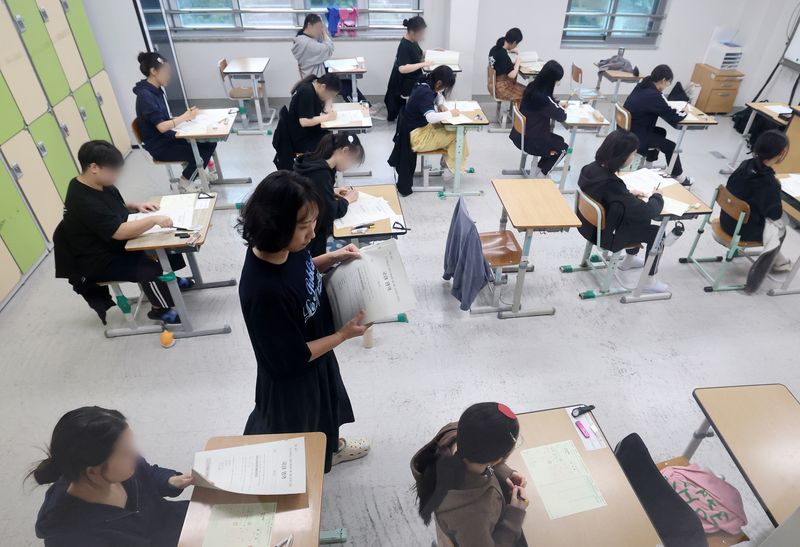
[Financial News] Analysis shows that the mathematics section of the September mock exam for the 2027 College Scholastic Ability Test (CSAT) was set at a similar level to last year's CSAT. The exam was assessed as having aimed to differentiate between middle- and upper-tier students by including medium-to-high-difficulty questions that require accurately interpreting given conditions and applying function graphs and multiple concepts together, rather than relying on complex calculations.
Nam Chi-yeol, a teacher at Baekseok High School, analyzed the exam trends at a briefing held at Government Complex Sejong on the 2nd, stating, "The difficulty level is similar to last year's September mock exam and CSAT," and adding, "Some questions requiring comprehensive thinking may have felt somewhat tricky." He explained that, compared with last year's CSAT, the number of questions assessing the ability to analyze function graphs had increased.
In the common section, Question 21 of Mathematics II and Question 22 of Mathematics I were identified as key differentiating questions. Question 21 requires students to infer a function's graph based on differentiability and synthesize multiple conditions. Question 22 was assessed as having strong discriminating power among top-tier students because it requires understanding the relationship between the inverse functions of exponential and logarithmic functions, translations of graphs, and the relationship with quadratic functions.
Question 14 of Mathematics I was also identified as a question with strong discriminating power. It requires finding the rule of a sequence defined through a function and determining the value that makes the sum a natural number.
Among the elective subjects, Question 28 in Calculus, Question 30 in Probability and Statistics, and Question 30 in Geometry were expected to have relatively strong discriminating power. However, the examiners said that, overall, they had reduced the number of problems involving overly complex calculations or requiring excessive time to solve.
The college admissions industry also generally assessed the difficulty as similar to last year's CSAT. Etoos Edu and Jinhak Co., Ltd. viewed it as similar to last year's exam, while Jongro Academy assessed it as similar or slightly easier. MegaStudyEdu Co. Ltd., on the other hand, judged that the exam was more difficult than last year's.
Compared with the June mock exam, many analyses suggested that the burden of the common section had increased. The college admissions industry likewise identified Questions 21 and 22 as key differentiating questions. In particular, Jinhak Co., Ltd. believed that quite a few test-takers may have found Question 21 more difficult than Question 22.
Assessments of Question 14 were mixed. Etoos Edu analyzed that its perceived difficulty was high because of its unfamiliar format and the amount of calculation, while MegaStudyEdu Co. Ltd. also assessed it as a question requiring considerable thought. Jinhak Co., Ltd., however, viewed the format as unfamiliar but judged that the difficulty of the sequence problem itself was no higher than in previous exams.
The elective subjects were generally assessed as relatively straightforward. However, MegaStudyEdu Co. Ltd. analyzed that Questions 28 through 30 in Calculus successively required different types of reasoning, likely creating a time burden for top-tier students.
The linkage rate between this mock exam and the EBS CSAT was 50%, with 15 of the 30 questions linked to EBS materials. Teacher Nam advised, "Rather than trying to predict the answer, students should accurately analyze the circumstances in each case and review a variety of concepts so that they do not focus excessively on any particular unit."
[email protected] Lee Bo-mi Reporter