India Moves Closer to Russia on Defense Cooperation, Pursuing S-500 and Su-57 Acquisitions After S-400
- Input
- 2026-09-02 14:01:21
- Updated
- 2026-09-02 14:01:21
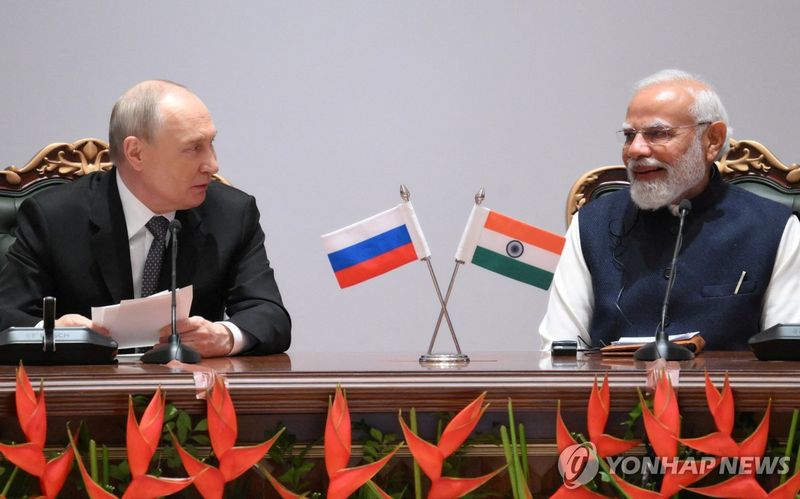
【New Delhi, India = Correspondent Pragya Awasati】India is moving closer to Russia in the defense sector, discussing the possible acquisition of the next-generation S-500 missile system and fifth-generation stealth fighter Sukhoi Su-57 after procuring Russia’s S-400 missile system.
According to The Times of India on the 2nd, Indian Prime Minister Narendra Damodardas Modi and Russian President Vladimir Putin were reportedly expected to discuss ways to expand defense cooperation between the two countries, including the S-500 missile system and Sukhoi Su-57, when they met recently on the sidelines of the Shanghai Cooperation Organization (SCO) summit.
The discussions also appear to have been influenced by India’s experience operating the S-400 missile system, which it previously imported. The S-400 reportedly proved effective in detecting and intercepting aerial threats during Operation Sindoor, raising interest in Russian air defense systems in India.
India ordered five S-400 missile system battalions under a $5.43 billion contract in 2018, equivalent to approximately 41.1 billion won, and has so far received four battalions, which have been deployed along the western, northern, and eastern fronts. The fifth and final battalion is scheduled to be delivered by November 2026.
India’s Ministry of Defence has reportedly approved a project worth more than 500 billion rupees, or 7.215 trillion won, to acquire five additional S-400 missile system battalions. Russia has also bid for the project, and media reports suggest that co-production, including local manufacturing in India, could be considered.
India’s planned acquisition of the S-500 missile system is expected to add an upper layer of defense to the air defense network rather than replace the existing S-400 missile system. While the S-400 missile system can counter aircraft, drones, and cruise missiles at distances of up to 400 kilometers, the S-500 missile system is designed to address advanced threats such as ballistic missiles and hypersonic weapons. Its maximum interception range is reportedly about 600 kilometers, with an engagement altitude of 180 to 200 kilometers and a response time of three to four seconds, shorter than that of the S-400. Rather than replacing one another, the S-500 and S-400 are expected to divide roles and form a multilayered air defense network.
Through the acquisition of the S-500 missile system, India is expected to expand the existing S-400 missile system’s defensive coverage. It may also consider co-production between Indian and Russian defense companies instead of simply purchasing the system.
Russia’s fifth-generation stealth fighter Sukhoi Su-57 has also emerged as a key topic of discussion between the Indian and Russian leaders. Russia has reportedly proposed licensed production of the Sukhoi Su-57 in India and the possible integration of Indian-made weapons.
India’s interest in the Sukhoi Su-57 stems from concerns over a fighter shortage and a widening capability gap caused by China’s development of fifth- and sixth-generation fighters. India’s indigenous fifth-generation fighter is not expected to enter operational service before 2035, making the Sukhoi Su-57 a potential option for filling the capability gap until then. If local production is realized, defense cooperation between the two countries could expand beyond simple procurement into a joint-production model. However, it remains uncertain whether the acquisition of the S-500 missile system and Sukhoi Su-57 will lead to actual contracts. Neither system was included in the joint statement issued after the India-Russia summit in December last year. Technical, cost, and logistical support conditions are reportedly still under discussion.
The impact of India’s additional purchases of Russian weapons on its defense cooperation and strategic relationship with the United States is another variable. The two countries are also reportedly discussing expanded military and logistics cooperation, as well as a modernization program for the Indian Air Force’s Sukhoi Su-30MKI fighters, in addition to air defense systems and fighter aircraft.
Ultimately, the recent defense cooperation discussions between India and Russia appear to go beyond the purchase of a few specific weapons systems. India is seeking to strengthen its multilayered air defense network based on the S-400, counter high-altitude and hypersonic threats with the S-500 missile system, and address a fighter capability gap with the Sukhoi Su-57. With local joint production, maintenance support, logistics cooperation, and modernization of existing fighters also under discussion, attention is focused on whether military cooperation between the two countries will expand into a more long-term, industrial framework.\u00a0
[email protected] Correspondent Pragya Awasati Reporter