Net Losses at Local Public Enterprises Rise from KRW 2.7 Trillion to KRW 3.5 Trillion as Frozen Public-Service Rates and Weaker Development Results Take Their Toll
- Input
- 2026-09-02 12:50:20
- Updated
- 2026-09-02 12:50:20
[Financial News] Net losses at local public enterprises nationwide rose 31% last year, from KRW 2.7 trillion to KRW 3.5 trillion. Structural deficits continued as public services such as water supply, sewerage, and urban rail transit were provided at rates below cost. Profits at urban development corporations fell by more than KRW 340 billion, while losses from public development expanded by nearly KRW 270 billion, dragging down overall performance. Debt at local public enterprises also increased by more than KRW 5 trillion in a year as borrowing rose to fund new town development and other projects.
The Ministry of the Interior and Safety announced on the 2nd the 2025 settlement results for 421 local public enterprises nationwide, including 254 directly operated enterprises such as water supply and sewerage providers, 78 local public corporations, and 89 public agencies.
Local public enterprises recorded a net loss of KRW 3.5216 trillion last year, up KRW 840.3 billion, or 31.3%, from KRW 2.6813 trillion in 2024.
Net losses at directly operated enterprises, including water supply, sewerage, and public development businesses run by local governments, increased by KRW 293.3 billion, from KRW 2.334 trillion to KRW 2.6273 trillion.
Net losses at local public corporations and agencies rose from KRW 347.4 billion to KRW 894.3 billion over the same period, an increase of KRW 546.9 billion. These corporations and agencies accounted for about 65% of the KRW 840.3 billion increase in total net losses.
Among the corporations, urban development corporations saw the largest change in performance. They still posted a net profit of KRW 467.4 billion last year, but that was KRW 341.7 billion less than the KRW 809.1 billion recorded in 2024. MOIS explained that fluctuations in revenue from land sales and other factors affected the results. The corporations did not fall into the red, but the sharp decline in their profits significantly reduced the support they had provided to the overall earnings of local public enterprises, thereby widening the overall deficit.
Public development also deteriorated sharply. Net losses increased from KRW 18.6 billion in 2024 to KRW 285.8 billion last year, widening the deficit by KRW 267.2 billion.
The net loss at urban rail transit operators also increased from KRW 1.2453 trillion to KRW 1.4875 trillion, a rise of about KRW 240 billion. Combined, the decline in urban development corporations’ profits and the expanded losses in public development and urban rail transit amounted to around KRW 850 billion. Increased profits at other local public corporations partially offset the losses, bringing the overall increase in net losses to KRW 840.3 billion.
Although the water supply and sewerage sectors recorded large losses, their losses did not rise sharply from the previous year. Net losses in sewerage increased by KRW 25.1 billion, from KRW 1.8236 trillion to KRW 1.8487 trillion, while water supply losses rose by KRW 500 million, from KRW 490.2 billion to KRW 490.7 billion.
Low rates are a key reason water supply, sewerage, and urban rail transit services continue to post large annual losses. The water-supply rate-recovery ratio was 74.7% last year. In other words, if it costs KRW 100 to provide the service, only about KRW 75 is collected through user fees. The ratios were 48.1% for sewerage and 52.4% for urban rail transit, meaning that user fees covered only about half of the costs.
An MOIS official analyzed, "The freezing of rates and the minimization of increases to stabilize prices affected the continued losses in these businesses."
The scale of local public enterprises’ operations continued to grow. Total assets increased by KRW 8.7 trillion, or 3.5%, from KRW 247.1 trillion in 2024 to KRW 255.8 trillion last year. Assets have risen for five consecutive years, from KRW 223.3 trillion in 2021. The workforce also grew from 96,665 to 106,699 over the same period, reflecting the expansion of local public enterprises’ housing supply and regional development projects.
Urban development corporations, in particular, expanded rapidly. Their assets increased by KRW 5.8 trillion, from KRW 76.2 trillion to KRW 82 trillion. This represented about two-thirds of the KRW 8.7 trillion increase in total assets among local public enterprises. Debt at local public enterprises also rose by KRW 5.2 trillion, from KRW 69.8 trillion in 2024 to KRW 75 trillion last year. MOIS cited increased borrowing by regional development corporations for new town construction in the Seoul Capital Area and higher long-term rental deposits as the main causes. In fact, debt at urban development corporations increased by KRW 4.3 trillion, from KRW 48.7 trillion to KRW 53 trillion. The increase in their debt alone accounted for more than 80% of the overall increase.
MOIS assessed, "The overall financial structure remains stable, as the debt ratio of local public enterprises has stayed around 40% over the past eight years."
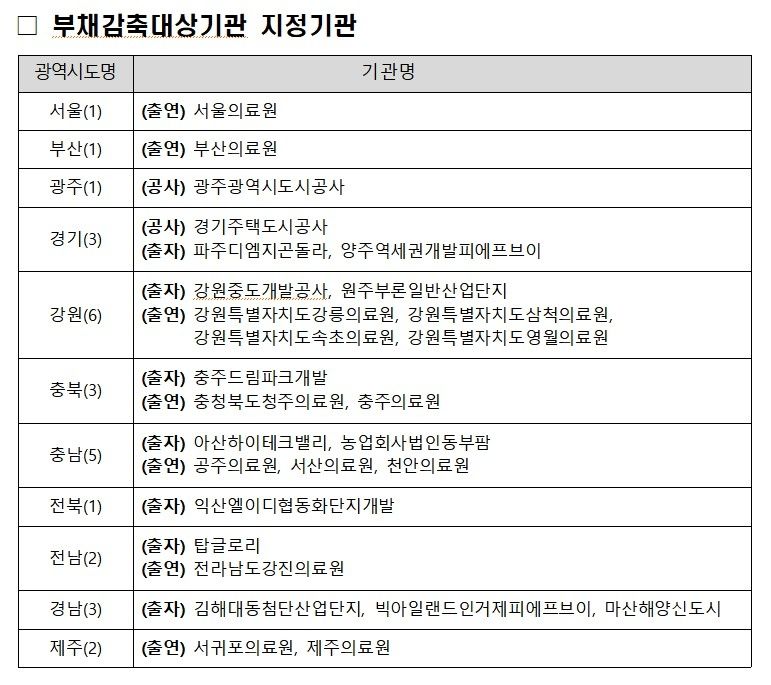
MOIS plans to strengthen oversight of institutions with high financial risks. Based on settlement data from the past three years, it evaluated debt size, debt ratios, return on total assets, and other indicators, designating 102 institutions as institutions subject to focused debt management. Of these, 28 institutions—including two local public corporations and 26 invested or funded institutions with high financial risk—were separately designated as institutions subject to debt reduction measures.
These institutions will be required to establish and implement five-year financial and debt-management plans containing measures to reduce debt and improve profitability. Their implementation results will be reviewed as part of management evaluations.
[email protected] Lee Bo-mi Reporter