Cheong Wa Dae: “Corporate tax revenue will exceed 200 trillion won next year due to the semiconductor boom; tax revenue conditions are favorable”
- Input
- 2026-09-02 11:33:32
- Updated
- 2026-09-02 11:33:32
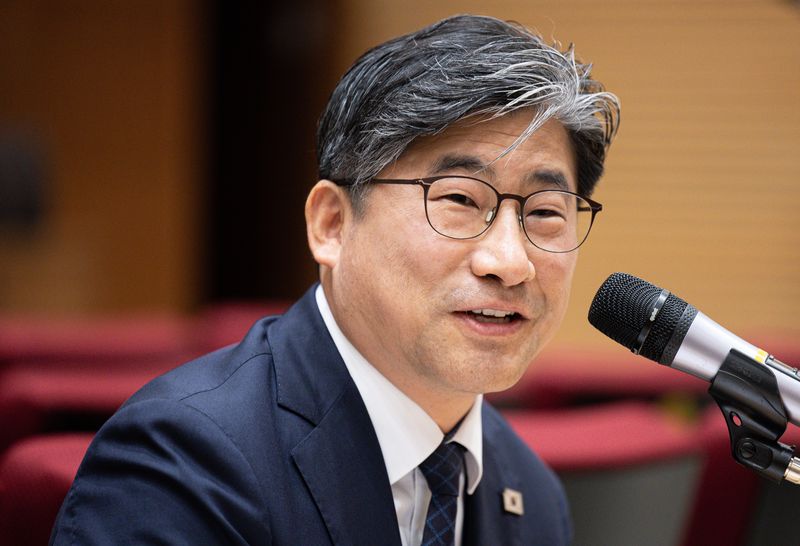
[Financial News] Senior Presidential Secretary for Fiscal Planning Ryu Deok-hyeon said on the 2nd that the government expects to collect more than 200 trillion won in corporate tax revenue next year due to the semiconductor boom. The government has drawn up next year’s budget with total expenditure of 820.9 trillion won, the largest amount ever.
Appearing on Columbia Broadcasting System (CBS) radio that day, Ryu said, “People call it a ‘jackpot’ when even 100 trillion won comes in, but according to the tax revenue forecast, the corporate tax revenue reflected in the budget appears likely to exceed around 200 trillion won.”
Ryu explained, “National tax revenue will exceed 580 trillion won next year. Even more than 400 trillion won would be an enormous amount of revenue,” adding, “The government’s budgetary and fiscal role is to use those taxes to purchase the public goods needed by everyone.”
Ryu cited the semiconductor boom driven by the growth of the artificial intelligence (AI) industry as a major reason for the increase in tax revenue. He said, “Next year, our semiconductor industry is truly experiencing a windfall thanks to the global revival of the AI industry,” adding, “That is why its impact on tax revenue can be considered the greatest.”
He continued, “The economy has also been improving this year and is now getting better next year as well,” explaining, “The fact that tax revenue conditions are generally quite favorable—including income tax, securities transaction tax and consumption tax—may also be part of the backdrop for considering a large-scale fiscal program.”
Regarding the government’s decision to establish the 162.3 trillion won Future Response Fund, Ryu said, “Quite literally, we are temporarily storing fiscal resources in a reservoir to prepare for the future, so that they can be used appropriately when needed.”
Responding to concerns that the government’s discretion could become excessive in managing the fund, he countered, “Whether it is a fund or the general account, nothing bypasses the National Assembly’s budget review process,” adding, “Everything is planned in advance, submitted to the National Assembly for review, finalized, and then allocated to programs. It is not something we can spend freely.”
However, he stressed that the fund needs to be operated flexibly within a certain range to respond to unexpected program needs and price fluctuations. Ryu explained, “The government was given discretionary authority so that it can use the funds when unexpected program or spending needs arise,” adding, “It provides some flexibility to spend without drawing up a supplementary budget.”
Regarding criticism that the government is pursuing expansionary fiscal policy while the Bank of Korea (BOK) is raising its policy rate, he added, “There are groups and sectors that are suffering and facing difficulties because of high interest rates or rate hikes,” noting, “There are areas that fiscal policy needs to address.”
[email protected] Choi Jong-geun Reporter