Bank NPLs Near KRW 19 Trillion, Highest in Eight Years; Corporate-Loan NPLs Rise by KRW 1 Trillion
- Input
- 2026-09-02 14:58:43
- Updated
- 2026-09-02 14:58:43
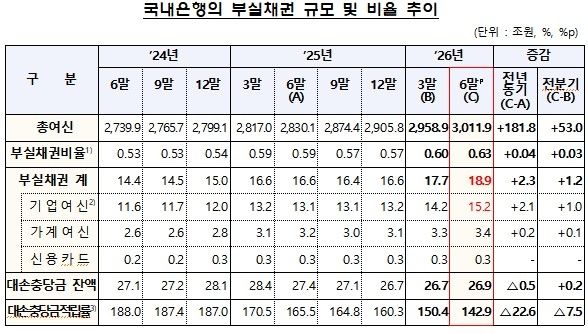
[Financial News] Non-performing loans at domestic banks have swelled to nearly KRW 19 trillion, reaching their highest level in eight years. Corporate-loan NPLs alone surged by about KRW 1 trillion in just three months. As bad loans increase, particularly among small and medium-sized enterprises (SMEs) and individual business owners, concerns are growing that risks among vulnerable borrowers could weigh on banks’ soundness amid expectations of further interest-rate increases.
According to data on domestic banks’ NPLs released by the Financial Supervisory Service on the 2nd, the NPL ratio stood at 0.63% at the end of June, up 0.03 percentage points from 0.60% at the end of March. The total volume of NPLs reached KRW 18.9 trillion, an increase of KRW 1.2 trillion from three months earlier. This was the highest level in eight years, since KRW 19.4 trillion in June 2018.
The expansion of corporate-loan NPLs drove the overall increase. Corporate-loan NPLs totaled KRW 15.2 trillion, up KRW 1 trillion from the previous quarter. This marked the highest level in seven years and three months, since March 2019. Household-loan NPLs rose by KRW 100 billion to KRW 3.4 trillion, while credit-card receivables remained unchanged from the previous quarter at KRW 300 billion.
New NPLs also surged. New NPLs in the second quarter totaled KRW 7.2 trillion, up KRW 1.7 trillion from the previous quarter. Of this amount, new corporate-loan NPLs accounted for KRW 5.7 trillion, an increase of KRW 1.6 trillion, while new household-loan NPLs rose by KRW 100 billion to KRW 1.4 trillion.
NPL growth was particularly steep among SMEs. New NPLs at SMEs totaled KRW 4.5 trillion, up KRW 1.2 trillion from the previous quarter. New NPLs at large companies increased by KRW 400 billion to KRW 1.2 trillion.
Banks resolved KRW 6.1 trillion in NPLs during the second quarter, up KRW 1.7 trillion from the previous quarter. Even so, they failed to keep pace with the increase in new NPLs.
The NPL ratio for loans to small and medium-sized corporations rose 0.05 percentage points to 1.08%, while the ratio for loans to individual business owners increased 0.01 percentage points to 0.67%. The household-loan NPL ratio rose 0.01 percentage points from the previous quarter to 0.33%. The ratio for mortgage loans remained unchanged at 0.22%, while the ratio for other credit loans and similar products rose 0.01 percentage points to 0.67%. The NPL ratio for credit-card receivables increased 0.06 percentage points to 1.88%.
The balance of loan-loss provisions held by banks stood at KRW 26.9 trillion, up KRW 200 billion from the previous quarter. However, because NPLs increased by a larger amount, the loan-loss coverage ratio fell 7.5 percentage points to 142.9%.
An official from the Financial Supervisory Service said, "Considering the long-term average NPL ratio and the banking sector’s loss-absorbing capacity, soundness remains at a satisfactory level." The official added, "However, preemptive management is necessary given the continued rise in NPL ratios in some vulnerable sectors, as well as the possibility of a prolonged situation in the Middle East and rising interest rates at home and abroad."
[email protected] Park Moon-soo Reporter