AI Reads, Humans Judge... Halving the Time Needed to Gather Governance Evidence [fn Market Watch]
- Input
- 2026-09-02 14:10:47
- Updated
- 2026-09-02 14:10:47
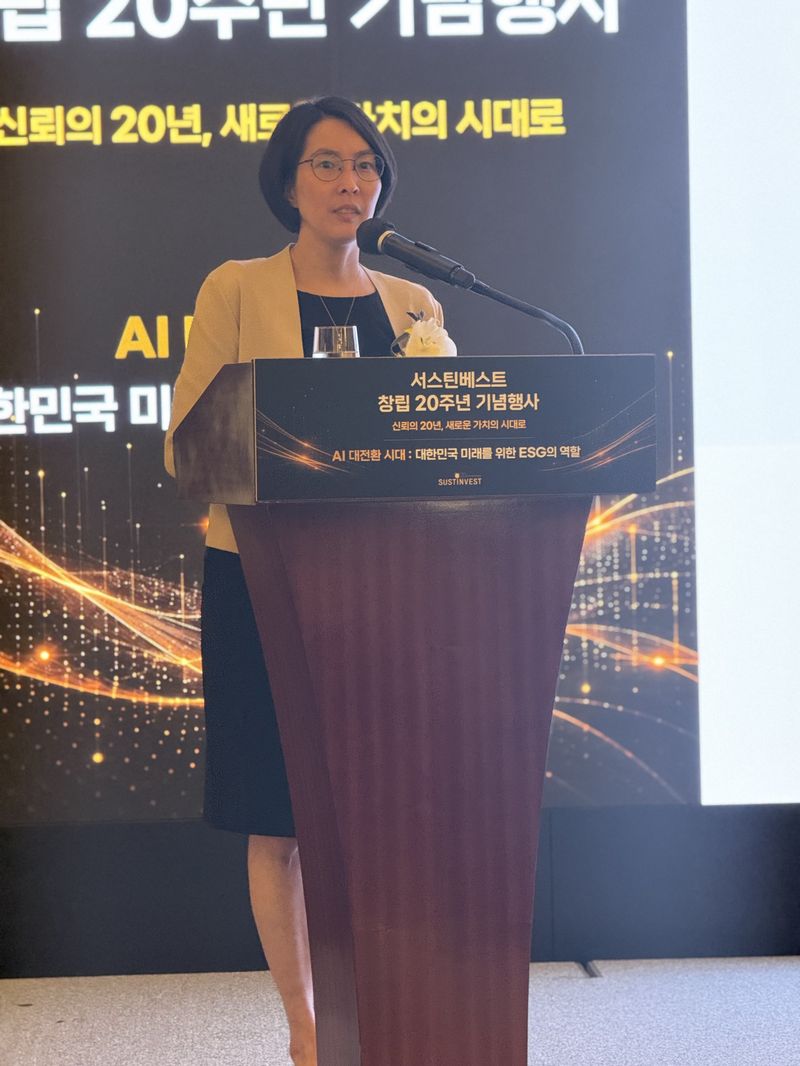
[Financial News] Sustinvest, the first company in South Korea to introduce environmental, social, and governance (ESG) evaluations, has applied its accumulated data and artificial intelligence (AI) to evaluation work, cutting the time needed to gather evidence for governance indicators in half. Rather than using the time saved to reduce costs, the company plans to expand the scope of companies it evaluates and shorten update cycles. AI handles repetitive document reading, while researchers remain responsible for the final judgment.
On the 2nd, Go Eun-hae, head of Sustinvest’s AX Center and Research Data Division, said at Sustinvest’s 20th-anniversary event at The Westin Josun Seoul in Jung-gu, Seoul, "We collect and organize more than 500,000 pages of material each year," adding, "Because 70% of our total working hours was spent on collection and organization, there was a strong need to introduce AI."
The materials collected include sustainability reports, business reports, company websites, shareholder meeting notices, government announcements, and news reports. Sustinvest applied AI to what it calls “reading labor,” reducing the time required to collect and organize evidence for each governance indicator by approximately 50%.
Sustinvest gathers disclosures from DART, after which a large language model (LLM) reads and organizes the documents. A search engine is then used to verify the necessary information. The source of the original text is linked to each sentence extracted by AI, and the data is not finalized until the responsible researcher verifies it directly.
Go explained, "For data users, this means they can review more companies using more up-to-date evidence."
AI is generally applied more intensively to areas that contain vast amounts of unstructured material than to structured data. The assessment is that it is particularly effective in areas such as ESG disclosures and sustainability reports, which previously had to be read directly by people.
AI hallucinations are controlled through Retrieval-Augmented Generation (RAG), which restricts searches to evidence found in corporate disclosures. Every answer includes the source of the original text, while the possibility of misreading context is addressed through a Human-in-the-Loop structure in which people conduct the final verification.
The work process was also designed so that AI handles document collection, structuring, reading, and extraction, while experts take charge of review, judgment, and final confirmation. Go said, "Because AI has limitations, the value of reliable source data and expert judgment becomes even greater."
Meanwhile, Sustinvest’s distinguishing strength is its accumulated data. Since its establishment in 2006, the company has built 20 years of time-series data, covering 1,305 companies, and accumulated more than 8 million data points.
Next year, Sustinvest plans to expand the companies covered by its evaluations, build new datasets, broaden its insight reports, and develop ESG indicators related to AI.
Go added, "The key is to evaluate more companies more quickly and on the basis of more reliable evidence," saying, "We will use the time saved to expand coverage and shorten update cycles."
[email protected] Kang Gu-gwi Reporter