Sustinvest Chairman Ryu Young-jae: "We Must Build Sovereign Shareholders’ Meetings" [Financial News Market Watch]
- Input
- 2026-09-02 11:33:16
- Updated
- 2026-09-02 11:33:16
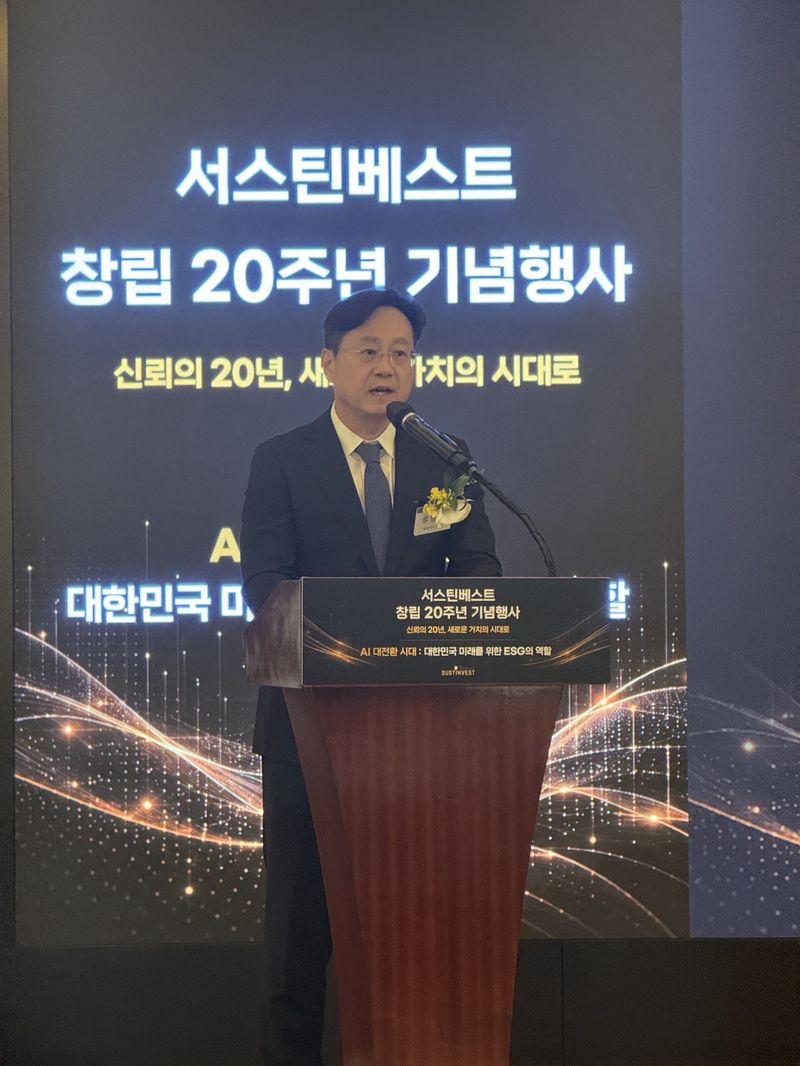
[Financial News] Ryu Young-jae, chairman and CEO of Sustinvest, has proposed building a “sovereign shareholders’ meeting” system, arguing that the capital market must establish its own “sovereignty” following the debate over AI sovereignty. He said the country must move away from a structure in which voting decisions at shareholders’ meetings—the highest decision-making bodies of listed Korean companies—are excessively influenced by a small number of foreign proxy advisers. He identified the development of domestic proxy advisers as the key infrastructure needed to achieve this.
At the event marking Sustinvest’s 20th anniversary at The Westin Josun Seoul in Jung-gu, Seoul, on the second, Ryu emphasized, "We must build sovereign shareholders’ meetings" and added, "The key infrastructure for this is domestic proxy advisers."
He also looked back on the difficult conditions surrounding the company’s early years. Ryu said, "After I founded the company in 2006 and said we would conduct ESG evaluations, people responded by asking what ESG had to do with MSG." He added, "I believed that if we worked to make our companies and capital market sustainable and sound, the market and demand would follow."
Regarding the ups and downs of Korea’s ESG market, he observed, "An ESG frenzy swept through the market at the end of 2022, but it became quiet within two or three years." He added, "The principle that a tree with shallow roots cannot bear fruit also applies to ESG." He further stressed, "We must replace the paradigm centered on short-term efficiency and productivity from our days as a late-developing country with a future-oriented focus on sustainability."
Ryu’s call for “sovereignty over shareholders’ meetings” stems from the increased foreign ownership of Korean stocks. Foreign investors hold about 30% of the domestic stock market, while the average for the four major financial holding companies is as high as 64%. The grounds used by overseas institutions with substantial voting rights to make their decisions are concentrated among global proxy advisers such as Institutional Shareholder Services (ISS) and Glass Lewis. Some analyses estimate that the two companies together account for 90% of the global proxy-advisory market.
He pointed out, "There have been repeated criticisms that recommendations on major issues, including mergers, dividends and director appointments, are detached from Korea’s commercial-law system and market practices." He added, "Foreign proxy advisers apply uniform global standards."
However, he made clear that he was not criticizing foreign investment itself. "This is not about restricting overseas investors from investing in Korean stocks," he explained. "It is about ensuring that the context of our market and accurate information are sufficiently reflected when voting rights are exercised."
In Korea’s capital market, controversies over recommendations from foreign proxy advisers have repeatedly arisen. Domestic institutions and overseas proxy advisers have reached conflicting conclusions during major corporate decisions, including the 2015 merger of Samsung C&T and Cheil Industries, as well as director appointments and corporate-governance restructuring at major companies. Critics have also argued that these recommendations fail to sufficiently reflect Korea-specific institutional contexts, such as holding-company structures, the elimination of circular shareholdings, and inheritance and gift tax systems.
Ryu viewed this as an extension of the debate over “sovereign AI.” He emphasized, "Just as sovereign AI rests on self-reliance in data and computing, sovereign shareholders’ meetings can be achieved on advisory infrastructure that understands our companies and market most accurately." He added, "Only by breaking away from habitual reliance on overseas systems and the uncritical adoption of advanced-country models can we leap from a catch-up economy to a leading economy."
Sustinvest has provided proxy-advisory services for corporate governance and minority shareholders since the early 2010s. Ryu said, "I have been doing this work for the past 15 years based on the view that domestic proxy advisers are necessary." He added, "The importance of corporate governance has grown further following amendments to the Commercial Act."
Ryu identified “companies’ sustainable growth” as the standard for governance reform. He stated, "Governance reform should be carried out from the perspective of whether it pursues companies’ sustainable growth." He added, "We must adopt a new framework rather than becoming overly tilted toward the interests of any particular group."
Kang Kum-sil, Korea’s Global Climate and Environment Ambassador and a former Minister of Justice, who attended the event, said, "We are entering an era in which companies are being held legally accountable for climate and environmental issues." She added, "ESG will become a corporate survival strategy."
[email protected] Kang Gu-gwi Reporter