Korean Overseas Emergency Relief Team of 44 Arrives in Kathmandu Aboard Military Transport Plane
- Input
- 2026-09-02 10:43:38
- Updated
- 2026-09-02 10:43:38
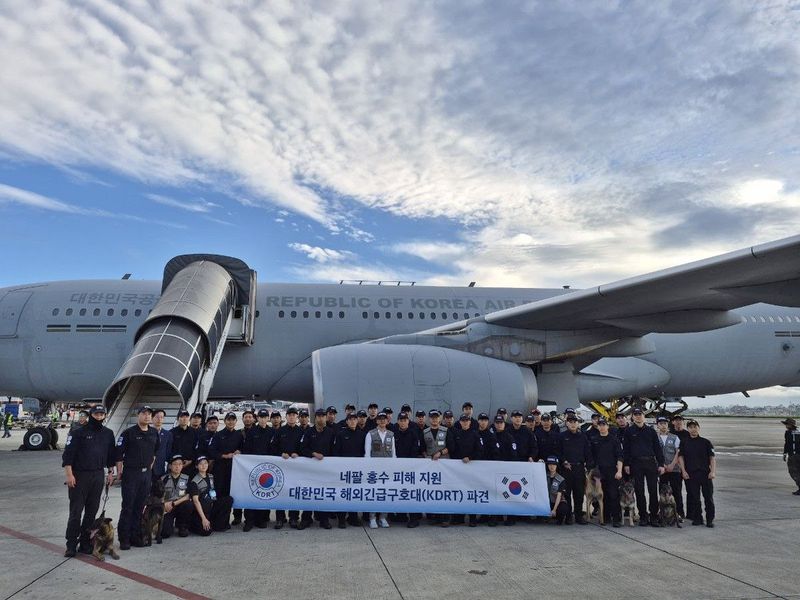
[Financial News] The Korea Disaster Relief Team (KDRT) arrived in Kathmandu, the Nepalese capital, on the 2nd (local time) to support search-and-rescue operations at sites affected by severe flooding in Nepal.
The Air Force’s multipurpose aerial refueling aircraft, the KC-330 Cygnus, carrying KDRT personnel, landed at Tribhuvan International Airport at around 6:27 a.m. that day.
The KDRT consists of 44 members: three from the Ministry of Foreign Affairs (MOFA), including team leader Lee Gyu-ho, director-general of MOFA’s Development Cooperation Bureau; four from the Korea International Cooperation Agency (KOICA); and 37 from the National Fire Agency (NFA).
They also brought five search-and-rescue dogs and various advanced pieces of equipment, including high-resolution imaging drones, acoustic and video detectors for locating buried victims, and thermal imaging detectors.
The KDRT will work with Nepalese authorities to search for and rescue victims, including nine South Koreans who went missing after large-scale flooding struck on the 26th of last month. The operation is scheduled to last about 10 days, but it may be extended depending on conditions at the site.
Earlier, the government dispatched a 20-member joint rapid-response team to Nepal in two groups, on the 27th and 29th of last month. The team used helicopters and drones and also conducted ground searches for the nine missing South Koreans, but has yet to achieve any clear results.
The rapid-response team had previously operated helicopters and other equipment only after obtaining individual permits from Nepalese authorities. However, the KDRT, dispatched at the request of the Nepalese government, is expected to conduct more active searches.
The ground-search team organized by the rapid-response team has currently advanced as far as Dhunche in Rasuwa, Bagmati Province, which suffered severe damage from the flooding.
Dhunche is also located about 2 kilometers from the weir dam, the upper dam of the Upper Trishuli (UT)-1 Hydropower Plant, where the nine missing South Koreans worked.
The KDRT is a relief team formed primarily from government ministries and related agencies to support countries affected by large-scale disasters overseas through disaster relief, lifesaving operations, and medical assistance.
This is the KDRT’s 12th deployment. It was first activated during the 2008 Sichuan earthquake in China and was also dispatched to Canada after major wildfires there in 2023.
As the damage from the severe flooding grew beyond control, the Nepalese government asked South Korea to send an emergency relief team to support search-and-rescue operations in the affected areas.
As of the previous day, a combined total of 1,019 people had died and 4,462 were missing in Nepal and China’s neighboring Tibet Autonomous Region.
[email protected] International Affairs Correspondent Lee Seok-woo Reporter